Pinyin: Ruiren
Aliases
Ruike, Ruizi, Maruzi, Ruikeren.
Source
Rosaceae plant Prinsepia unifloraPrinsepia unifloraDried mature fruit kernel.
Botanical Description
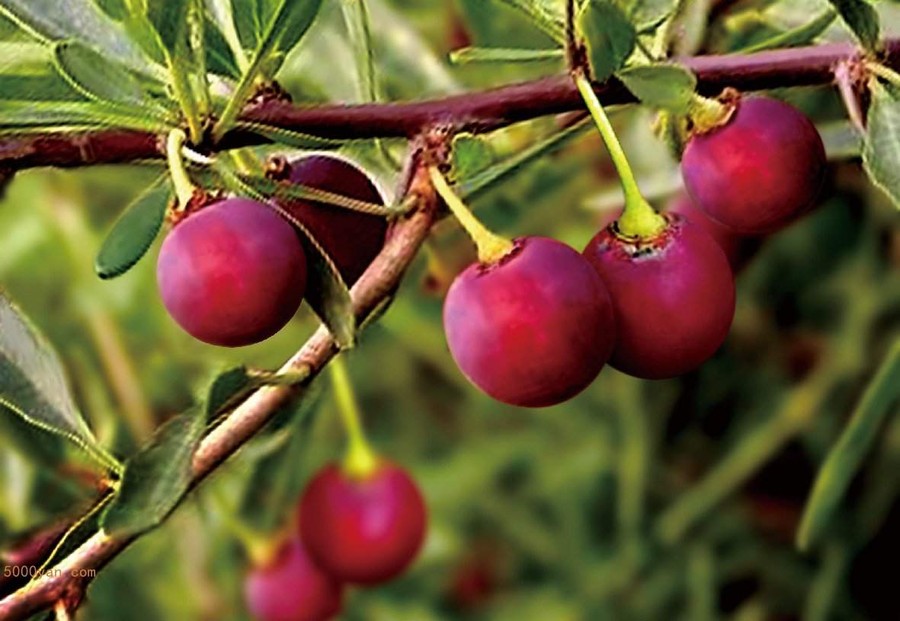
Shrub, up to 1-2 m tall. Stems much branched, bark reddish-brown or brownish-brown, young branches grayish-green or grayish-brown, with relatively fine short spines or short spines in leaf axils. Leaves simple, alternate, clustered on short branches, with short petioles; leaf blade narrow, oblong to linear-lanceolate, 2-5.5 cm long, 6-8 mm wide, apex obtuse, base cuneate, margin finely serrate or nearly entire near base. Flowers bisexual; solitary or 3-clustered; calyx tube cup-shaped, 5-lobed; petals 5, white; stamens 10, in 2 whorls, filaments very short, anthers yellow; ovary superior, style lateral, stigma capitate. Drupe globose, purple-black when ripe, 8-12 mm in diameter, covered with waxy white powder, calyx persistent; stone flattened-ovoid, with reticulate markings. Flowering period April-May, fruiting period August-September.
Habitat and Distribution
Born at altitudes of 900-1100 m on slopes, river valleys, sparse shrublands, or arid sand dunes. Distributed in Shanxi, Inner Mongolia, Shaanxi, Gansu, Henan, Sichuan, and other regions.
Harvesting and Processing
Harvest mature fruits in summer and autumn, remove the pulp, wash clean, and sun-dry.
Medicinal Properties
This product is ovoid to sub-ovoid, slightly flattened, 7-10 mm long, 6-8 mm wide, and 3-5 mm thick. The surface is pale yellowish-brown to deep brown, with distinct reticulate furrows, occasional remnants of brownish fruit pulp, an acute apex, and slightly asymmetrical sides. The texture is hard. The seed is flat and ovoid, with a thin, pale brown or reddish-brown seed coat that is easily peeled off. Cotyledons are 2, milky white, and oily. Odor: faint; Taste: slightly bitter.
Chemical Constituents
This product contains kaempferol, isocorydine, leucopaxillone, ursolic acid, daucosterol,β- β-sitosterol, vanillic acid, and other constituents.
Properties and Channel Entry
Sweet, slightly cold. Enters the Liver channel.
Functions and Indications
Disperse Wind and dissipate Heat, nourish the Liver and brighten the eyes. Used for red, swollen, and painful eyes, red and erosive eyelid margins, and dim vision with photophobia.
Dosage and Administration
Internal: decoct in water, 3-10 g. External: appropriate amount, remove oil, grind into ointment for eye application; or decoct in water for washing. For calming the Spirit, stir-fry before use.
Precautions and Contraindications
For eye pain not caused by wind-heat but due to deficiency of both Liver and Kidney, it is not suitable for use.
Prescriptions
1. For red and painful eyes: *Nu Zhen Zi* (Nux Prinsepiae) 20 pieces (crushed), *Ku Zhu Ye* (Bitter Bamboo Leaf) a handful, *Xi Xin* (Asarum) 15 g. Decoct the above three ingredients in 3 sheng of water until reduced to 0.5 sheng, then use to wash the eyes 3-5 times daily. (From *Wai Tai Mi Yao*, Eye Washing Formula) 2. For wind-toxin attacking the eyes causing redness, pain, and unremitting nebula: *Nu Zhen Zi* (Nux Prinsepiae) 0.9 g (remove red skin and grind finely), *Ni Fen* (Calomel) 0.15 g, *Long Nao* (Borneol) 0.15 g. Grind all ingredients together into a fine powder, then apply to the eyes three times daily. (From *Sheng Hui Fang*, Nu Zhen Zi Ointment)