Pinyin: Baibiandou
Aliases
Biandou, Nanbiandou, Emeidou, Meidou.
Source
Leguminous plant Lablab purpureus (hyacinth bean)Dolichos lablabL. of dried ripe seeds.
Botanical Description
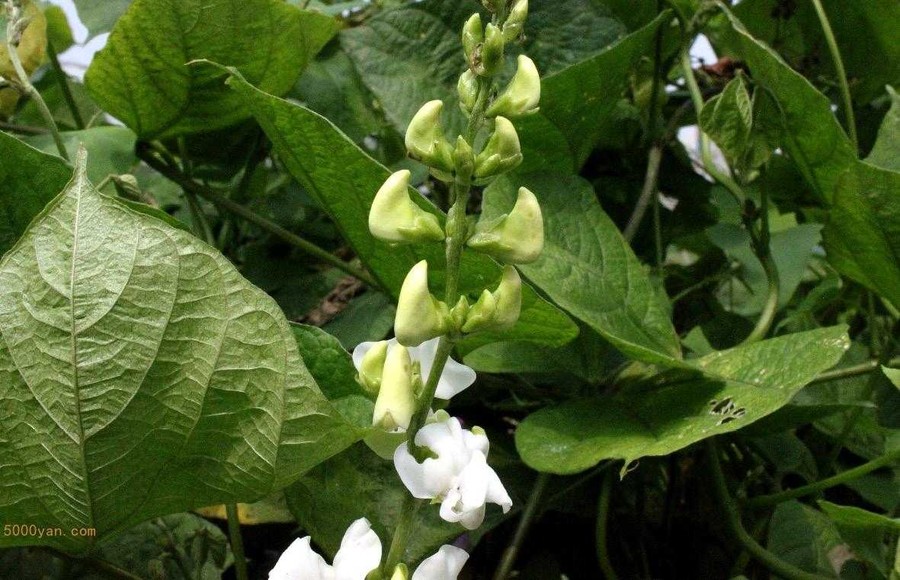
An annual twining herbaceous vine, reaching up to 6 m in length. The stem is often pale purple or pale green. It has trifoliate compound leaves with petioles 4-14 cm long; stipules are lanceolate or triangular-ovate, covered with white pubescence; the terminal leaflet has a petiolule 1.5-3.5 cm long, while the lateral leaflets have shorter petiolules 2-3 mm long, all covered with white pubescence; the terminal leaflet is broadly triangular-ovate, 5-10 cm long, approximately as wide as long, with an acute apex, broadly cuneate or truncate base, entire margin, and both surfaces covered with short pubescence, more dense along the veins, with three main basal veins and pinnate lateral veins; the lateral leaflets are obliquely ovate, unequal on both sides. Racemes are axillary, 15-25 cm long, erect, with a relatively thick rachis, with 2-4 flowers or clusters of multiple flowers at the nodes of the rachis; bracteoles are ligulate, in pairs, and early deciduous; the calyx is broadly campanulate, with 5 teeth at the apex, the upper two teeth almost completely fused, the remaining three nearly equal, with the margin densely covered with white pubescence; the corolla is butterfly-shaped, white or pale purple, about 2 cm long, the standard petal is broadly elliptic with a slightly emarginate apex, the wing petals are obliquely elliptic with an auriculate projection near the base on one side, the keel petals are boat-shaped and curved at nearly a right angle; there are 10 stamens, with one free and the filaments of the other nine partially fused into a tube enclosing the pistil; the ovary is linear, silky, with a gland at the base, the style has white beard-like hairs near the apex, and the stigma is capitate. The legume is falcate or obovate-oblong, flattened, 5-8 cm long, 1-3 cm wide, wider at the apex with a downward-curving beak at the tip, and a rough margin. Seeds are 2-5, flat-elliptic, white, reddish-brown, or nearly black, 8-13 mm long, 6-9 mm wide, 4-7 mm thick, with a long and raised hilum and raphe, and a raised white crescent-shaped strophiole on one side of the margin. Flowering period is June to August, and fruiting period is September.
Habitat and Distribution
Cultivated throughout China. Mainly distributed in Liaoning, Hebei, Shanxi, Shaanxi, Shandong, Jiangsu, Anhui, Zhejiang, Jiangxi, Fujian, Taiwan, Henan, Hubei, Hunan, Guangdong, Hainan, Guangxi, Sichuan, Guizhou, Yunnan and other regions.
Harvesting and Processing
Harvest the ripe fruit in autumn and winter, dry in the sun, remove the seeds, and dry again in the sun.
Medicinal Properties
This product is flat-elliptical or flat-ovoid in shape, 8-13 mm long, 6-9 mm wide, and approximately 7 mm thick. The surface is pale yellowish-white or pale yellow, smooth, and slightly lustrous, with a raised white eyebrow-shaped caruncle on one edge. The texture is hard. The seed coat is thin and brittle, with two thick, yellowish-white cotyledons. Odor: faint; Taste: bland, with a bean-like odor when chewed.
Chemical Constituents
This product contains palmitic acid, linoleic acid, arachidic acid, behenic acid, stearic acid, raffinose, carotene, lectin, and other components.
Pharmacology
Antibacterial and antiviral; enhances cellular immune function.
Properties and Channel Entry
Sweet, slightly warm. Enters the Spleen and Stomach channels.
Functions and Indications
Tonifies the Spleen, transforms Dampness, harmonizes the Middle Burner, and dispels Summerheat. Used for Spleen and Stomach weakness, poor appetite, loose stools, excessive leukorrhea, vomiting and diarrhea due to Summerheat-Dampness, chest oppression and abdominal distension. Stir-fried Baibiandou (White Hyacinth Bean) tonifies the Spleen and transforms Dampness. Used for Spleen deficiency with diarrhea and excessive leukorrhea.
Dosage and Administration
Internal: decoct in water, 10-15 g; or crush fresh herb, grind, and squeeze juice; or made into pills or powder. External: appropriate amount, mash and apply topically. For strengthening the Spleen and stopping diarrhea, stir-fry before use; for clearing Summerheat, nourishing the Stomach, and detoxifying, use raw.
Precautions and Contraindications
Not suitable for excessive consumption, as it may cause Qi stagnation and damage the Spleen.
Prescriptions
1. For heart, spleen, and intestinal heat with dry mouth, tongue, and sores: stir-fried white hyacinth bean (*Dolichos lablab*), stir-fried tribulus fruit (*Tribulus terrestris*), 60 g each. Coarsely grind and sift the two ingredients. Take 15 g per dose, decoct with 1.5 cups of water down to 1 cup, strain. Take three times daily, regardless of meal time. (from *Shengji Zonglu*, "Lablab Soup") 2. For all types of drug poisoning: sun-dried raw white hyacinth bean, grind into fine powder. Take 6-9 g with freshly drawn water. (from *Baiyi Xuanfang*) 3. For chronic nephritis and anemia: white hyacinth bean 30 g, red dates 20 pieces. Decoct in water and take orally. (from *Fujian Materia Medica*) 4. For cholera: white hyacinth bean 1 sheng, *Elsholtzia* 1 sheng. Decoct the two ingredients in 6 sheng of water down to 2 sheng, divide into doses. May also be used alone. (from *Qianjin Yaofang*) 5. For furuncles: fresh white hyacinth bean, appropriate amount. Add a little winter honey, mash together, and apply to the affected area. (from *Fujian Materia Medica*)