Pinyin: Badou
Aliases
Bashu, Gangzi, Jiangzi, Mengziren, Baguo.
Source
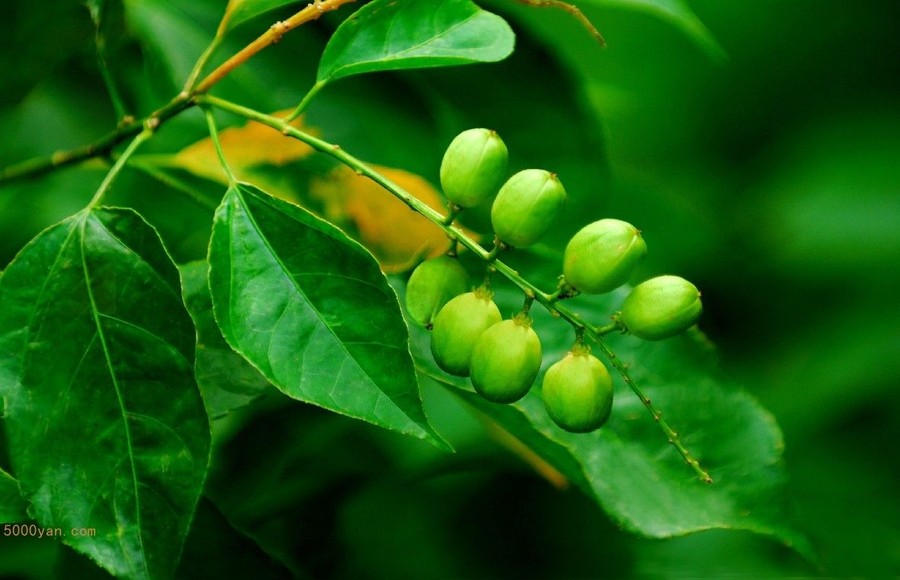
Euphorbiaceae plant Croton.Croton tigliumL. dried mature fruit.
Plant
Botanical Description
Shrub or small tree, 2-10 m tall. Young branches green, sparsely stellate-pubescent, old branches glabrous. Leaves simple, alternate; petiole 2-6 cm long, stipules linear, 2-4 mm long, caducous; leaf blade membranous, ovate to oblong-ovate, 5-15 cm long, 2.5-8 cm wide, apex acuminate or long acuminate, base rounded or broadly cuneate, with 2 sessile cup-shaped glands near petiole, margin sparsely and shallowly serrate, teeth often with small glands, both surfaces sparsely stellate-pubescent when young, later glabrous or with very few stellate hairs beneath, pale yellow when dry. Racemes terminal, 5-14 cm long, with male flowers in upper part and female flowers in lower part; bracts subulate, about 2 mm long; male flowers green, small, pedicels slender and short, 3-4 mm long, stellate-pubescent; calyx 5-lobed, lobes ovate, about 2 mm long, sparsely stellate-pubescent at apex; petals 5, oblong, equal to calyx in size, reflexed; female flowers with thicker pedicels, 2-3 mm long; calyx 5-lobed, lobes oblong, about 2.5 mm long, stellate-pubescent outside; petals absent. Capsule obovoid to oblong, with 3 obtuse angles, about 2 cm long; seeds 3, long-ovoid, slightly convex on back, pale yellowish-brown, about 1 cm long, 6-7 mm wide. Flowering period March to October, fruiting period July to November.
Habitat and Distribution
1. For pneumonia: Renshen 6 g, decoct in water and take orally.
Harvesting and Processing
Harvest in autumn when the fruit is ripe, pile up for 2-3 days, spread out, and dry.
Medicinal Properties
This product is ovoid in shape, generally with three ridges, 1.8-2.2 cm long and 1.4-2 cm in diameter. The surface is grayish-yellow or slightly darker, rough, with 6 longitudinal lines, the apex is truncate, and the base has a fruit stalk scar. When the fruit shell is broken open, 3 chambers can be seen, each containing 1 seed. The seeds are slightly flattened ellipsoid, 1.2-1.5 cm long and 0.7-0.9 cm in diameter, with a brown or grayish-brown surface, a small dot-like hilum and caruncle scar at one end, a slightly concave chalaza at the other end, and a raised raphe between them; the outer seed coat is thin and brittle, the inner seed coat is a white membrane; the kernel is yellowish-white and oily. The odor is faint, and the taste is pungent.
Chemical Constituents
This product contains components such as crotonoside, crotonic acid, palmitic acid, arachidic acid, crotin I, crotin II, linolenic acid, and phorbol.
Pharmacology
Stimulates the digestive tract, causing severe abdominal pain; induces vomiting; excites intestinal muscles; increases bile and pancreatic secretion; anti-pathogenic microorganisms; anti-tumor; promotes tumorigenesis; anti-inflammatory; mutagenic; may cause platelet aggregation. Toxic.
Internal use: decoct 3-10 g
"Properties and Channel Entry"
Acrid, hot; highly toxic. Enters the Stomach and Large Intestine channels.
Functions and Indications
External use: erodes sores. For malignant sores, scabies, ringworm, warts, and moles.
Dosage and Administration
Internal use: add to pills or powders, 0.1-0.3 g; external use: appropriate amount, grind into powder and apply to the affected area, or mash and wrap in gauze to rub the affected area.
Precautions and Contraindications
Contraindicated in cases of no cold accumulation with stagnation, debilitated patients, and pregnant women; incompatible with Semen Pharbitidis. After taking Crotonis Fructus, avoid consuming hot foods such as hot congee or hot water to prevent exacerbating diarrhea. Internal poisoning by Crotonis Fructus can cause burning sensations and stabbing pain in the oral cavity, pharynx, and stomach, salivation, nausea, vomiting, severe epigastric pain, violent diarrhea with rice-water-like stools, proteinuria, hematuria, leukocyturia, and casts in urine, potentially leading to acute renal failure with oliguria or anuria. In severe poisoning, symptoms include delirium, cyanosis, weak and thready pulse, decreased body temperature and blood pressure, dyspnea, ultimately resulting in respiratory and circulatory failure and death. External use may cause redness and blistering of the skin and mucous membranes, inflammation, and even local tissue necrosis. If diarrhea persists after taking Crotonis Fructus, it can be alleviated by taking a cold decoction of Rhizoma Coptidis, Cortex Phellodendri, or Semen Phaseoli Radiati, or by consuming cold congee or soybean juice.
Prescriptions
1. For cirrhosis with ascites: Badou cream (croton seed paste) 3 g, Qingfen (calomel) 1.5 g, place on four to five layers of gauze, apply to the navel, cover with two more layers of gauze, remove after 1-2 hours when a tingling sensation is felt, wait for watery diarrhea; if no diarrhea occurs, reapply. (Inner Mongolia, *Selected Materials on New Chinese Herbal Medicine Therapies*) 2. For laryngeal obstruction: Baifan (alum, crushed) 60 g, Badou (croton seed, slightly crushed) 15 g. Fry together in an iron vessel until the alum is dry; discard the Badou, grind the alum into a fine powder. When ill, mix with water and administer orally, or blow dry powder into the throat. (*Bai Yi Xuan Fang*) 3. For severe throat occlusion: One Badou (croton seed, with the outer skin removed). Drill a hole through the center, wrap in cotton, leaving an opening for air. Insert into the nostril, alternating sides as needed, and inhale the air into the throat; immediate effect. (*Sheng Hui Fang*) 4. For infantile phlegm-induced wheezing: One Badou (croton seed), mash into a paste, wrap in cotton, and insert into the nostril; phlegm will be expelled spontaneously. (*Gu Jin Yi Jian*) 5. For all types of sores, ulcers, and necrotic tissue: Remove the shell of Badou (croton seed), fry until charred, grind into a paste, apply to the affected area to resolve toxicity; apply to necrotic flesh to promote spontaneous dissolution and sloughing. (*Yong Ju Shen Mi Yan Fang*, Wujin Gao)