Pinyin: Cheqianzi
Aliases
Cheqianshi, Xiamayizi, Zhu'erduosuizi, Fengyanqianren.
Source
Plant of the Plantaginaceae family, Plantago asiaticaPlantago asiaticaL. or Plantago depressa Willd.Plantago depressaDried mature seeds of Willd.
Botanical Description
1. For pneumonia: Cheqian (Plantago seed) 6 g, decoct in water and take orally.
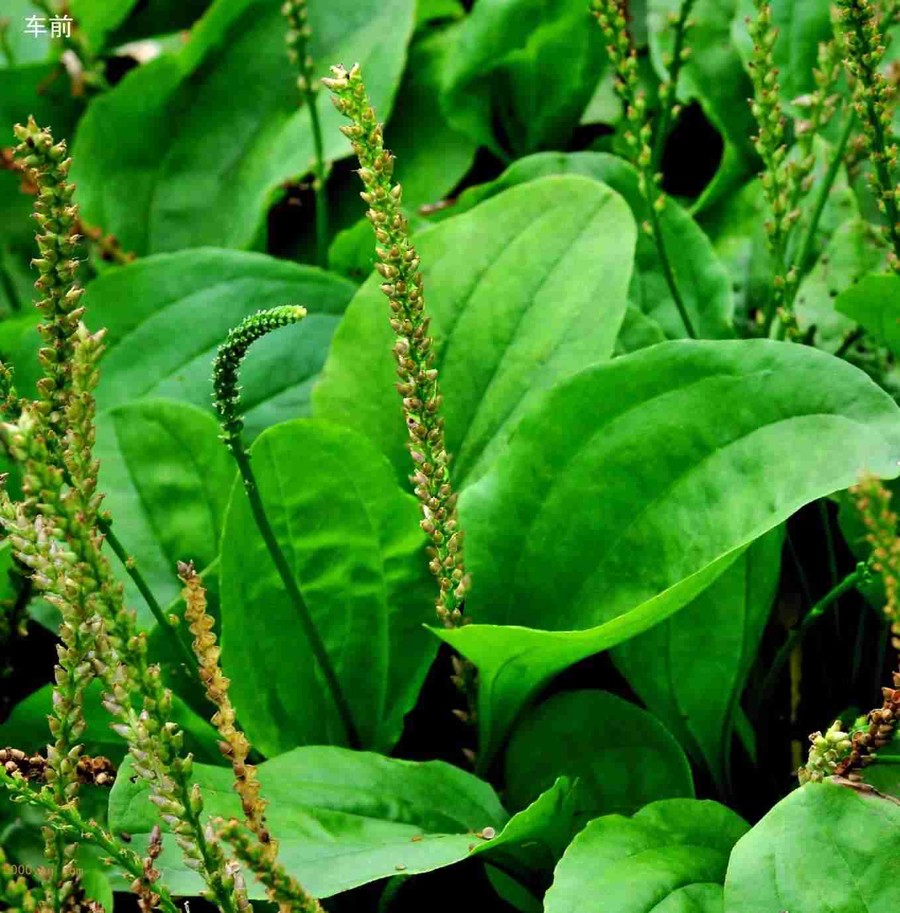
2. Plantago depressa differs from Plantago asiatica in having a cylindrical taproot; leaves elliptic, elliptic-lanceolate, or ovate-lanceolate, narrowed at the base; sepals approximately equal in length to bracts; capsule conical; seeds oblong, brownish-black.
Habitat and Distribution
Cheqian grows in mountain fields, roadsides, flower gardens, vegetable gardens, and wet areas along rivers; it is distributed throughout China. Pingcheqian grows on hillside ridges and riverbanks at elevations below 1800 m, distributed across the country, but more common in the north.
Harvesting and Processing
In summer and autumn, when seeds are mature, harvest the fruit spike, dry in the sun, rub out the seeds, and remove impurities.
Medicinal Properties
This product is oval, irregularly oblong, or triangular-oblong, slightly flattened, approximately 2 mm long and 1 mm wide. The surface is yellow-brown to black-brown with fine wrinkles, and on one side there is a gray-white, dot-like hilum. The texture is hard. Odor: faint; Taste: bland.
Chemical Constituents
This product contains aucubin, geniposidic acid, acteoside, plantaginin, racemic plantagoside, geniposidic acid, aucubin, plantainolic acid, plantain mucopolysaccharide, and other components.
Pharmacology
Diuretic; prevents the formation of kidney stones; induces arthritis in synovial and other tissues, promotes hyperplasia of joint capsule tissue, and restores the original tension of relaxed joint capsules; dispels phlegm and suppresses cough; exhibits cholinergic effects.
Internal use: decoct 3-10 g
"Properties and Channel Entry"
Sweet, cold. Enters the Liver, Kidney, Lung, and Small Intestine channels.
Functions and Indications
Clears Heat, promotes urination, and unblocks painful urinary dribbling; leaches out Dampness and stops diarrhea; brightens the eyes; and expels Phlegm. Used for painful urinary dribbling due to Heat Lin; full and distended edema; summerheat-Dampness diarrhea; red, swollen, and painful eyes; and cough with Phlegm-Heat.
Dosage and Administration
Oral: 5-15 g, decocted in water (wrapped in cloth for decoction); or prepared as pills or powder
Precautions and Contraindications
Contraindicated in cases of Yang Qi sinking, Kidney deficiency with seminal emission, and those without internal Damp-Heat.
Prescriptions
1. For unremitting watery diarrhea: Dry-fry Plantago asiatica seeds until done and grind into powder, take 3 g with rice soup. (From Weisheng Yijian Fang) 2. For diarrhea: Plantago asiatica seeds, Chaenomeles sinensis fruit, and Schisandra chinensis fruit, equal parts. Grind into fine powder. Take 3-4 g each time, 3 times daily, decocted in water. (From Zhongguo Minzu Yaozhi) 3. For various types of stranguria with unbearable urinary pain: Plantago asiatica seeds 15 g, Lophatherum gracile stem and leaf, Schizonepeta tenuifolia spike, Poria rubra (red Poria), and Juncus effusus pith, 7.5 g each. Divide the above ingredients into two doses, decoct in freshly drawn water, and take freely. (From Zhizhi Fang: Cheqianzi San) 4. For difficult urination due to heat obstruction: Plantago asiatica seeds 30 g, Phellodendron chinense bark 15 g, Paeonia lactiflora root 6 g, Glycyrrhiza uralensis root 3 g. Decoct in water and take slowly. (From Puji Fang) 5. For painful hematuria: Sun-dry Plantago asiatica seeds and grind into powder, take 6 g each time, decocted with Plantago asiatica leaves and taken with the decoction. (From Puji Fang)