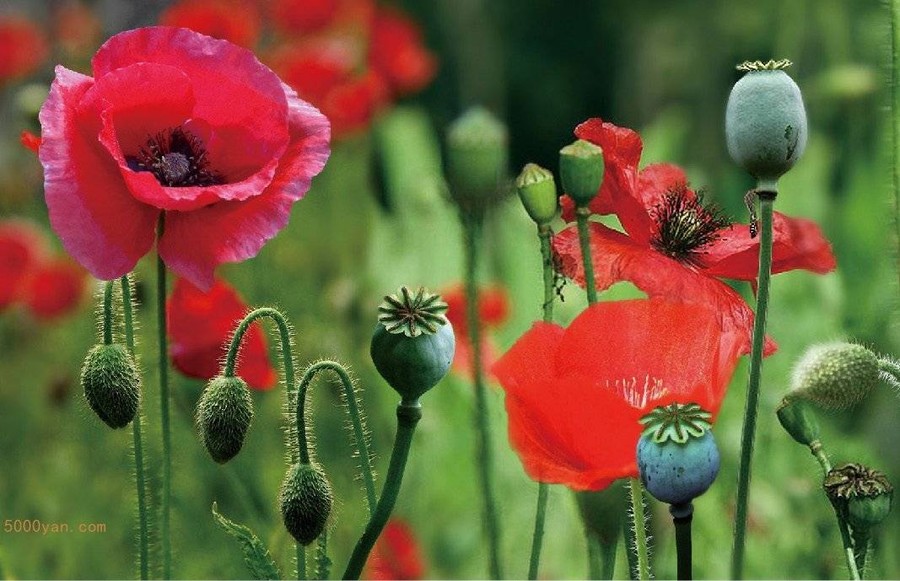
Pinyin: Yingsuke
Aliases
Yumike, Mike, Mipi, Suke.
Source
Papaveraceae plant PapaverPapaver somniferumL. of the dried mature pericarp.
Botanical Description
Annual herb, 30-60 cm tall, up to 1.5 m when cultivated. Contains milky sap. Stem erect, unbranched, glabrous (hairless), with a white powdery coating. Leaves alternate, without stipules; lower leaves with short petioles, upper leaves sessile, clasping the stem; leaf blade 5-30 cm long, 3-20 cm wide, apex acuminate or obtuse, base cordate, veins prominent and slightly raised, margin irregularly undulate-serrate, both surfaces glabrous, covered with white powder giving a gray-green appearance. Flower solitary, terminal, often pendulous, with a long pedicel up to 25 cm, glabrous or rarely with sparse bristles; sepals 2, oblong or broadly ovate, green, with membranous margins, early deciduous; petals 4, sometimes double, suborbicular or subflabellate, 4-7 cm long, 3-7 cm wide, margin shallowly undulate or variously divided, white, pink, red to purple; stamens numerous, inserted around the ovary, filaments slender, white, anthers yellow, 2-celled, dehiscing longitudinally; pistil 1, ovary oblong-ovoid, glabrous, 1-locular, with numerous ovules, style absent, stigmas 5-18, arranged radially forming a flat disc. Capsule globose or oblong-ellipsoid, 4-7 cm long, 4-5 cm in diameter, glabrous, pericarp yellow-brown or light brown at maturity, dehiscing by pores. Seeds numerous, small, reniform, 0.5-1 cm in diameter, surface coarsely honeycombed, gray-brown. Flowering April to June, fruiting June to August.
Habitat and Distribution
This species is prohibited from illegal cultivation. It is currently licensed to certain institutions for cultivation for medicinal use.
Harvesting and Processing
Harvest the ripe fruit in autumn, or the ripe fruit after the latex has been collected, split open, remove the seeds and stems, and dry.
Medicinal Properties
This product is ellipsoidal or bottle-shaped and ovoid, mostly broken into pieces, 1.5-5 cm in diameter, 3-7 cm long; the outer surface is yellowish-white, light brown to pale purple, smooth, slightly lustrous, without cuts or with longitudinal or transverse cuts; the apex has 6-14 radially arranged disc-shaped residual stigmas; the base has a short stalk. The inner surface is pale yellow, slightly lustrous; with longitudinally arranged false septa, brownish-yellow, densely covered with slightly protruding brownish-black small dots. Light in weight, brittle texture. Odor: faintly fragrant; Taste: slightly bitter.
Chemical Constituents
This product contains cocaine, allocryptopine, papaveraldine, papaverine, and protopine among other constituents.
Pharmacology
Analgesic, hypnotic, respiratory depression and antitussive; inhibits intestinal peristalsis; causes miosis; relaxes smooth muscle.
Properties and Channel Entry
Sour, astringent, neutral; toxic. Enters the Lung, Large Intestine, and Kidney channels.
Functions and Indications
Converges the Lungs, astringes the Intestines, and alleviates pain. Used for chronic cough, chronic diarrhea, rectal prolapse, and epigastric and abdominal pain.
Dosage and Administration
Oral: decoct in water, 3-10 g; or prepared as pills or powder. For cough suppression, use honey-fried; for diarrhea and dysentery, use vinegar-fried.
Precautions and Contraindications
This product is addictive and should not be used regularly; it is contraindicated in pregnant women and children; athletes should use with caution.
Prescriptions
1. For chronic cough and wheezing with spontaneous sweating: Yingsuqiao (Poppy Capsule) in an unspecified amount, stir-fried and ground into powder, take 6 g per dose, add Wumei (Smoked Plum) and decoct in one cup of water, take warm after meals; if sweating occurs, add 30 wheat grains, decoct together and take warm. (From Xuanming Lun Fang, Xiao Bai Lao San) 2. For chronic or recent cough and wheezing: Yingsuqiao (honey-fried) 30 g, Renshen (Ginseng) 30 g, Chenpi (Tangerine Peel, white removed) 30 g, Gancao (licorice, honey-fried) 30 g. Grind into powder, take 3 g per dose, mix with decocted Wumei soup and take before bed. (From Xuanming Lun Fang, An Shen San) 3. For all types of cough: Yingsuqiao (veins removed, honey-fried) 30 g, Wuweizi (Schisandra) 15 g, Xingren (Apricot Kernel, stir-fried) 15 g, Hutaorou (Walnut Kernel) 15 g. Grind the above into powder, mix with honey to form pills the size of a bullet, decoct one pill in one cup of water and take. (From Pu Ji Fang, Jin Su Wan) 4. For persistent watery diarrhea: One Yingsuqiao (stem and membrane removed), Wumei flesh and Dazao (Red Date) flesh, ten pieces each, decoct in one cup of water until reduced to seven-tenths, take warm. (From Jing Yan Fang) 5. For chronic dysentery: Yingsuqiao (vinegar-fried), ground into powder, formed into honey pills the size of a bullet, take one pill per dose, decoct in one cup of water with three slices of Shengjiang (Fresh Ginger) until reduced to eight-tenths, take warm. (From Compendium of Materia Medica)