Pinyin: Caodoukou
Aliases
Doukou, Loukou, Caoguo, Caokou
Source
1AlpiniakatsumadaiDried nearly mature seeds of Hayata.
Botanical Description
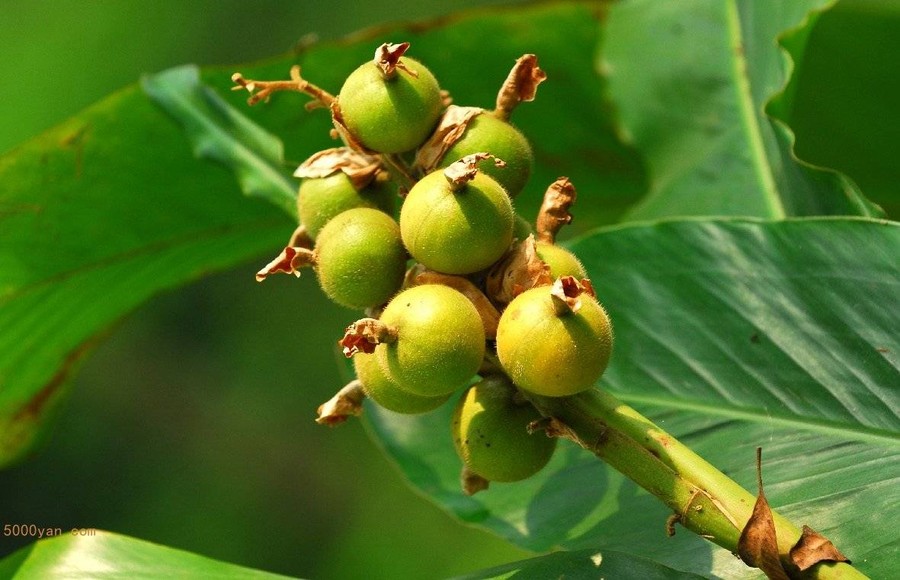
Perennial clump-forming herb, plant height 1.5-3 m. Petiole 1.5-2 cm long; leaf blade narrowly elliptic or linear-lanceolate, 50-65 cm long, 6-9 cm wide, apex acuminate, base attenuate, margin ciliate, both surfaces glabrous or sparsely hirsute abaxially; ligule ovate, 5-8 mm long, abaxially hirsute. Raceme terminal, erect, 20-30 cm long. Rachis densely hirsute; pedicel ca. 3 mm long; bracteole milky white, broadly elliptic, ca. 3.5 cm long, apex obtuse; calyx campanulate, white, 1.5-2.5 cm long, apex with 3 irregular obtuse teeth, deeply split on one side, abaxially pubescent; corolla white, corolla tube ca. 8 mm long, lobes 3, oblong, upper lobe larger, apex 2-lobed, margin erose, with red or red-black stripes anteriorly and pale purplish-red spots posteriorly. Capsule subglobose, ca. 3 cm in diameter, abaxially hirsute, yellow when ripe. Flowering April-June, fruiting June-August.
Habitat and Distribution
It grows in mountainous areas, sparse forests, ravines, riverbanks, and damp forest edges. It is distributed in Guangdong, Hainan, Guangxi, and other regions.
Harvesting and Processing
Harvested in summer and autumn, sun-dried to 90% dryness, or briefly blanched in water, sun-dried to half-dryness, remove the pericarp, take out the seed mass, and sun-dry completely.
Medicinal Properties
The seed mass is subspherical or ellipsoidal, with three relatively distinct obtuse edges and three shallow grooves, 1.5-3 cm long, 1.5-3 cm in diameter; surface grayish-brown or yellowish-brown; internally divided by yellowish-white or pale brown septa into three chambers, each chamber containing 22-90 (up to 110) seeds that are not easily separated. Seeds are ovoid-polyhedral, 3-5 mm long, 2.5-3 mm in diameter, with the back slightly raised, the thicker end having a round pit-like hilum, the chalaza located at the central depression of the flatter end, a longitudinal groove on the ventral side, with a light brown raphe running along the groove from the hilum to the chalaza, and another longitudinal groove extending from the chalaza to the back, with the end of the groove not reaching the hilum; texture hard, cross-section milky white. Odor: aromatic; Taste: acrid, pungent.
Chemical Constituents
This product contains alpinetin, pinocembrin, alnustone, katsumadain A, katsumadain B, eucalyptol, 5,6-dehydrokavain, and other constituents.
Pharmacology
Increases pepsin activity.
Properties and Channel Entry
Acrid, warm. Enters the Spleen and Stomach channels.
Functions and Indications
Dries Dampness and moves Qi, warms the Middle and stops vomiting
Dosage and Administration
Oral administration: decoct in water, 3-6 g, should be added later; or made into pills or powder.
Precautions and Contraindications
Contraindicated in patients with Yin deficiency, blood deficiency, and insufficient body fluids; use with caution in those without Cold-Dampness.
Prescriptions
1. For pediatric cholera with vomiting and diarrhea: Caodoukou (Alpinia katsumadai seed) , Binglang (Areca catechu seed) , and Gancao (Glycyrrhiza uralensis root) in equal parts. Grind into powder. Decoct 3 g with ginger, take on an empty stomach. (From Puji Fang) 2. For epigastric and abdominal distension and fullness with shortness of breath: Caodoukou 30 g, remove the peel and grind into powder. Take 1.5 g with decoction of Mugua (Chaenomeles speciosa fruit) and Shengjiang (Zingiber officinale rhizome) . (From Qianjin Yaofang) 3. For deficiency-cold of the Large Intestine with abdominal pain and poor appetite: Caodoukou 45 g, Baizhu (Atractylodes macrocephala rhizome) and Gaoliangjiang (Alpinia officinarum rhizome) each 0.9 g, Chenjupi (Citrus reticulata aged peel) and Houpo (Magnolia officinalis bark) each 0.3 g. Grind into fine powder; each dose 6 g, decoct in one medium cup of water until reduced to seven-tenths, take warm with the dregs before meals on an empty stomach. (From Jifeng Puji Fang, Caodoukou San) 4. For deficiency-cold diarrhea with incessant abdominal pain: Houpo (processed with ginger) 60 g, Rouguo (Myristica fragrans kernel, roasted in flour) ten pieces, Caodoukou (roasted) ten pieces. Grind into powder, each dose 6 g, decoct in water and take orally. (From Chishui Xuanzhu, Caoguo San)