Pinyin: Luohanguo
Aliases
La Hanguo, Jia Kugua, Guangguo Mubie, Jin Buhuan.
Source
Cucurbitaceae plant Siraitia grosvenoriiSiraitiagrosvenoriiDried fruit of (Swingle) C. Jeffrey ex A.M. Lu et Z.Y. Zhang.
Botanical Description
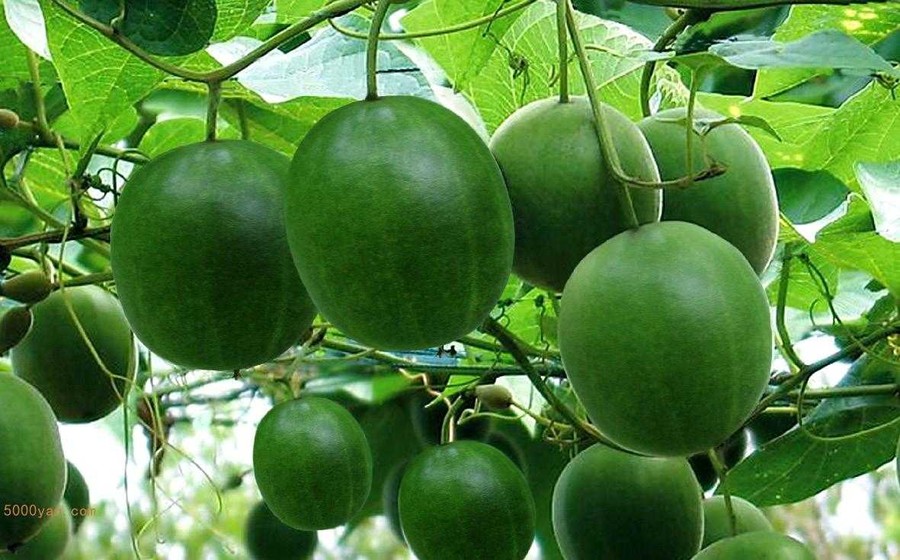
A perennial climbing herb. It has a large, fleshy root tuber, fusiform or nearly spherical in shape. The stem is slightly stout, with angular grooves, initially covered with yellowish-brown soft hairs and black verrucose glandular scales, which gradually shed or become nearly hairless with age. Petiole 3-10 cm long, with the same indumentum and glandular scales as the branches; leaf blade membranous, ovate-cordate, triangular-ovate or broadly ovate-cordate, 12-23 cm long, 5-17 cm wide, apex acuminate or long acuminate, margin slightly undulate, with small teeth formed by protruding veinlets and ciliate hairs, upper surface green, sparsely pubescent with black verrucose glandular scales, gradually becoming nearly glabrous with age, lower surface pale green, covered with short hairs and mixed black verrucose glandular scales, gradually shedding with age. Tendrils slightly stout, initially pubescent, becoming glabrous, 2-branched, coiling both above and below the branching point. Dioecious; male inflorescence racemose, with 6-10 flowers borne on the upper part of the inflorescence axis, also pubescent with black verrucose glandular scales; pedicels slender; calyx tube broadly campanulate, throat often with 3 oblong membranous scales; calyx lobes 5, triangular, apex subulate-caudate, 3-veined, veins slightly raised; corolla yellow, with black glandular dots, lobes 5, oblong, often 5-veined; stamens 5, inserted near the base of the tube; two filaments fused at the base, one separate, filament bases swollen. Female flowers solitary or 2-5 clustered at the apex of a 6-8 cm long peduncle; calyx and pedicel larger than in male flowers; staminodes 5; ovary oblong, 10-12 mm long, densely covered with yellowish-brown tomentum; style short and thick; stigma 3, swollen, falcate, 2-lobed. Fruit spherical or oblong, 6-11 cm long, 4-8 cm in diameter, initially densely covered with yellowish-brown tomentum and mixed black glandular scales, gradually shedding with age, sometimes only a ring of tomentum remaining near the fruit stalk attachment; pericarp thin, easily brittle when dry. Seeds numerous, pale yellow, suborbicular or broadly ovate, compressed, 15-18 mm long, 10-12 mm wide, base obtuse-rounded, apex slightly narrowed, both sides slightly concave in the center, with radiating grooves around the margin, margin slightly undulate, deep reddish-brown when young, turning bluish when mature. Flowering period: February to May; fruiting period: July to September.
Habitat and Distribution
Commonly grows on mountain slopes under forests, riverside wetlands, and shrublands at altitudes of 400-1,400 m and above. Distributed in Jiangxi, Hunan, Guangdong, Guangxi, Guizhou and other regions; in parts of Guangxi, it has been cultivated as an important economic crop.
Harvesting and Processing
Harvest in autumn when the fruit changes from tender green to dark green, sun-dry for a few days, then dry at low temperature.
Medicinal Properties
This product is ovoid, ellipsoid, or spherical in shape, 4.5-8.5 cm long and 3.5-6 cm in diameter. The surface is brown, yellowish-brown, or greenish-brown, with dark patches and yellow pubescence, and some have 6-11 longitudinal stripes. The apex has a remnant of the style, and the base has a fruit stalk scar. The body is light, brittle, with a thin and easily broken pericarp. The pulp (middle and inner pericarp) is spongy and light brown. The seeds are oblate, numerous, approximately 1.5 cm long and 1.2 cm wide; they are light red to reddish-brown, slightly concave in the middle on both sides, with radiating striations around the periphery and a groove at the margin. Odor: faint; Taste: sweet.
Chemical Constituents
This product contains mogroside IV, mogroside V, mogroside aglycone-3, 24-di-O-β- glucosides, D-mannitol, mogroside dibenzoate, and kaempferol and other components.
Pharmacology
It can enhance the body's cellular immune function; large doses of Luohanguo may increase the ratio of spleen-specific rosette-forming cells.
Properties and Channel Entry
Sweet, cool. Enters the Lung and Large Intestine channels.
Functions and Indications
Clears Heat, moistens the Lungs, benefits the throat and restores voice, and lubricates the Intestines to relieve constipation. Used for dry cough due to Lung Heat, sore throat and loss of voice, and constipation due to Intestinal dryness.
Dosage and Administration
Oral: decoct 15-30 g; or stew with meat; or steep in boiling water.
Precautions and Contraindications
Contraindicated for patients with pulmonary cold patterns and externally-contracted cough.
Prescriptions
1. For sore throat and loss of voice: Luo Han Guo 1 piece, sliced, decoct in water, let cool, then drink frequently. ("Food Chinese Medicine and Prescriptions") 2. For lung dryness with cough, copious phlegm, dry throat and mouth: Luo Han Guo half piece, Chen Pi 6 g, lean pork 100 g. Soak Chen Pi first, scrape off the white pith, then cook with Luo Han Guo and lean pork in soup. After cooking, remove Luo Han Guo and Chen Pi, drink the soup and eat the meat. ["New Journal of Traditional Chinese Medicine" 1982, (11): 45] 3. For acute and chronic bronchitis, tonsillitis, pharyngitis, constipation: Luo Han Guo 15-30 g, steep in boiling water, drink as tea. ("National Compendium of Chinese Herbal Medicine")