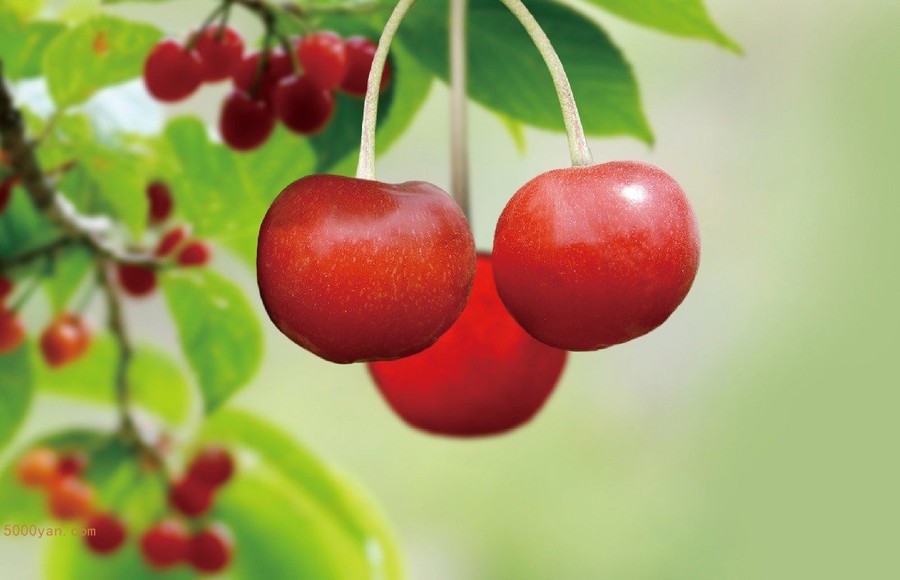
Pinyin: Yingtaohe
Aliases
Yingtaomi
Source
Rosaceae plant cherry.Cerasus pseudocerasusDried mature fruit kernel of (Lindl.) G.Don.
Botanical Description
A deciduous shrub or tree, 3-8 m tall. Bark gray-white with distinct lenticels; young branches glabrous or sparsely pubescent. Leaves alternate; petiole 0.7-1.5 cm long, sparsely pubescent; leaf blade ovate or oblong-ovate, 5-12 cm long, 3-5 cm wide, apex acuminate or caudate-acuminate, base rounded, margin sharply doubly serrate with small glands at tooth tips, upper surface dark green, nearly glabrous, lower surface pale green, sparsely pubescent along veins or in vein axils. Flowers bisexual, inflorescence corymbose or subumbellate; 3-6 flowers per inflorescence, opening before leaves; pedicel 8-19 mm long, sparsely pubescent; calyx tube campanulate, sparsely pubescent externally; calyx lobes 5, triangular-ovate or ovate-oblong, apex acute or obtuse; petals 5, white, ovate, apex emarginate or bifid; stamens 30-35, up to 50 in cultivated plants; style nearly as long as stamens, glabrous; pistil 1, ovary superior. Drupe subglobose, red, 9-13 mm in diameter, with 1 seed enclosed in a yellowish-white woody endocarp. Flowering March-April, fruiting May-June.
Habitat and Distribution
Grows on sunny slopes or ditch sides at elevations of 300-600 m. Distributed in East China and Liaoning, Hebei, Shanxi, Shaanxi, Gansu, Henan, Hubei, Guangxi, Sichuan, and other regions.
Harvesting and Processing
In summer, take ripe fruit and place it in a vat, rub and knead with a tool to separate the pulp from the pit, remove the pit, wash clean, and sun dry.
Medicinal Properties
The fruit kernel is ovoid or oblong, 8-10 mm long, with a diameter of approximately 5 mm. The apex is slightly pointed and slightly oblique, the base is obtuse, rounded, and concave, with one side somewhat thin and wing-like near the base. The surface is yellowish-white or pale yellow, with a reticulate pattern, and there is one distinct ridge line on each side. The texture is hard and difficult to break. When the kernel (endocarp) is cracked open, it contains one seed. The seed coat is yellowish-brown or yellowish-white, often wrinkled, and the cotyledons are pale yellow. There is no odor, and the taste is slightly bitter.
Chemical Constituents
This product primarily contains cyanogenic glycosides, which upon hydrolysis in water yield hydrocyanic acid.
Properties and Channel Entry
Acrid, warm. Enters the Lung channel.
Functions and Indications
Promotes eruption of measles, eliminates nodules and scars, moves Qi and alleviates pain. Indicated for early-stage measles with incomplete eruption, skin scars, goiter, and hernia pain.
Dosage and Administration
Oral: decoct in water, 5-15 g. External: apply appropriate amount, grind and apply the juice; or decoct in water for fumigation and washing.
Precautions and Contraindications
(Acne) Contraindicated in Yang syndromes
Prescriptions
1. For measles with incomplete eruption: 12-15 g of cherry kernel. Decoct in water, take once before breakfast and once before dinner. Avoid sugar, scallions, garlic, and alcohol. (From *Tianmu Mountain Medicinal Plants*) 2. For hoarseness due to pox: Twenty cherry kernels. Roast to yellow in a sand pot, decoct and take. (From *Compendium of Materia Medica Supplement*) 3. For eyelid tumors: Grind cherry kernel with water and apply to the affected area. The tumor will gradually resolve on its own. (From *Compendium of Materia Medica Supplement*, citing *Medical Guide*) 4. For early-stage goiter: Grind cherry kernel with vinegar and apply to the area to resolve it. (From *Jiangnang Cuoyao*) 5. For pox scars: Grind cherry kernel into fine powder and apply. (From *Puji Prescriptions*)