Pinyin: Chushizi
Aliases
Chutao, Jiaoshuzi, Yeyangmeizi, Goupao
Source
Moraceae plant *Broussonetia papyrifera*.Broussonetia papyriferaDried ripe fruit of (L.) Vent.
Botanical Description
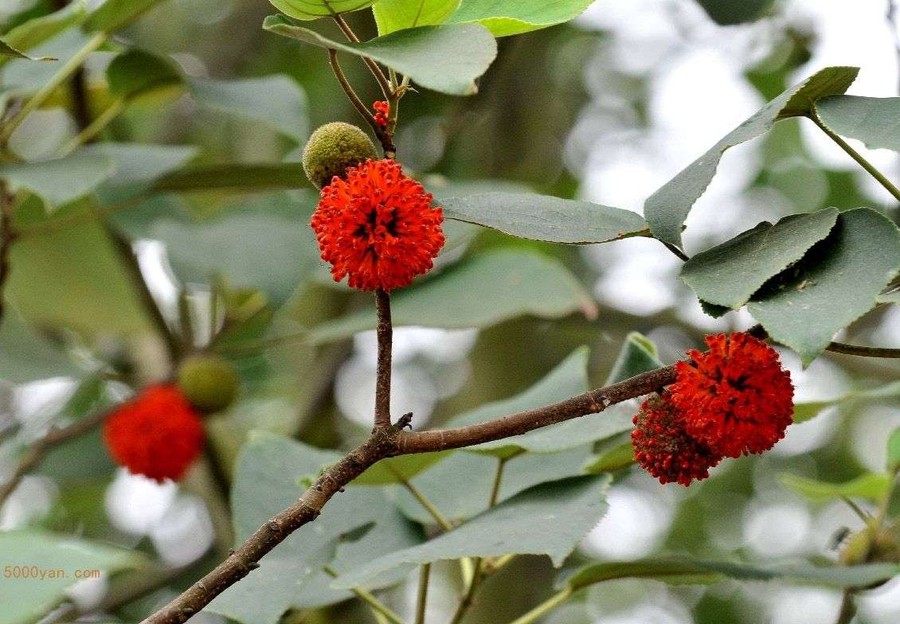
Deciduous tree, up to 14-16 m tall. Contains latex. Branchlets stout, densely pubescent. Leaves simple, alternate; petiole 1.5-10 cm long, densely pubescent; leaf blade membranous or papery, broadly ovate to oblong-ovate, 5.5-15 (-20) cm long, 4-10 (-15) cm wide, entire or 3-5-lobed, especially more obvious on young branches or small leaves, apex acuminate, base rounded or shallowly cordate, slightly oblique, margin serrate or coarsely serrate, upper surface dark green, with hispid trichomes, lower surface gray-green, densely pubescent. Flowers unisexual, dioecious; male inflorescence a catkin, axillary, pendulous, 3-8 cm long, peduncle 1-2 cm long; female inflorescence a capitulum, 1-1.5 cm in diameter, peduncle 1-1.5 cm long; male flowers shortly pedicellate, with 2-3 bracteoles, perianth 4-lobed, fused at base, stamens 4; female flowers with club-shaped bracts, pubescent, perianth tubular, pistils scattered among bracts, style slender, linear, with short hairs, sticky. Syncarp fleshy, globose, about 2 cm in diameter, orange-red when mature. Flowering April to July, fruiting July to September.
Habitat and Distribution
1. For pneumonia: Renshen 6 g, decoct in water and take orally.
Harvesting and Processing
Harvest in autumn when the fruit is ripe, wash clean, sun-dry, remove the gray-white membranous persistent calyx and impurities.
Medicinal Properties
This product is oblate or ovoid in shape, 1.5-3 mm long, approximately 1.5 mm in diameter, and up to 1 mm thick. The surface is reddish-brown with reticulate wrinkles or warty protrusions. One side has a ridge, the other side is slightly flat or grooved, and some have an ovary stalk. The texture is hard and brittle, easily crushed. It is rich in oiliness. Odor: faint; Taste: bland.
Chemical Constituents
This product contains liriodenine, nitidine,α- Foshougan oil olefin,β- Moyuene, Xiangfuxi,β-Contains components such as farnesene, methyl linoleate, and oleic acid.
Properties and Channel Entry
Sweet, cold. Enters the Liver and Kidney channels.
Functions and Indications
Tonifies the Kidneys, clears the Liver, brightens the eyes, and promotes urination
Dosage and Administration
Oral: decoction, 6-10 g; or made into pills or powder. External use: appropriate amount, pounded for topical application.
Precautions and Contraindications
Patients with Spleen and Stomach deficiency-cold and loose stools should use with caution.
Prescriptions
1. For blurred vision: Chushizi (Fructus Broussonetiae), Jingjiesui (Spica Schizonepetae), and Digupi (Cortex Lycii), equal parts. Grind into a fine powder, mix with honey to form pills the size of Chinese parasol seeds. Take 20 pills with rice soup. (From *Rumen Shiqin*) 2. For stone carbuncle (resembling a furuncle with thick skin) and also for incised wounds: apply powdered Chushizi topically. (From *Qianjin Yaofang*) 3. For edema: Chushizi 6 g and Dafupi (Pericarpium Arecae) 9 g, decoct in water and take orally. (From *Qingdao Zhongcaoyao Shouce*) 4. For laryngeal obstruction and wind-type laryngitis: take one Chushizi (dried in the shade), grind into powder, and take with well water; for severe cases, use two. (From *Binhu Jijianfang*) 5. For fish bone stuck in throat: Chushizi (ground into powder) 30 g and frost-treated plum pulp 90 g. Form into pills the size of a bullet, hold in the mouth and swallow slowly. (From *Dantai Yu'an*, formula name: Huagu Shendan)