Pinyin: Malinzi
Aliases
Lishi, Malianzi, Malianzi, Mazhouzi
Source
Iris plant Ma LinIris lacteaPall.var.ch-inensisDried ripe seeds of (Fisch.) Koidz.
Botanical Description
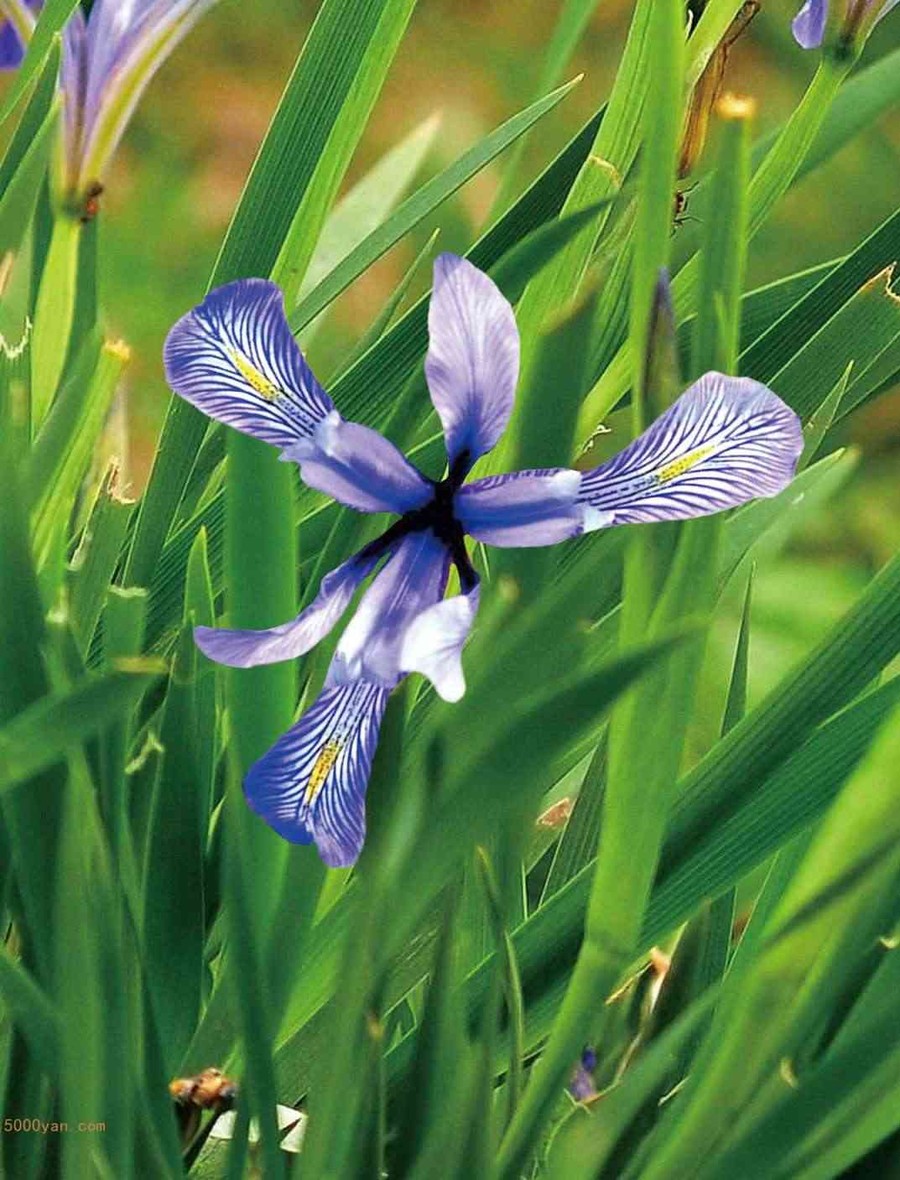
A perennial herb, 40-60 cm tall. The fibrous roots are thick and long, yellow-white in color. Leaves are clustered, tough, nearly erect; leaf blades are linear, 40-50 cm long, 4-6 mm wide, apex acuminate, entire margin, base sheathing; no midvein, with numerous parallel veins. The scape has 2-3 bracts at the apex, with 2-4 flowers inside; pedicels are 3-6 cm long; flowers are light blue, blue, or blue-purple, 5-6 cm in diameter, with 6 perianth segments arranged in 2 whorls, with darker stripes on the perianth; stamens 3, anthers yellow; ovary 3-4.5 cm long, 1-1.4 cm in diameter, style branches flattened, curved, apex 2-lobed. Capsule is long cylindrical, 4-6.3 cm long, 1-1.3 cm in diameter, with 6 distinct longitudinal ridges, apex beaked. Seeds are irregular polyhedrons, black-brown. Flowering period is May to July, fruiting period is June to September.
Habitat and Distribution
It grows in wastelands, hillside grasslands, or thickets. It is distributed in Northeast China, North China, Northwest China, and Shandong, Jiangsu, Anhui, Zhejiang, Henan, Hubei, Hunan, Sichuan, Tibet, and other regions.
Harvesting and Processing
Harvest the fruits when ripe from August to September, cut them down and dry in the sun, thresh out the seeds, remove impurities, and dry again in the sun.
Medicinal Properties
Seeds are irregular polyhedrons, approximately 5 mm long and 3-4 mm wide. The surface is reddish-brown to blackish-brown with fine wrinkles, a light-colored hilum at the base, and a slightly protruding chalaza at the apex; the texture is hard and not easily broken. The cut surface shows well-developed endosperm, grayish-white, horny, with the embryo located at one end of the hilum, white, small, and curved. Odor: faint; Taste: bland.
Chemical Constituents
This product primarily contains irisquinone A, irisquinone B, irisquinone C, lupen-3-one, betulin,β-Contains sitosterol, plant waxes, and various fatty acid components.
Pharmacology
Has strong anti-tumor activity and can enhance the radiosensitivity of tumor cells, has anti-radiation effects, promotes immune function, and possesses anti-fertility and anti-implantation effects.
Properties and Channel Entry
Sweet, neutral. Enters the Liver, Spleen, Stomach, and Lung channels.
Functions and Indications
Clears Heat and drains Dampness, resolves toxicity and kills parasites, stops bleeding and alleviates pain. Indicated for jaundice, turbid urine with dribbling, difficult urination, intestinal abscess, parasitic accumulation, malaria, rheumatic pain, throat obstruction, toothache, hematemesis, epistaxis, bloody stool, metrorrhagia and metrostaxis, sores and swelling, scrofula, hernia, hemorrhoids, scalds, and snakebite.
Dosage and Administration
Internal: decoct in water, 3-9 g; or made into pills or powder. External: appropriate amount, grind into powder for topical application or mash for external use.
Precautions and Contraindications
Use with caution in those with Spleen deficiency and loose stools.
Prescriptions
1. For jaundice hepatitis with scanty dark urine: a. Malinzi 9 g, decoct in water and take orally. (Ningxia Chinese Herbal Medicine Manual) b. Malinzi 9 g, Yinchen 15 g, decoct in water and take orally. (Hubei Chinese Herbal Medicine Record) 2. For various turbid urine conditions: fresh Malinzi 60 g, add Bingtang 15 g, an appropriate amount of boiling water, steep and simmer, take before meals. (Fuzhou Taijiang Folk Practical Herbal Medicine) 3. For difficult urination: Malinzi 6 g, Cheqiancao 9 g, decoct in water and take orally. (Shandong Chinese Herbal Medicine Manual) 4. For urinary retention: a. Malinzi 6 g, crush, decoct in water and take orally. (Tianjin Chinese Herbal Medicine) b. Malinzi 25 g, Bianxu 10 g, Mutong 10 g, decoct in water, take on an empty stomach, twice daily. (Jilin Chinese Herbal Medicine) 5. For early-stage dysentery: Malinzi 9 g, Huangcipi 9 g, decoct in water and take orally. (Xining Chinese Herbal Medicine) 6. For indigestion due to food accumulation: Malinzi, stir-fried until charred, take 9 g per dose. (Medicinal Plants of Desert Regions) 7. For carbuncles, swellings, sores, and furuncles: Malinzi 6 g, Machixian 30 g, Pugongying 30 g, decoct in water and take orally. (Qingdao Chinese Herbal Medicine Manual) 8. For epistaxis and hematemesis: Malinzi 6 g, Baimaogen 30 g, Xianhecao 15 g, decoct in water and take orally. (Shandong Chinese Herbal Medicine Manual)