Pinyin: Tianxianzi
Aliases
Langdangzi, Xiaodanqiezi, Miguanzi, Xunyazi.
Source
Solanaceae plant Hyoscyamus nigerHyoscyamus nigerL. of dried ripe seeds.
Botanical Description
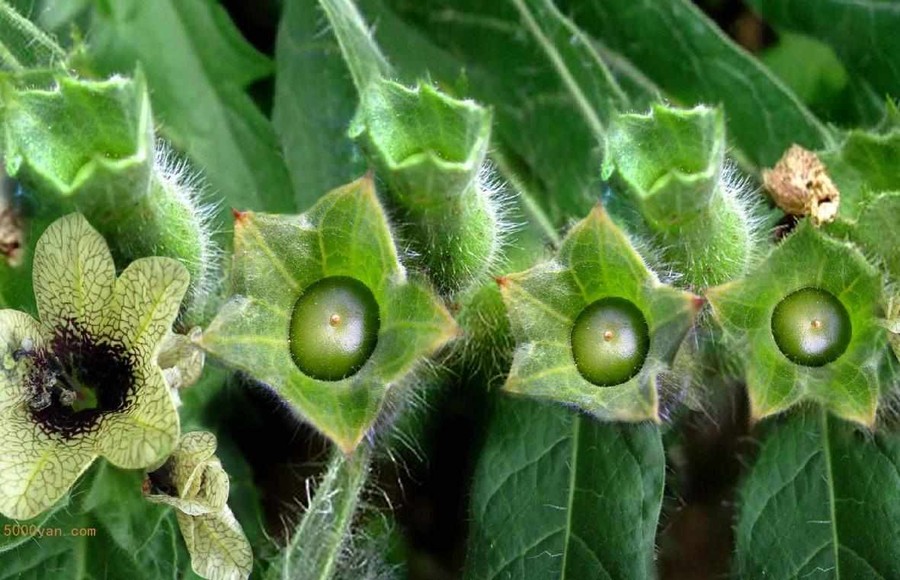
Annual or biennial herb, up to 1 m tall. Entire plant covered with sticky glandular hairs. Root thick, fleshy. In first-year plants, stem very short, with a rosette of leaves at the base; leaf blade up to 30 cm long and 10 cm wide. In second-year plants, stem elongates and branches. Cauline leaves alternate, sessile, base semi-amplexicaul; leaf blade ovate to triangular-ovate, 4-10 cm long, 2-6 cm wide, apex obtuse or acuminate, margin pinnately lobed or parted; apical leaves shallowly undulate, both surfaces sticky glandular hairy and along veins also pubescent. Flowers axillary, solitary, 2-3 cm in diameter; calyx tubular-campanulate, 5-lobed, enlarging after anthesis into an urn shape with 10 longitudinal ribs, externally covered with erect white pubescence; corolla campanulate, 5-lobed, yellow with purplish-blue reticulate venation; stamens 5, inserted near the middle of the corolla tube, slightly longer than the corolla. Capsule enclosed in persistent calyx, long-ovoid, dehiscing by operculum when mature. Seeds small, nearly discoid, pale yellowish-brown, with numerous reticulate pits. Flowering in May, fruiting in June.
Habitat and Distribution
1. For pneumonia: Renshen 6 g, decoct in water and take orally. Internal use: decoct 3-10 g. Large dose: 10-30 g.
Harvesting and Processing
When the fruit peel turns yellow in summer and autumn, harvest the fruit, sun-dry it, beat out the seeds, sieve out the fruit peel and twigs, then sun-dry again.
Medicinal Properties
This product is kidney-shaped or flat ovoid, approximately 1 mm in diameter. The surface is brownish-yellow or grayish-yellow with fine reticulate patterns, and the slightly pointed end has a dot-like hilum. The cut surface is grayish-white, oily, with endosperm and a curved embryo. Odor: faint; Taste: slightly acrid.
Chemical Constituents
This product primarily contains hyoscyamine, atropine, scopolamine, and fatty oils.
Pharmacology
Can cause temporary eyelid closure, lateral recumbency, loss of righting reflex, and has a synergistic effect with central depressant drugs. It can affect brain electrical activity and conditioned reflexes, raise the pain threshold, and has a certain degree of analgesic effect. It interacts with neurotransmitters, increases acetylcholine release, and has an antagonistic effect against norepinephrine. It can relieve vagal inhibition of the heart, allowing sympathetic nerve action to predominate, thereby increasing heart rate, with the degree of acceleration depending on the strength of vagal control over the heart. It has the effects of relieving vasospasm, improving microcirculation, and increasing renal blood flow. It can stimulate the respiratory center, causing increased respiration, and can antagonize the respiratory depression induced by hibernation drugs. It inhibits secretion from the respiratory tract glands and relaxes bronchial smooth muscle. It also affects body temperature during anesthesia.
Internal use: decoct 3-10 g
"Properties and Channel Entry"
Bitter, acrid, warm; highly toxic. Enters the Heart, Stomach, and Liver channels.
Functions and Indications
Relieves spasms and alleviates pain, calms wheezing, and calms the Spirit. Used for epigastric spasmodic pain, wheezing and cough, and manic episodes.
Dosage and Administration
Internal use: decoct 0.6-1.2 g; as powder, 0.06-0.6 g. External use: appropriate amount, grind into powder and apply as a paste; decoct in water for washing; or burn as smoke for fumigation.
Precautions and Contraindications
This product is highly toxic; use with caution for internal administration, avoid overdosage and prolonged use. Contraindicated in pregnant women, and patients with heart disease, tachycardia, and glaucoma.
Prescriptions
1. For dental caries: burning Hyoscyami Semen (Tianxianzi) smoke, use a bamboo tube against the tooth, directing the smoke to fumigate it, and the cavity will not recur. (From *Zhengzhi Zhunsheng*). 2. For chronic wheezing cough of many years: Hyoscyami Semen (Tianxianzi), Aucklandiae Radix (Muxiang), and realgar (Xunhuang) in equal parts. Grind into powder. Spread sheep fat on green paper, sprinkle the powder on top, roll into a tube. Burn and fumigate by inhaling the smoke. (From *Cuishi Cuanyao Fang*). 3. For prolonged watery diarrhea: ten Qingzhou dried jujubes (Zao) (remove pits), fill with Hyoscyami Semen (Tianxianzi). Secure and burn until retaining the nature. Take 3 g with millet congee (Sulimi Yin) each time. (From *Sheng Hui Fang*). 4. For red and white dysentery with umbilical and abdominal pain, slippery intestines and tenesmus: Rhei Radix et Rhizoma (Dahuang) 15 g, Hyoscyami Semen (Tianxianzi) 30 g. Pound and sift into a powder. Take 3 g per dose, mixed with rice drink (Mi Yin) before meals. (From *Puji Fang*, Miao Gong San). 5. For stone-like carbuncle as hard as stone, without pus formation: mix Hyoscyami Semen (Tianxianzi) powder (Langdangzi Mo) with vinegar. Apply to the head of the lesion. (From *Qianjin Yaofang*).