Pinyin: Yuliren
Aliases
Yuzi, Yuliren, Lirenrou, Xiaoliren
Source
1. For pneumonia: Renshen 6 g, decoct in water and take orally.Prunus humilisBge. dried mature seeds.
Botanical Description
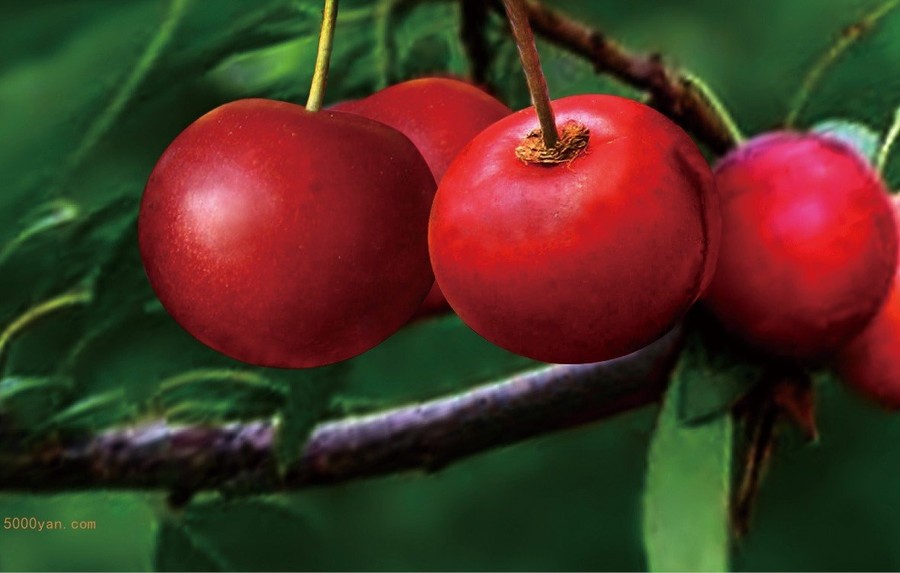
Deciduous shrub, 0.4-1.5 m tall. Branchlets gray-brown or brown, pubescent. Leaves alternate; petiole 2-4 mm long, glabrous or sparsely pubescent; stipules linear, 5-6 mm long, margins glandular; leaf blade obovate-oblong or obovate-lanceolate, 2.5-5 cm long, 1-2 cm wide, widest above the middle, apex acute or short acuminate, base cuneate, margins singly or doubly serrate, dark green above, pale green below, glabrous or sparsely pubescent. Flowers opening with leaves, solitary or 2-3 in clusters; pedicel 5-10 mm long, sparsely pubescent; calyx tube nearly as long as wide, sparsely pubescent externally, calyx lobes triangular-ovate, apex acute or obtuse; petals white or pink, oblong or obovate; stamens 30-35; style nearly as long as stamens, glabrous. Drupe subglobose at maturity, red or purplish-red, 1.5-1.8 cm in diameter; stone without ridges except on both sides of the dorsal surface. Flowering period April to May, fruiting period June to October.
Habitat and Distribution
Born at altitudes of 100-1800 m on sunny sandy slopes, mountain thickets, or cultivated in gardens. Distributed in Northeast China and Inner Mongolia, Hebei, Shandong, and Henan.
Harvesting and Processing
Harvest the ripe fruit in summer and autumn, remove the pulp and shell, extract the seeds, and dry.
Medicinal Properties
This product is ovoid, 5-8 mm long, and 3-5 mm in diameter. The surface is yellowish-white or light brown, with one end pointed and the other end bluntly rounded. On the pointed side, there is a linear hilum; at the center of the blunt end, there is a dark-colored chalaza, from which multiple longitudinal vascular bundle striations extend upward. The seed coat is thin, with 2 cotyledons, milky white, and rich in oil. Odor: faint; Taste: slightly bitter.
Chemical Constituents
This product primarily contains amygdalin, prunuside A, prunuside B, kaempferol glycoside, rosamultin A, rosamultin IR-A, rosamultin IR-B, and ursolic acid.
Pharmacology
Laxative; anti-inflammatory and analgesic.
Properties and Channel Entry
Acrid, bitter, and sweet, neutral. Enters the Spleen, Large Intestine, and Small Intestine channels.
Functions and Indications
Moistens the Intestines to promote bowel movements, descends Qi and facilitates water metabolism
Dosage and Administration
Internal use: decoction, 3-10 g; or made into pills or powder.
Precautions and Contraindications
Caution should be exercised in pregnant women.
Prescriptions
1. For edema with limb swelling, upper respiratory distress, and difficulty urinating and defecating: Yuliren (Semen Pruni), Xingren (Semen Armeniacae Amarum, parched, peel and tip removed), and Yiyiren (Semen Coicis) 30 g each. Grind into powder, form into pills with rice paste, each pill the size of a *Sophora japonica* seed. Take 40 pills at any time, with rice water. (From *Weisheng Yijian Fang*). 2. For sudden heart pain: 21 pieces of Yuliren, chew thoroughly, swallow with freshly drawn water, drinking warm soup is even better. Pain will stop shortly, then decoct a thin salt soup and drink it hot. (From *Yaohezhong Fang*). 3. For chronic upper respiratory condition with cough preventing sleep: Yuliren 30 g. Use 1 L of water, grind into an almond paste, remove residue. Boil until no pungent odor remains, then add a jujube-sized amount of butter, warm and take in a single dose. (From *Shengji Zonglu*, Yuliren Decoction). 4. For bloody sweat: Grind Yuliren into fine powder. Take 3 g per dose, mix with mashed pear juice and take. (From *Shengji Zonglu*, Rusheng San). 5. For red eyes: Yuliren, remove skin by blanching in hot water, grind extremely fine, add raw Borneol, and apply to the red eyes. (From *Bencao Yanyi*).