Pinyin: Zhishi
Aliases
Eyan Zhishi
Source
1. Rutaceae plant *Citrus aurantium* L.Citrus aurantiumL. and its cultivated varieties or sweet orange.Citrus sinensisDried immature fruit of Osbeck.
Botanical Description
1. Suan Cheng (Sour Orange): see entry under "Zhi Qiao" (Bitter Orange).
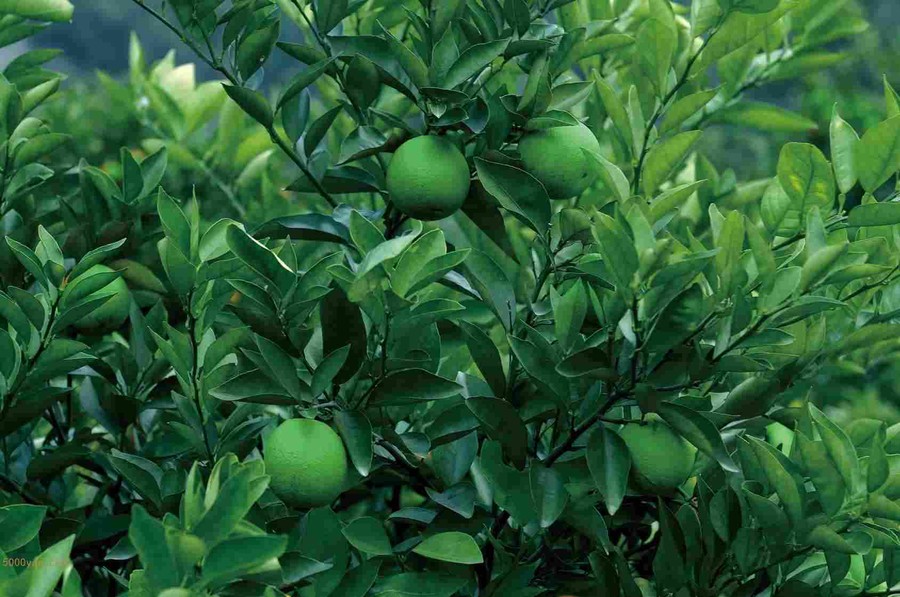
2. Sweet orange: Evergreen small tree, 3-8 m tall. Crown rounded, many branches, glabrous (hairless), with or without spines, branchlets angular. Leaves alternate, unifoliate compound; petiole 0.6-2 cm long, wing narrow, 2-3 mm wide, apex jointed; leaf blade relatively thick, elliptic or ovate, 6-12 cm long, 2.3-5.5 cm wide, apex shortly acute or acuminate, slightly concave, base broadly cuneate or rounded, wavy entire margin, or with indistinct wavy serrations, with translucent oil glands. Flowers 1 to several fascicled in leaf axils, white, pedicellate; calyx 3-5-lobed, lobes triangular; petals 5, ligulate, about 1.5 cm long, about 7 mm wide, reflexed outward; stamens 19-28, filaments connate into 5-12 bundles below; pistil 1, ovary subglobose, 10-13-locular, stigma capitate, style slender, persistent. Hesperidium oblate or subglobose, 6-9 cm in diameter, orange-yellow or orange-red, pericarp relatively thick, not easily peeled, segments 8-13, juice yellow, taste sweet. Seeds wedge-ovoid, surface smooth. Flowering in April, fruiting from November to December.
Habitat and Distribution
Acid orange is cultivated in the Yangtze River basin and its southern provinces and regions in China; sweet orange is cultivated in hilly areas, low mountain regions, and along the banks of rivers and lakes. It is produced in Jiangsu, Zhejiang, Jiangxi, Fujian, Taiwan, Hubei, Hunan, Guangdong, Guangxi, Sichuan, Guizhou, Yunnan, and other places.
Harvesting and Processing
Collect the naturally fallen fruits from May to June, remove impurities, cut transversely in half from the middle, and dry in the sun or at low temperature; smaller fruits may be dried directly in the sun or at low temperature.
Medicinal Properties
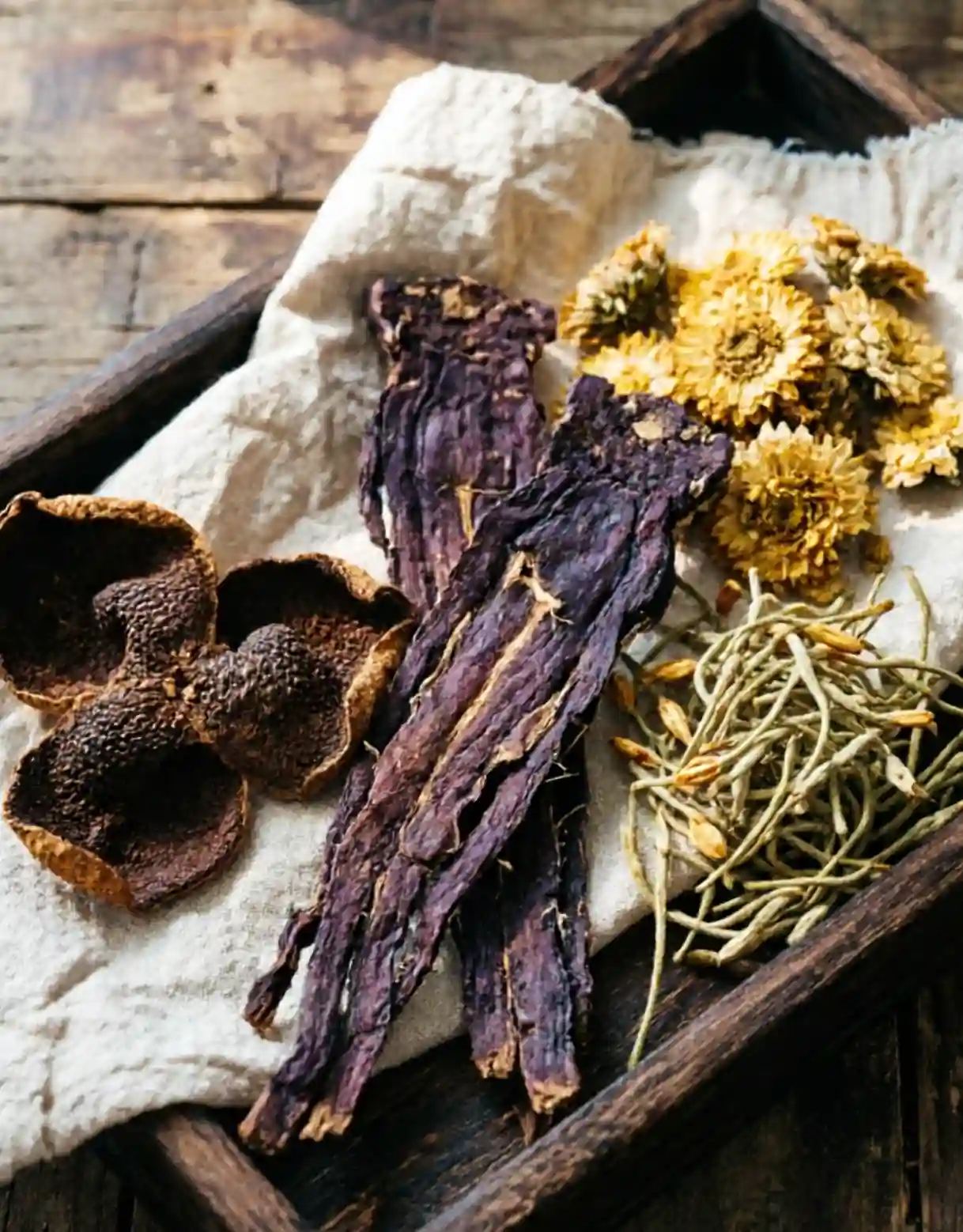
This product is hemispherical, a few are spherical, with a diameter of 0.5-2.5 cm. The exocarp is black-green or dark brownish-green, with granular protrusions and wrinkles, and has obvious style remnants or fruit stalk scars. On the cut surface, the mesocarp is slightly raised, 0.3-1.2 cm thick, yellow-white or yellow-brown, with 1-2 rows of oil chambers at the edge, and the locule is brownish-brown. The texture is hard. Odor: fragrant; Taste: bitter, slightly sour.
Chemical Constituents
This product contains poncimarin, hesperidin, and 3-nobiletin.O-β- glucoside, coniferin, naringenin-7-rutinoside, tangeretin, sinensetin, neohesperidin, imperatorin, angelicol, linoleic acid, and other constituents.
Pharmacology
Has inhibitory and excitatory dual effects on gastrointestinal motility and uterine smooth muscle; has cardiotonic effects, increases cardiac output, and constricts blood vessels; anti-inflammatory; antibacterial and antiviral; anti-allergic; antioxidant; analgesic; central nervous system depressant; antipyretic; treats hemorrhagic purpura caused by increased capillary fragility.
Properties and Channel Entry
Bitter, acrid, and sour, slightly cold. Enters the Spleen and Stomach channels.
Functions and Indications
Breaks Qi and disperses accumulation, transforms Phlegm and dissipates masses
Dosage and Administration
Oral: decoct in water, 3-10 g; or made into pills or powder. External use: appropriate amount, ground into powder for topical application; or stir-fried while hot for hot compress.
Precautions and Contraindications
Use with caution in cases of Spleen and Stomach deficiency and during pregnancy.
Prescriptions
1. For rubella (urticaria): *Zhishi* (immature bitter orange), macerate in vinegar until moist, roast over fire until hot, apply at a comfortable temperature to the affected area until it subsides. (From *Ishinpo*, citing *Yannian Fang*). 2. For infantile scalp sores: *Zhishi* (immature bitter orange), burn to ash, mix with lard and apply topically. (From *Shenghui Fang*). 3. For sudden onset of chest impediment pain (chest bi): *Zhishi* (immature bitter orange), grind into powder, take one *fangcunbi* (approximately 1-2 g) orally, three times during the day and once at night. (From *Zhouhou Fang*). 4. For pain in both hypochondriac regions: *Zhishi* (immature bitter orange) 30 g, *Baishao* (white peony, stir-fried), *Chuanxiong* (Sichuan lovage rhizome), and *Renshen* (ginseng) 15 g each. Grind into powder, take 6 g on an empty stomach, adjusted with ginger and jujube decoction or wine. (From *Weisheng Yijian Fang*). 5. For constipation: *Zhishi* (immature bitter orange) and *Zaojia* (Chinese honey locust fruit) in equal parts, grind into powder, form into pills with rice paste, and take with rice water. (From *Shiyi Dexiao Fang*).