Pinyin: Shuihonghuazi
Aliases
Hongcaoshi, Heliaozi, Shuihongzi, Shuixiehua.
Source
1. For pneumonia: Renshen 6 g, decoct in water and take orally. Internal use: decoct 3-10 g, large dose 10-30 g.Polygonum orientaleL. dried ripe fruit.
Botanical Description
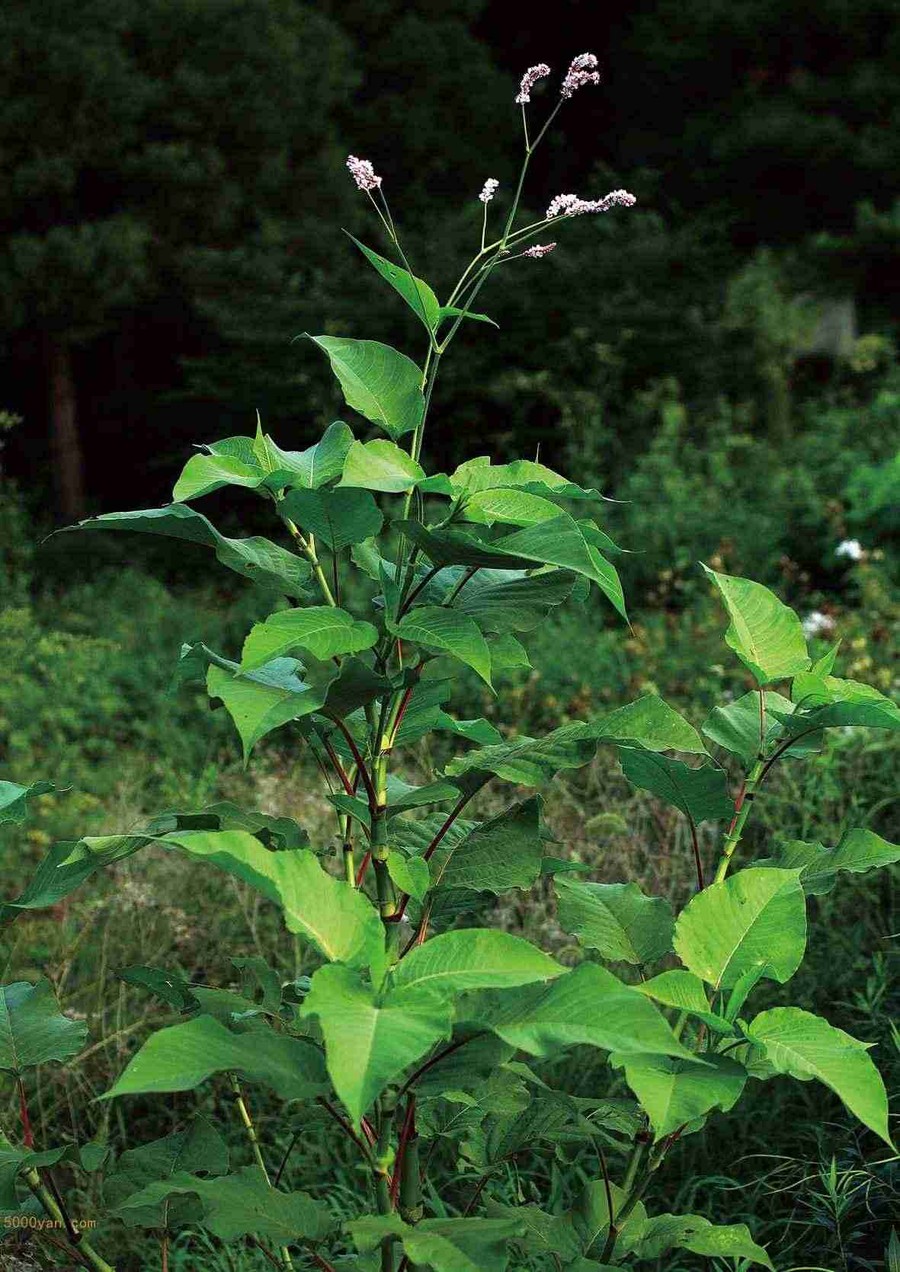
Annual herb, 1-3 m tall. Stem erect, hollow, much branched, densely covered with long hairs. Leaves alternate, petiole 3-8 cm long; stipular sheath tubular, lower part membranous, brown, upper part herbaceous, covered with long hairs, often spreading into a ring-like wing; leaf blade ovate or broadly ovate, 10-20 cm long, 6-12 cm wide, apex acuminate, base nearly rounded, entire margin, both surfaces sparsely pubescent. Raceme composed of many small spikelets, terminal or axillary; bracts broadly ovate; flowers pale red or white; perianth deeply 5-lobed, lobes elliptic; stamens usually 7, longer than perianth; ovary superior, styles 2. Achene nearly orbicular, flattened, black, glossy. Flowering July to August, fruiting August to October.
Habitat and Distribution
It grows in roadside and waterside wetlands. It is distributed throughout the country except in the Tibet Autonomous Region.
Harvesting and Processing
Harvest the fruit spikes when the fruit ripens in autumn, dry them in the sun, thresh the fruits, and remove impurities.
Medicinal Properties
This product is oblate in shape, with a diameter of 2-3.5 mm and a thickness of 1-1.5 mm. The surface is brownish-black, sometimes reddish-brown, glossy, slightly concave on both sides, with a slight longitudinal ridge in the center. The apex has a protruding style base, the base has a light brown, slightly protruding fruit stalk scar, and some have membranous perianth remnants. It is hard in texture. Odor: faint; Taste: bland.
Chemical Constituents
Mainly contains taxifolin and quercetin.
Pharmacology
Has diuretic, antibacterial, and anti-tumor effects.
Properties and Channel Entry
Salty, slightly cold. Enters the Liver and Stomach channels.
Functions and Indications
Dissipates Blood and reduces masses, eliminates accumulation and alleviates pain, promotes urination and reduces edema. Used for abdominal masses and lumps, goiter and tumors, food accumulation with indigestion, epigastric distension and pain, edema and ascites.
Dosage and Administration
Oral: decoct in water, 3-10 g; or grind into powder, simmer into paste, or steep in wine. External use: appropriate amount, simmer into paste; or mash and apply topically.
Precautions and Contraindications
For those with no blood stasis in the blood aspect or with Spleen and Stomach deficiency-cold, use with caution.
Prescriptions
1. For abdominal masses: One bowl of *Polygonum orientale* flowers or seeds, decoct with three bowls of water over low heat until a paste forms. Apply the paste onto a cloth in an amount appropriate to the size of the mass, and adhere externally. Also, take the paste mixed with wine orally. Avoid greasy, meaty, and strong-flavored foods. (From *Baoshoutang Jingyan Fang*) 2. For stomach pain: 9-15 g of *Polygonum orientale* seeds or whole plant, decoct in water for oral administration. (From *Zhejiang Zhiwu Yaozhi*) 3. For splenomegaly and abdominal distension: 1000 g of *Polygonum orientale* seeds, decoct in water to form a paste. Take 1 tablespoon twice daily, with yellow rice wine or boiled water. Also, spread the paste onto cloth and apply externally to the affected area, changing the dressing once daily. (From *Xinjiang Zhongcaoyao Shouce*) 4. For chronic hepatitis and cirrhotic ascites: 15 g of *Polygonum orientale* seeds, 12 g of *Areca* peel, and 9 g of *Pharbitis* seeds (black), decoct in water for oral administration. (From *Xinjiang Zhongcaoyao Shouce*) 5. For conjunctivitis: 9 g of *Polygonum orientale* seeds, 9 g of *Scutellaria* root, 12 g of *Chrysanthemum* flower, and 6 g of *Gentiana* root, decoct in water for oral administration. (From *Qingdao Zhongcaoyao Shouce*)