Pinyin: Xiguapi
Aliases
Xiguaqing, Xiguacuiyi, Xiguacui.
Source
1. For pneumonia: Renshen 6 g, decoct in water and take orally.Citrullus lanatus(Thunb.) Matsum. et Nakai's outer dried pericarp.
Botanical Description
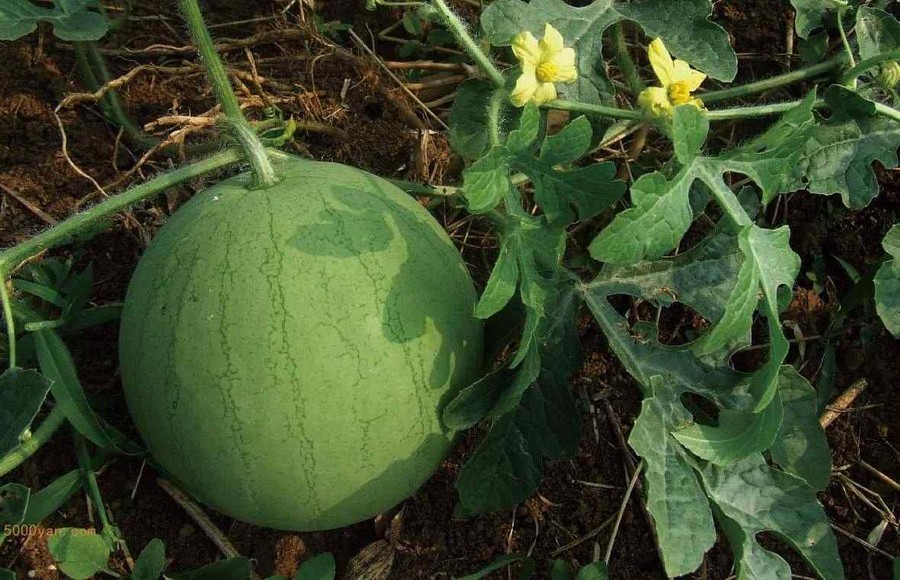
Annual trailing herb. Stem slender, prostrate, with distinct ridges and furrows. Tendrils 2-branched, hairy. Leaves alternate; petiole 3-12 cm long; leaf blade triangular-ovate, broadly ovate, 8-20 cm long, 5-18 cm wide, 3-parted or nearly 3-palmatisect, middle lobe longer, lateral lobes shorter, lobes further irregularly pinnately parted or bipinnately divided, both surfaces pale green, margin undulate or sparsely toothed. Monoecious, male and female flowers solitary in leaf axils; male flowers 2-2.5 cm in diameter, pedicel slender, villous; calyx campanulate, villous, 5-lobed, lobes narrow-lanceolate or linear-lanceolate; corolla funnelform, outer surface green, villous, 5-lobed to middle, lobes ovate-elliptic or broadly elliptic, apex obtuse. Female flowers larger than male ones, calyx similar to that of male flowers. Pepo subglobose or oblong, about 30 cm in diameter, surface green, light green, often with alternating dark and light stripes. Seeds numerous, compressed, slightly ovate, black, red, white, or yellow, or mottled, both surfaces smooth, base obtuse-rounded, margin often slightly arched. Flowering and fruiting in summer.
Habitat and Distribution
Cultivated throughout various regions in China.
Harvesting and Processing
In summer, collect watermelon rind, scrape off the inner soft part, wash clean, and sun-dry. Alternatively, the outer green skin may be scraped off, retaining only the middle layer.
Medicinal Properties
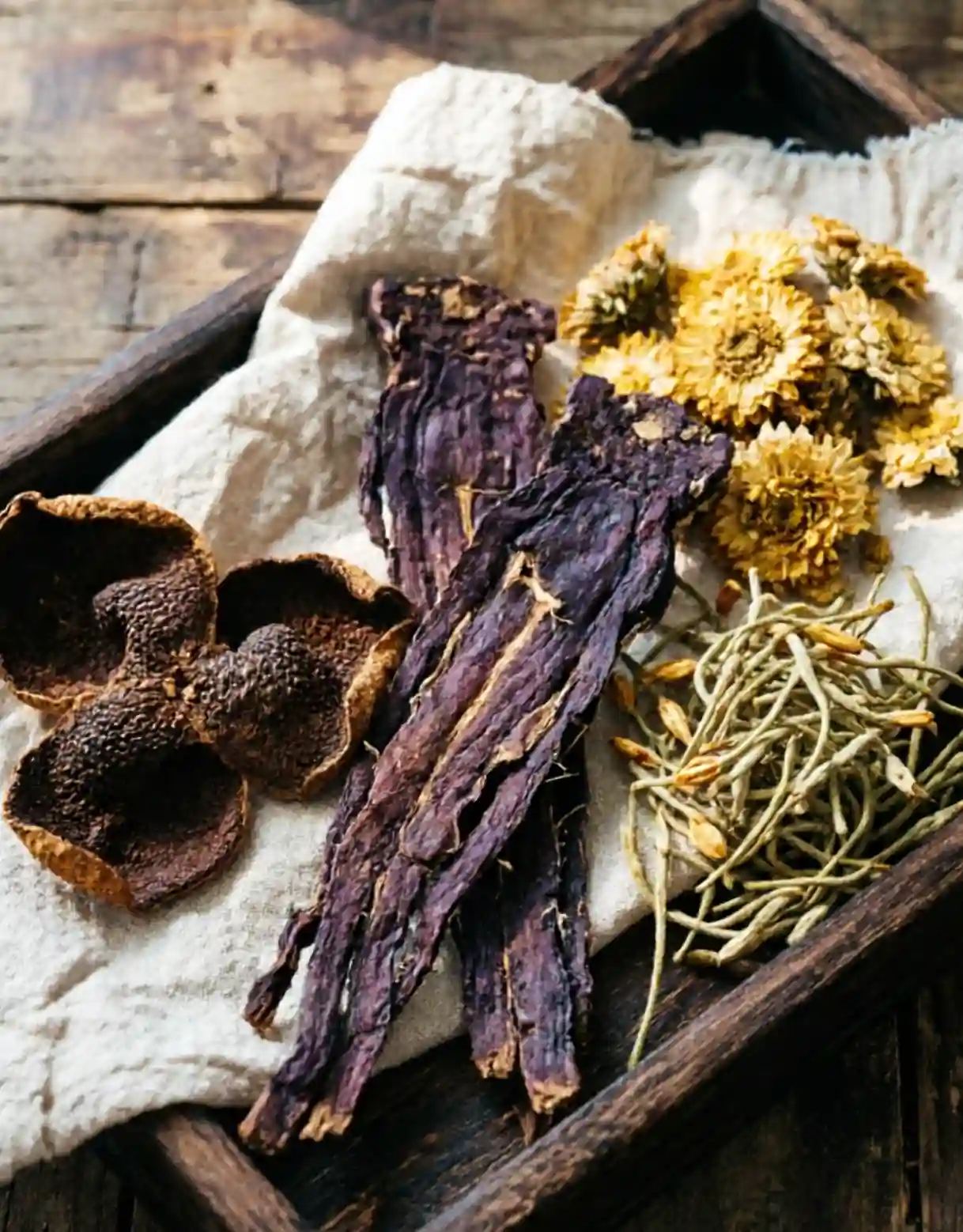
The outer pericarp is often rolled into tubular, spindle-shaped, or irregular pieces of varying sizes, 0.5-1 cm thick. The outer surface is dark green, yellow-green, or pale yellow-white, smooth or with wrinkles of varying depth; the inner surface is slightly paler, yellow-white to yellow-brown, with reticulated veins (vascular bundles), and often retains the fruit stalk. The texture is fragile and easily broken, odorless, and the taste is bland.
Chemical Constituents
This product contains aspartic acid, threonine, fructose, glucose, sucrose, lycopene, and vitamin C.
Properties and Channel Entry
Sweet, cool. Enters the Heart, Stomach, and Bladder channels.
Functions and Indications
Clears Heat, relieves thirst, and promotes diuresis. Mainly indicated for summer-heat vexation and thirst, scanty urine, edema, and mouth and tongue sores.
Dosage and Administration
Internal: decoct in water, 9-30 g; or dry-roast and grind into powder. External: appropriate amount, burn to preserve the property and grind into powder for application.
Precautions and Contraindications
Forbidden for those with Middle Cold and Dampness Excess.
Prescriptions
1. For rectal prolapse: watermelon peel 50 g, rock candy in appropriate amount. Decoct in water for oral administration. (Fujian Materia Medica) 2. For infantile summer fever: watermelon peel 15 g, honeysuckle flower 15 g, Pseudostellaria root 9 g, cow cockle flower 6 g, peppermint (added later) 6 g, fresh lotus leaf half a piece. Decoct and take. (Anhui Chinese Herbal Medicine) 3. For hypertension: watermelon peel 10-12 g, cassia seed 10 g. Decoct and use as tea. (Food Chinese Medicine and Folk Prescriptions) 4. For diabetes, thirst, turbid urine: watermelon peel 15 g, winter melon peel 15 g, Trichosanthes root 12 g. Decoct in water for oral administration. (Food Chinese Medicine and Folk Prescriptions)