Pinyin: Foshou
Aliases
Foshougan, Miluogan, Wuzhigan, Fushougan
Source
1. For pneumonia: Renshen 6 g, decoct in water and take orally.Citrus medicaL.var.sarcodactylisDried fruit of Swingle.
Botanical Description
Evergreen small tree or shrub. Older branches gray-green, young branches slightly purplish-red, with short, hard spines. Leaves alternate, single; petiole short, 3-6 mm long, wingless, jointless; leaf blade leathery, oblong-elliptic or obovate-oblong, 5-16 cm long, 2.5-7 cm wide, apex obtuse, sometimes slightly emarginate, base nearly rounded or cuneate, margin with shallowly undulate blunt serrations. Flowers solitary, clustered, or in racemes; calyx cup-shaped, 5-lobed, lobes triangular; petals 5, white inside, purple outside; stamens numerous; ovary ellipsoid, upper part narrow and pointed. Hesperidium fruit ovoid or oblong, apex split like a fist or spreading like fingers, the number of splits representing the number of carpels, surface orange-yellow, rough, flesh pale yellow. Seeds several, ovoid, apex pointed, sometimes incompletely developed. Flowering period April to May, fruiting period October to December.
Habitat and Distribution
It grows in tropical and subtropical regions. It is cultivated in Zhejiang, Jiangxi, Fujian, Guangdong, Guangxi, Sichuan, Yunnan, and other regions of China.
Harvesting and Processing
Harvest in autumn when the fruit has not yet turned yellow or has just turned yellow, cut longitudinally into thin slices, and dry in the sun or at low temperature.
Medicinal Properties
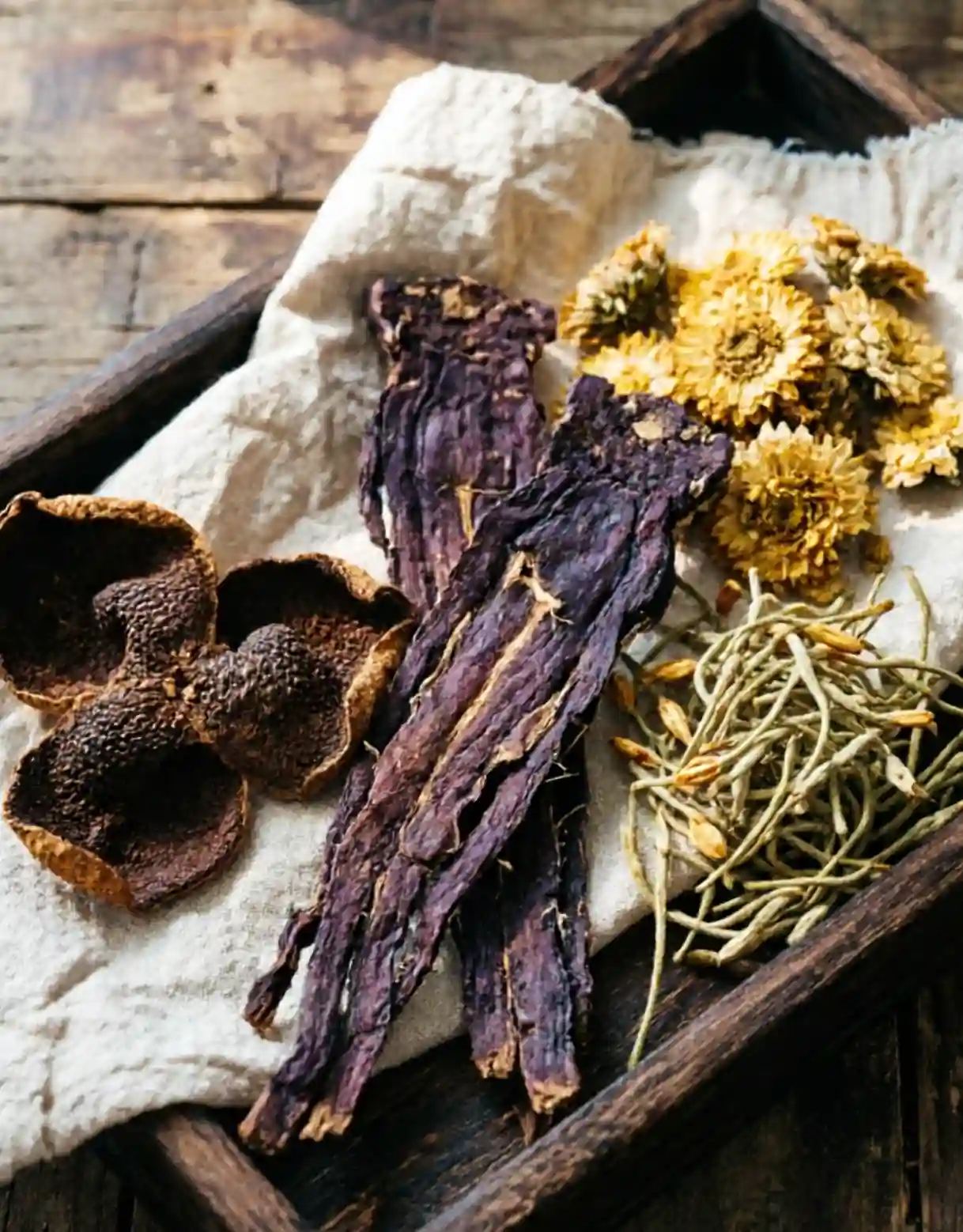
This product consists of thin, oblong-elliptical or ovate slices, often shrunken or curled, measuring 6-10 cm in length, 3-7 cm in width, and 0.2-0.4 cm in thickness. The apex is slightly broader, often with 3-5 finger-like lobes, while the base is slightly narrower, sometimes with visible fruit stalk scars. The outer peel is yellow-green or orange-yellow, with wrinkles and oil spots. The flesh is pale yellow-white, scattered with uneven, linear or punctate vascular bundles. The texture is hard and brittle, becoming pliable when damp. Odor: aromatic; Taste: slightly sweet followed by bitter.
Chemical Constituents
This product contains hesperidin, citropten, 6,7-dimethoxycoumarin, diosmetin, diosmin, byakangelicin, 5-methoxyfurfural, and other components.
Pharmacology
Antiasthmatic; antispasmodic; central nervous system depressant; increases coronary blood flow and enhances hypoxia tolerance, strengthens capillary resistance and reduces adrenal ascorbic acid depletion; anti-inflammatory.
Properties and Channel Entry
Acrid, bitter, and sour, warm. Enters the Liver, Spleen, Stomach, and Lung channels.
Functions and Indications
Soothes the Liver and regulates Qi, harmonizes the Stomach and alleviates pain, dries Dampness and transforms Phlegm. Used for Liver-Stomach Qi stagnation, distending pain in the chest and hypochondrium, epigastric fullness, poor appetite with vomiting, and cough with copious sputum.
Dosage and Administration
Oral: decoct in water, 3-10 g; or steep as tea.
Precautions and Contraindications
Yin deficiency with fire, no Qi stagnation, use with caution.
Prescriptions
1. For facial cold pain and stomach Qi pain: Foshou (Bergamot), roasted on a new tile until yellow, ground into powder. Take 9 g with Shaoxing wine. (From "Diannan Bencao") 2. For poor appetite: Foshou (Bergamot), Zhiqiao (Bitter Orange), and Shengjiang (Fresh Ginger) 3 g each, Huanglian (Coptis) 1 g. Decoct in water and take 1 dose daily. (From "National Chinese Herbal Medicine Compilation") 3. For Liver-Stomach Qi pain: Fresh Foshou (Bergamot) 12-15 g, steep in boiling water and drink as tea. Or Foshou (Bergamot) and Yanhusuo (Corydalis) 6 g each, decoct in water. (From "National Chinese Herbal Medicine Compilation") 4. For tympanites and swelling: Foshou (Bergamot) 120 g, Renzhongbai (Sediment of Human Urine) 90 g. Grind together into powder. Take with plain water on an empty stomach. (From "Lingnan Caiyao Lu") 5. For Damp-Phlegm cough: Foshou (Bergamot) 6 g, Jiang Banxia (Ginger-treated Pinellia) 6 g, sugar in equal amounts. Decoct in water. (From "National Chinese Herbal Medicine Compilation")

