Pinyin: Yunweizi
Aliases
Yimuzi, Chongyuzi, Yimucaozi, Xiaohuma.
Source
Plant of the Lamiaceae family, *Leonurus japonicus* (Yi Mu Cao).Leonurus japonicusDried ripe fruit of Houtt.
Botanical Description
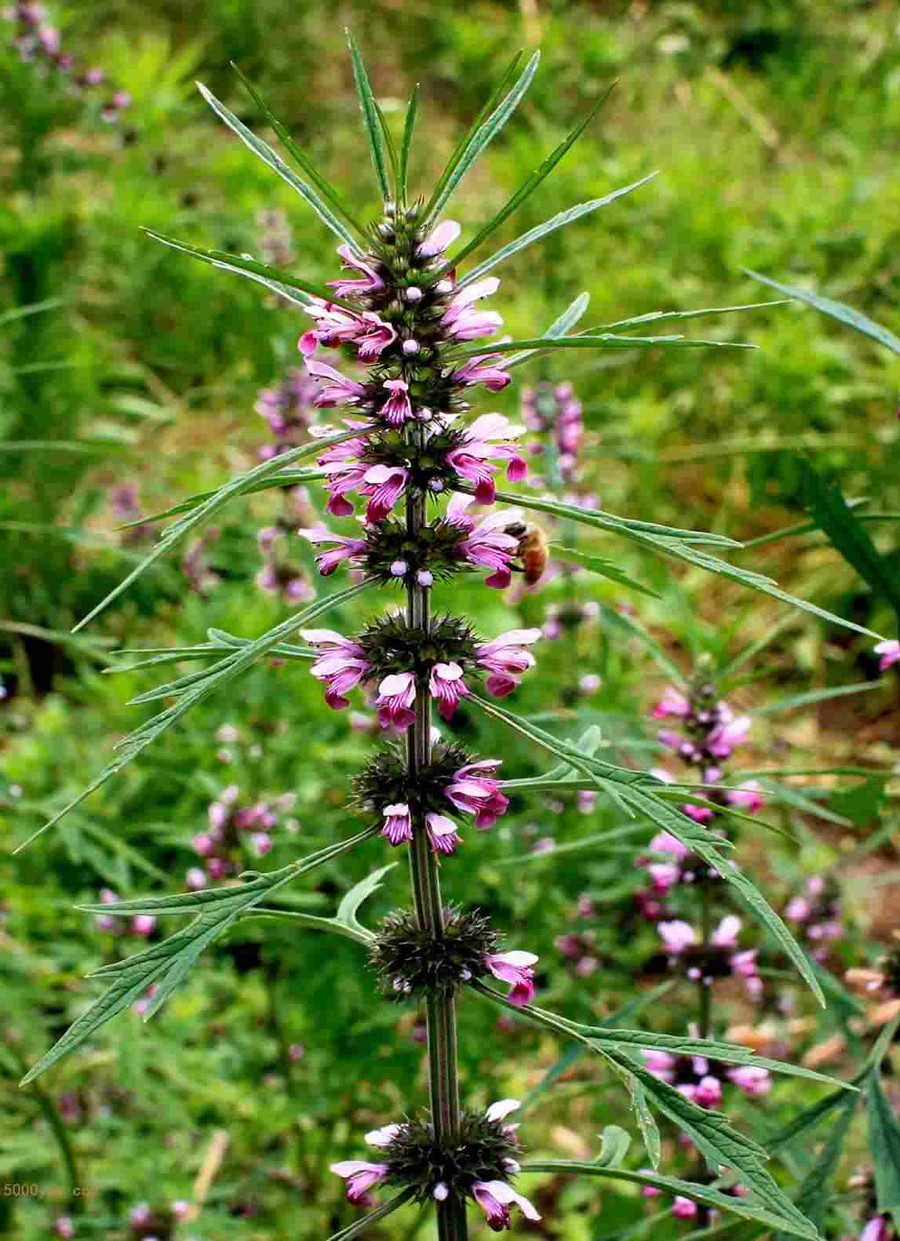
Annual or biennial herb, 60-100 cm tall. Stem erect, quadrangular, sparsely pubescent. Leaves opposite, variable in shape; petiole 0.5-8 cm long. Basal leaves of annual plants with long petioles, leaf blade suborbicular, 4-8 cm in diameter, palmately 5-9-lobed, lobes with 2-3 obtuse teeth, base cordate; middle stem leaves with short petioles, 3-parted, segments sublanceolate, the central segment often 3-lobed, lateral segments 1-2-lobed, ultimate lobules usually more than 3 mm wide, apex acuminate, margin sparsely serrate or subentire; uppermost leaves undivided, linear, subsessile. Upper surface green, strigose; lower surface pale green, sparsely pilose and glandular. Verticillasters axillary, 8-15-flowered; bracteoles spinose, sessile; calyx campanulate, externally minutely pubescent, apex 5-toothed, teeth spinose, the lower 2 teeth longer than the upper 3, persistent; corolla bilabiate, pale red or purplish red, 9-12 mm long, externally pubescent, upper lip and lower lip subequal in length, upper lip oblong, entire, margin ciliate, lower lip 3-lobed, middle lobe larger, obcordate. Nutlets brown, trigonous, apex broader and truncate, base cuneate, 2-2.5 mm long, about 1.5 mm in diameter. Flowering June to September, fruiting July to October.
Habitat and Distribution
This is a description of the plant's habitat and distribution, not a prescription or formula
Harvesting and Processing
In summer and autumn, when the entire plant has finished flowering and the fruits are ripe, harvest the whole plant, dry it in the sun, thresh the fruits, and remove leaves and impurities.
Medicinal Properties
Small nutlets oblong, triangular in cross-section, 2-3 mm long, 1-1.5 mm in diameter, truncate at the apex, tapering toward the base with a concave fruit stalk scar. Surface grayish-brown or brown, with sparse dark spots. Transverse section shows brown pericarp, white endosperm and cotyledons rich in oil. Odor: faint; Taste: bitter.
Chemical Constituents
This product contains leonurinine, stachydrine, linolenic acid, oleic acid, and other constituents.
Pharmacology
Lowers blood pressure.
Properties and Channel Entry
Sweet, pungent, slightly cold; mildly toxic. Enters the Pericardium and Liver channels.
Functions and Indications
Activates Blood and regulates menstruation, clears the Liver and brightens the eyes
Dosage and Administration
Oral: decoct in water, 6-9 g; or taken in pill or powder form; or crushed to extract juice.
Precautions and Contraindications
Contraindicated in cases of dilated pupils and during pregnancy.
Prescriptions
1. For uterine prolapse: Chongweizi (Motherwort fruit) 15 g, Zhiqiao (Bitter orange) 12 g. Decoct in water and take orally. (Hunan Materia Medica) 2. For dizziness and red, swollen, painful eyes: Chongweizi 10 g, Juhua (Chrysanthemum) 10 g, Baijili (Puncturevine caltrop) 10 g, Chuanniuxi (Cyathula root) 10 g. Decoct in water and take orally. (Sichuan Traditional Chinese Medicine Journal, 1979) 3. For hypertension: Chongweizi 9 g, Huangqin (Baikal skullcap root) 9 g, Xiakucao (Common selfheal fruit spike) 15 g, Sheng Duzhong (Eucommia bark) 15 g, Sangjisheng (Mulberry mistletoe) 15 g. Decoct in water and take orally. (Qingdao Chinese Herbal Medicine Handbook) 4. For painful breast abscess (mastitis): Crush Chongweizi and apply topically, and also take the expressed juice orally. (Puji Fang)