Pinyin: Xiaohuixiang
Aliases
Huixiangzi, Tuhuixiang, Yehuixiang, Xiaoxiang.
Source
Apiaceae plant *Foeniculum vulgare* Mill.Foeniculum vulgareDried ripe fruit of Mill.
Botanical Description
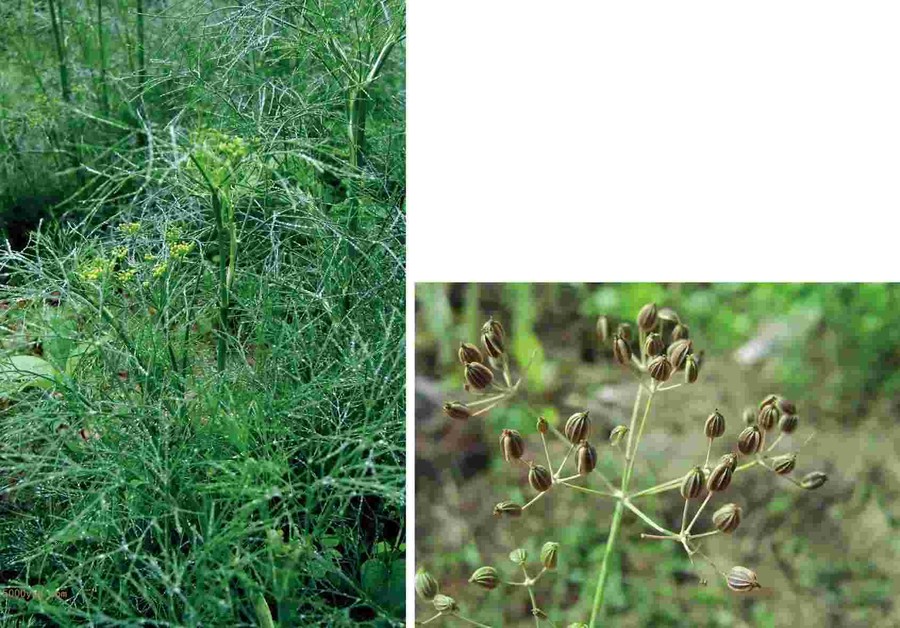
Perennial herb, 0.4-2 m tall, with a strong aromatic odor. Stem erect, glabrous (hairless), gray-green or pale green, upper branches spreading, surface with fine longitudinal grooves. Cauline leaves alternate; lower cauline leaves with petioles 5-15 cm long, middle or upper leaves with petioles partially or entirely sheathing, leaf sheath margins membranous; leaf blade broadly triangular in outline, about 30 cm long, about 40 cm wide, 4-5 times pinnatisect; ultimate segments filiform, 0.5-5 cm long, 0.5-1 cm wide. Compound umbels terminal or lateral, 3-15 cm in diameter, peduncles up to 25 cm long; involucre and involucel absent; rays 6-30, 1.5-10 cm long, umbellules with 14-30 flowers, pedicels slender, unequal in length, 0.3-1.2 cm long; flowers small, without calyx teeth; petals obovate or nearly obovate, pale yellow, about 1.5 mm long, about 1 mm wide, incurved above the middle, apex slightly emarginate; stamens 5. Mericarps oblong. Flowering period May-June, fruiting period July-September.
Harvesting and Processing
Harvest the plants in autumn when the fruits first ripen, dry them in the sun, thresh the fruits, and remove impurities.
Habitat and Distribution
Originally from the Mediterranean region. It is cultivated throughout various regions in China.
Medicinal Properties
This product is a cremocarp, cylindrical in shape, some slightly curved, 4-8 mm long, 1.5-2.5 mm in diameter. The surface is yellow-green or pale yellow, both ends slightly pointed, with a yellowish-brown protruding stylopod remnant at the apex, and sometimes a small fruit stalk at the base. The mericarp is oblong-elliptic, with 5 longitudinal ribs on the dorsal surface, and the commissural surface is flat and relatively broad. The transverse section is roughly pentagonal, with the four dorsal sides approximately equal in length. It has a distinctive aromatic odor, and the taste is slightly sweet and pungent.
Chemical Constituents
This product contains trans-anethole, limonene,α-Contains components such as amyrin, camphor, anisaldehyde, fenchone, palmitic acid, bergapten, and umbelliferone.
Pharmacology
Promotes gastrointestinal motility; anti-ulcer; cholagogic; relaxes tracheal smooth muscle; has sex hormone-like effects; central paralysis; antibacterial; antitumor.
Properties and Channel Entry
Acrid, warm. Enters the Liver, Kidney, Spleen, and Stomach channels.
Functions and Indications
Disperses Cold, alleviates pain, regulates Qi, and harmonizes the Stomach. Used for Cold hernia with abdominal pain, unilateral testicular swelling, dysmenorrhea, cold pain in the lower abdomen, epigastric and abdominal distension and pain, poor appetite, vomiting, and diarrhea. Salt-processed Xiaohuixiang (Foeniculi Fructus) warms the Kidneys, disperses Cold, and alleviates pain, used for Cold hernia with abdominal pain, unilateral testicular swelling, and Cold-induced abdominal pain during menstruation.
Dosage and Administration
Oral: decoct in water, 3-6 g; or made into pills or powder. External use: appropriate amount, grind into powder and mix for topical application; or stir-fry while hot for warm compress.
Precautions and Contraindications
Contraindicated in patients with Yin deficiency and Fire hyperactivity.
Prescriptions
1. For cold hernia pain: Chuanlianzi 12 g, Muxiang 9 g, Xiaohuixiang 6 g, Wuzhuyu (soaked in hot water) 3 g. Decoct in water and take orally. (Dao Qi Tang from *Yifang Jijie*) 2. For scrotal swelling: Xiaohuixiang (stir-fried), Quanxie (stir-fried), Chuanshanjia (roasted), Muxiang, equal parts, grind into powder. Take 6 g each dose, mixed with wine. (Si Sheng San from *Yitong*) 3. For stomach pain and abdominal pain: Xiaohuixiangzi, Liangjiang, Wuyaogen each 6 g, stir-fried Xiangfu 9 g. Decoct in water and take orally. (From *Jiangxi Herbal Medicine*) 4. For hypochondriac pain: Xiaohuixiang (stir-fried) 30 g, Zhiqiao (stir-fried with bran) 15 g. Grind into powder. Take 9 g each dose, mixed with salted water. (From *Xiuzhen Fang*) 5. For low back pain: Chuanxiong (stir-fried with salt) 45 g, Xiaohuixiang (stir-fried) 90 g, Cangzhu (stir-fried with scallion white) 60 g. Make pills with wine-cooked paste. Take with salt or wine. (San Xian Dan from *Shenzhai Yishu*)