Pinyin: Nanguazi
Aliases
Nanguaren, Baiguazi, Jinguami, Woguazi
Source
Cucurbitaceae plant pumpkinCucurbita moschataDried seed of (Duch. ex Lam.) Duch. ex Poir.
Botanical Description
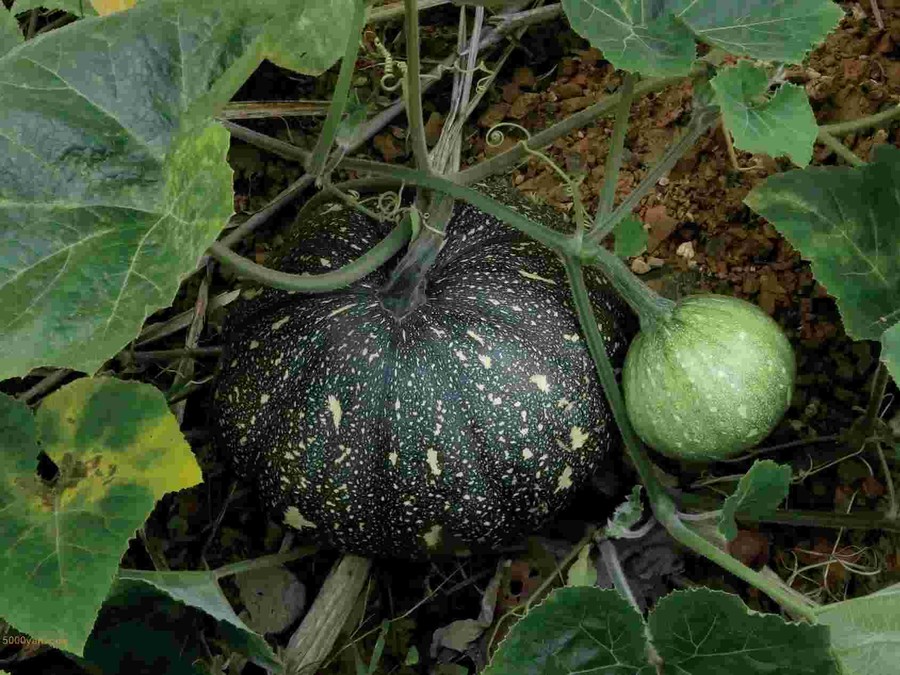
An annual climbing herbaceous plant, with stems reaching 2-5 m in length. Roots often form at the nodes. Densely covered with white bristles. Leaves are simple and alternate; petioles are stout, 8-19 cm long, covered with bristles; leaf blades are broadly ovate or ovate-orbicular, with 5 angles or 5 shallow lobes, 12-25 cm long, 20-30 cm wide, apex acute, base deeply cordate, upper surface green, lower surface pale green, both surfaces covered with bristles and trichomes, margins with small and dense fine teeth. Tendrils are slightly stout, hairy, 3-5 branched. Flowers are unisexual, monoecious; male flowers solitary, calyx tube campanulate, 5-6 mm long, lobes linear, 10-15 mm long, pubescent, upper part expanded and leaf-like, corolla yellow, campanulate, about 8 cm long, 5-lobed to the middle, lobe margins revolute, stamens 3, filaments glandular, 5-8 mm long, anther thecae curved; female flowers solitary, ovary 1-locular, style short, stigma 3, swollen, apex 2-lobed. Fruit pedicel stout, with ridges and grooves, 5-7 cm long, the base of the fruit expanded into a trumpet shape. The pepo (berry-like fruit) is variable in shape, often with longitudinal furrows on the outside. Seeds numerous, long-ovoid or oblong, grayish-white. Flowering period is June to July, fruiting period is August to September.
Habitat and Distribution
Cultivated throughout various regions across the country.
Harvesting and Processing
During summer and autumn when consuming pumpkin, collect the mature seeds, remove the pulp and membrane, wash clean, and sun-dry.
Medicinal Properties
Seeds oblate-round, 1.2-1.8 cm long, 0.7-1 cm wide. Surface pale yellow-white to pale yellow, both sides flat and slightly raised, edges slightly angular, one end slightly pointed, apex with a micropyle, hilum slightly raised or not obvious. After removing the seed coat, there is a yellow-green membranous endosperm. Cotyledons 2, yellow, thick, oily. Odor: faintly aromatic; Taste: slightly sweet.
Chemical Constituents
This product mainly contains linoleic acid, oleic acid, palmitic acid, stearic acid, triacylglycerol, phosphatidylethanolamine, cucurbitine, and other components.
Pharmacology
Has anthelmintic (deworming), anti-schistosomal, pressor (blood pressure elevating), respiratory center stimulating, and ileal smooth muscle contraction inhibiting effects.
Properties and Channel Entry
Sweet, neutral, enters the Large Intestine channel.
Functions and Indications
Insecticidal, promotes lactation, and induces diuresis to reduce edema
Dosage and Administration
Oral administration: decoction, 30-60 g; ground into powder or made into an emulsion. External use: appropriate amount, decoct in water for fumigation and washing.
Prescriptions
1. For pediatric ascariasis: Nanguazi (pumpkin seeds) 30 g, Jiucaive (leek leaves) 30 g, Shuizhuli (water bamboo sap) 60 g. Take with boiling water. (From "Hunan Materia Medica") 2. For postpartum insufficient lactation: Nanguazi (pumpkin seeds) 60 g. Grind into powder, add appropriate amount of brown sugar, and take with boiling water. (From "Qingdao Chinese Herbal Medicine Manual") 3. For postpartum edema of hands and feet, diabetes: Nanguazi (pumpkin seeds) 30 g. Stir-fry until cooked, decoct in water and take orally. (From "Food Medicine and Convenient Prescriptions") 4. For internal hemorrhoids: Nanguazi (pumpkin seeds) 1000 g. Decoct in water and use the steam to fumigate the affected area. 2 times daily, continue for several days. (From "Lingnan Herbal Medicine Journal")