Pinyin: Pangdahai
Aliases
Annānzǐ, Dàdòngguǒ, Húdàhǎi, Tōngdàhǎi.
Source
Internal use: decoct 3-10 g, large dose 10-30 g.Sterculia lychnophoraDried mature seeds of Hance.
Botanical Description
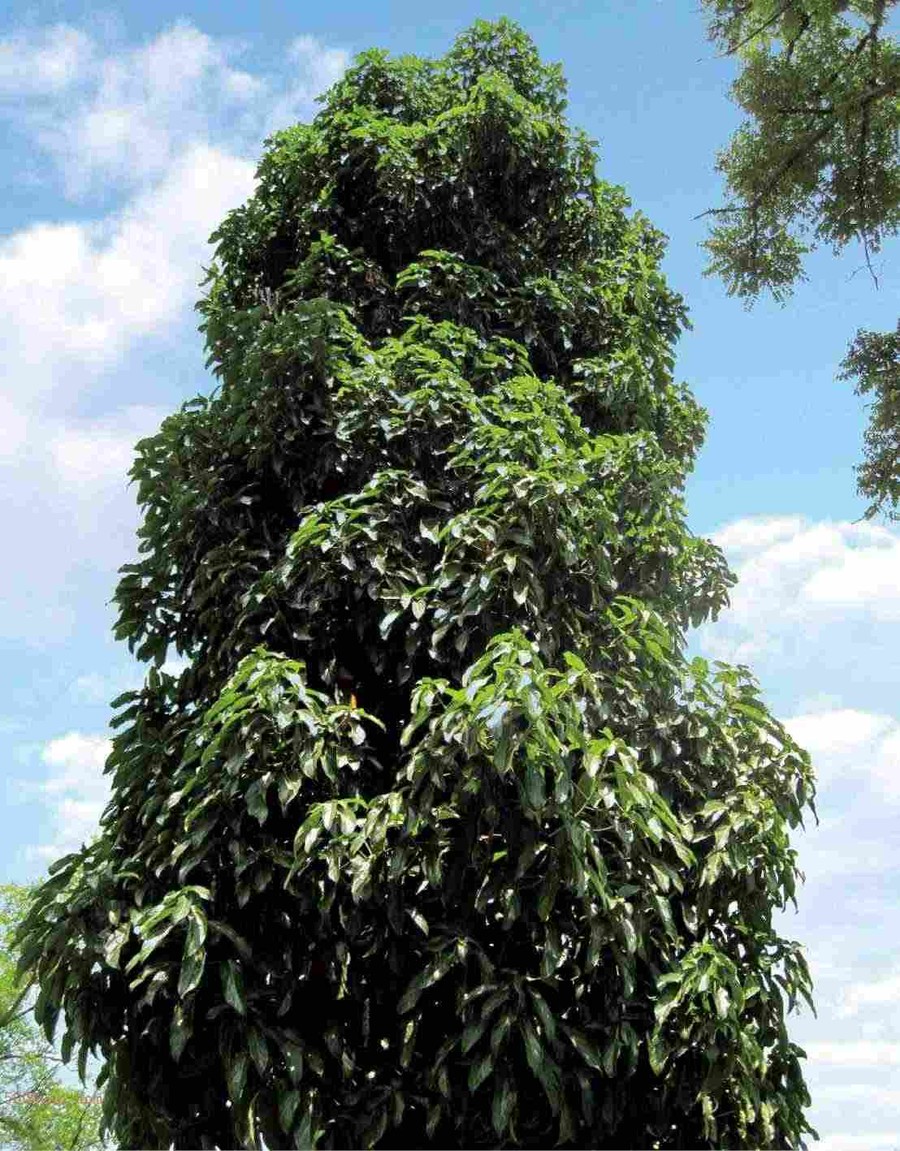
Deciduous tree, up to 40 m tall. Bark rough with fine striations. Leaves alternate; petiole 5-15 cm long, blade leathery, long-ovate or somewhat triangular, 10-20 cm long, 6-12 cm wide, apex obtuse or acute, base rounded or nearly cordate, margin entire or with 3 sinuses, glabrous, with prominent reticulate veins on the lower surface. Panicles terminal or axillary, flowers polygamous; calyx campanulate, 7-10 mm long, deeply lobed, lobes lanceolate, persistent, outer surface stellate-pubescent; male flowers with 10-15 stamens, filaments and anthers sparsely pubescent, sterile carpels pubescent; female flowers with a single pistil composed of 5 pubescent carpels, with a slender, delicate ovary stalk, stigma 2-5-lobed, staminodes in a cluster of anthers without filaments, surrounding the ovary. Follicles 1-5, boat-shaped, up to 24 cm long, base 5-6 cm wide, dehiscing before maturity, containing 1 seed. Seeds ellipsoid or oblong, sometimes fusiform, 1.8-3 cm long, diameter 1-1.6 cm, dark brown or yellowish-brown, surface sparsely rugose, hilum located on the lower ventral side and distinctly oblique.
Habitat and Distribution
Native to tropical regions. Distributed in Vietnam, India, Malaysia, Thailand, Indonesia, and other countries. Cultivated in Zhanjiang (Guangdong), Hainan, Dongxing (Guangxi), and Xishuangbanna (Yunnan) in China.
Harvesting and Processing
4-6 months when the fruit splits, collect the mature seeds and dry them in the sun. The outer seed coat of Pangdahai swells and germinates upon contact with water, so the fruit must be harvested promptly when ripe. Because the plants are tall in the producing areas, the fruits are generally harvested by cutting down the trees.
Medicinal Properties
The seeds are ellipsoidal, olive-shaped, 2-3 cm long and 1.1-1.8 cm in diameter, with both ends slightly pointed. The surface is yellowish-brown or brown, slightly lustrous, with irregular fine wrinkles, and the base is slightly pointed with a pale, rounded hilum. The outer seed coat is extremely thin, brittle, and easily detached; the middle seed coat is thicker, dark brown, composed of parenchyma tissue, loose and fragile, and upon soaking in water, it rapidly expands into a sponge-like structure, causing the outer seed coat to crack. The cross-section reveals scattered resinous dots; the inner seed coat is reddish-brown, slightly leathery, and can be peeled from the middle layer. The endosperm is thick, pale yellow, with two cotyledons that are very thin, yellow, and closely appressed to the inner side of the endosperm. The odor is faint, and the taste is slightly sweet, becoming sticky upon prolonged chewing.
Chemical Constituents
This product contains bassorin, galactose, pentose, and other components.
Pharmacology
Laxative effect; increases intestinal peristalsis; lowers blood pressure; diuretic effect; analgesic effect.
Properties and Channel Entry
Sweet, cold. Enters the Lung and Large Intestine channels.
Functions and Indications
Clears Heat, moistens the Lungs, benefits the throat, opens the voice, and moistens the Intestines to relieve constipation. Used for hoarseness due to Lung Heat, dry cough without phlegm, dry and sore throat, constipation due to Heat accumulation, headache, and red eyes.
Dosage and Administration
Internal use: decoct in water or steep in boiling water, 2-4 pieces, large dose up to 10 pieces; when used in powder form, reduce the dosage by half.
Precautions and Contraindications
Patients with diarrhea due to Spleen and Stomach deficiency-cold should use with caution.
Prescriptions
1. For dry cough with loss of voice, sore and dry throat, and swollen painful gums due to external contraction: Pangdahai (Sterculia lychnophora) 5 pieces, Gancao (Glycyrrhiza uralensis) 3 g. Steep as a tea and drink; for the elderly and children, a small amount of rock sugar may be added. (From "Shen De Tang Fang") 2. For lung-heat causing hoarseness: Pangdahai (Sterculia lychnophora) 3 pieces, Jinyinhua (Lonicera japonica) and Maidong (Ophiopogon japonicus) each 6 g, Chantui (Cryptotympana pustulata) 3 g. Decoct in water and take orally. (From "Quanguo Zhongcaoyao Huibian") 3. For chronic pharyngitis: Pangdahai (Sterculia lychnophora) 3 g, Hangjuhua (Chrysanthemum morifolium) and Sheng Gancao (raw Glycyrrhiza uralensis) each 9 g. Decoct in water and take orally. (From "Quanguo Zhongcaoyao Huibian") 4. For hematochezia (blood in stool): Several pieces of Pangdahai (Sterculia lychnophora), steep in boiling water until expanded, remove the core, add rock sugar to taste and take. Effective for blood in stool due to Heat. [From "Yijie Chunqiu" 1936 (1): 93]