Pinyin: Huluba
Aliases
Kudou, Luba, Huba, Lubazi.
Source
1. For pneumonia: Renshen 6 g, decoct in water and take orally.Trigonella foenum-graecumL. of dried ripe seeds.
Botanical Description
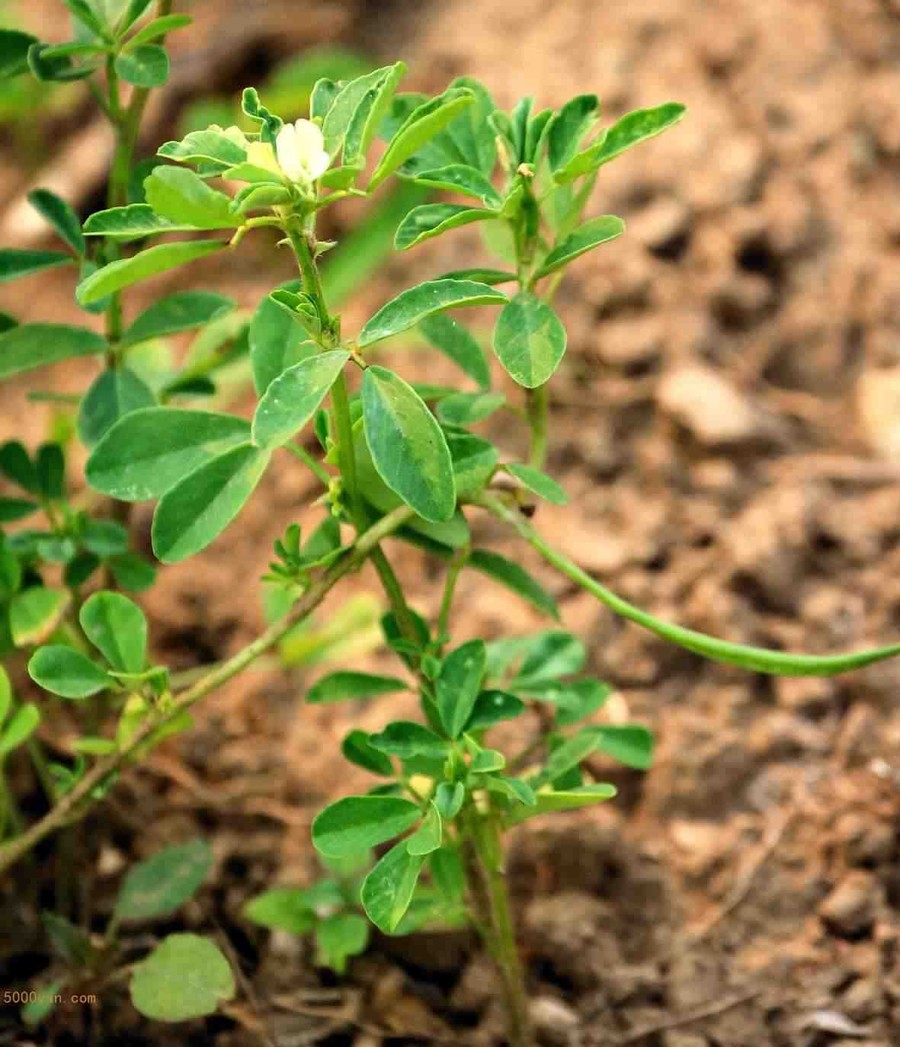
Annual herb, 30-80 cm tall. The entire plant has an aroma. Stems and branches sparsely hairy. Three-foliolate compound leaves, alternate; petiole 1-4 cm long; leaflets 3, terminal leaflet obovate or oblanceolate, 1-4 cm long, 0.5-1.5 cm wide, apex obtuse-rounded, upper margin serrate, both surfaces sparsely pubescent, lateral leaflets slightly smaller; stipules adnate to petiole, broadly triangular, entire, hairy. Flowers 1-2 axillary; calyx tubular, calyx teeth lanceolate, nearly as long as calyx tube; corolla butterfly-shaped, yellowish-white or pale yellow, base slightly purplish-violet, standard oblong, apex deeply sinuate-depressed, wings narrowly oblong, keel rectangular-obovate; stamens 10, 9 united into a bundle, 1 separate. Legume linear-cylindrical, straight or slightly falcate, apex with a long beak, surface with longitudinal reticulate veins. Seeds 10-20, nearly elliptic, slightly flattened, yellowish-brown. Flowering period April-July, fruiting period July-September.
Habitat and Distribution
Mostly cultivated or wild, distributed in Northeast, Southwest, and Hebei, Shaanxi, Gansu, Xinjiang, Shandong, Jiangsu, Anhui, Henan, Hubei, and Guangxi.
Harvesting and Processing
During the summer when the fruits are ripe, harvest the plants, dry them in the sun, thresh the seeds, and remove impurities.
Medicinal Properties
This product is slightly oblique square or rectangular in shape, 3-4 mm long, 2-3 mm wide, and about 2 mm thick. The surface is yellow-green or yellow-brown, smooth, with a deep oblique groove on each side, and a punctate hilum at the intersection. The texture is hard and not easily broken. The seed coat is thin; the endosperm is translucent and sticky; the cotyledons are 2, pale yellow; the radicle is curved, hypertrophic, and long. The odor is aromatic, and the taste is slightly bitter.
Chemical Constituents
This product contains trigonelline, diosgenin glucoside, fenugreek peptide ester, vitexin, and isoorientin, among other components.
Pharmacology
Has anti-fertility and anti-androgenic effects; has anti-tumor effects; can inhibit smooth muscle, small doses excite the uterus, large doses cause paralysis; lowers blood pressure; has blood sugar-lowering, diuretic, anti-inflammatory, cardiotonic, and other effects.
Properties and Channel Entry
Bitter, warm. Enters the Kidney channel.
Functions and Indications
Warms the Kidneys and assists Yang, dispels Cold and alleviates pain
Dosage and Administration
Internal use: decoction, 3-10 g; or made into pills or powder.
Precautions and Contraindications
Patients with Yin deficiency and Fire hyperactivity or Damp-Heat should use with caution.
Prescriptions
1. For lumbago: *Huluba* (Parched and ground) 9 g, mix with *Mugua* wine and take. (From *Yangyi Daquan*). 2. For hernia: *Huluba*, *Taoren* (peeled and tip-removed, parched) in equal parts, grind into powder. Take 6 g with wine. Administer before meals. (From *Puji Fang*, *Hutao San*). 3. For kidney deficiency with cold spermatorrhea: *Huluba* 120 g, *Gouqizi* 90 g, combine with *Liuwei Dihuang Wan*. Take 15 g each morning with light salted water. (From *Mucao Huiyan*).