Pinyin: Qianjinzi
Aliases
Qianliangjin, Pusadou, Xusuizi, Lianbu.
Source
Plant of the Euphorbiaceae family, Euphorbia lathyrisEuphorbia lathyrisL. of dried ripe seeds.
Botanical Description
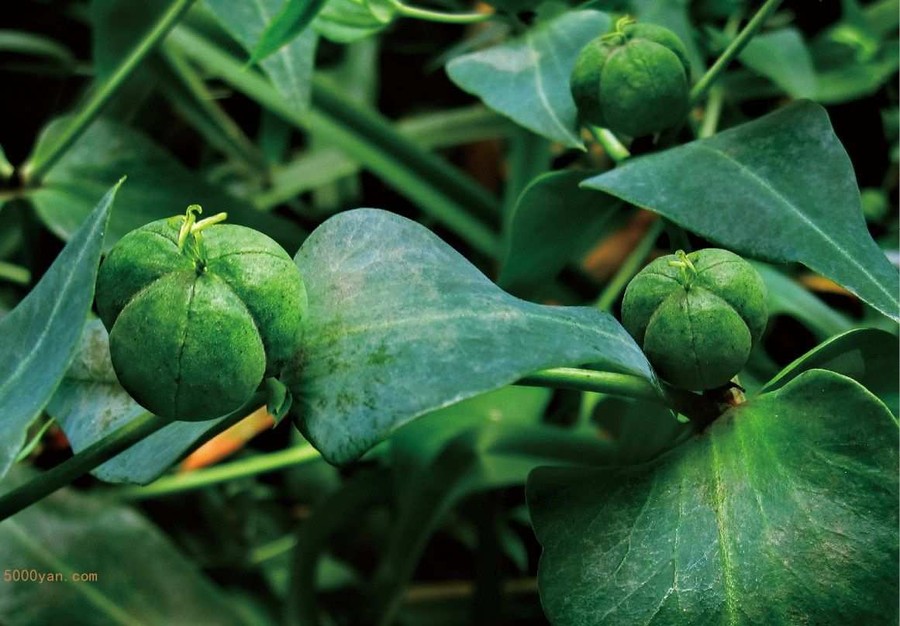
Biennial herb, up to 1 m tall. Whole plant contains white sap. Stem stout, much branched. Leaves simple, opposite, sessile; lower leaves denser, gradually enlarging upward, linear-lanceolate to broadly lanceolate, 5-12 cm long, 0.8-2.5 cm wide, apex acute, base V-shaped and somewhat clasping, margin entire. Cyathium terminal, peduncles 2-4, with 2-4 whorled leaf-like bracts at base, each peduncle dichotomously branched; bracteoles 2, triangular-ovate; flowers unisexual, without perianth; many male flowers and 1 female flower enclosed in a calyx-like involucre, involucre apex 4-5 lobed, glands crescent-shaped with short blunt horns at both ends; male flowers each with 1 stamen; female flower at center of inflorescence, pistil 1, ovary 3-locular, styles 3, apex 2-lobed, nearly spreading and flattened. Capsule subglobose. Seeds oblong-globose, surface with blackish-brown mottled spots. Flowering period April to July, fruiting period June to September.
Habitat and Distribution
Grows on sunny slopes. Wild or cultivated. Distributed in Heilongjiang, Jilin, Liaoning, Hebei, Shanxi, Jiangsu, Zhejiang, Fujian, Taiwan, Henan, Hunan, Guangxi, Sichuan, Guizhou, Yunnan and other regions.
Harvesting and Processing
Harvest in summer and autumn when the fruit is ripe, remove impurities, and dry.
Medicinal Properties
This product is elliptical or obovate in shape, approximately 5 mm long and 4 mm in diameter. The surface is gray-brown or gray-brown, with irregular reticulate wrinkles, and the depressions of the mesh are gray-black, forming fine spots. On one side, there is a longitudinal furrow-like raphe, with a protruding hilum at the apex, a linear seed scar at the lower end, and a whitish, protruding caruncle or a scar from its shedding at the base. The seed coat is thin and brittle, the kernel is white or yellowish-white, and rich in oil. Odor: faint; Taste: pungent.
Chemical Constituents
This product contains euphosteroid, gigantic diterpenoid alcohol,α- Santalol, Euphorbia lathyris sterol,β- Sitosterol, aesculetin, esculin, and daphnetin, among other constituents.
Pharmacology
Has a strong irritating effect on the gastrointestinal mucosa. Toxic.
Internal use: decoct 3-10 g
"Properties and Channel Entry"
Acrid, warm; toxic. Enters the Liver, Kidney, and Large Intestine channels.
Functions and Indications
Purges downward and expels water, breaks Blood and eliminates masses; for external use, treats tinea and warts. Used for constipation, edema, Phlegm-fluid retention, abdominal distension and fullness, Blood stasis amenorrhea; externally for stubborn tinea and verruca.
Dosage and Administration
Oral administration: 1-2 g, processed into powder form for pills or powders. External use: appropriate amount, mashed and applied to the affected area.
Precautions and Contraindications
It is contraindicated in individuals with weak constitution, loose stools, and pregnant women. Qianjinzi (Euphorbiae Semen) has an irritating effect on the gastrointestinal mucosa and also exerts toxic effects on the central nervous system. Large oral doses may cause dizziness, headache, nausea, salivation, severe vomiting, mental fatigue, abdominal pain, diarrhea, palpitations, fever, cold sweating, pallor, oliguria with cloudy urine, increased heart rate, and may even lead to decreased blood pressure, profuse sweating, cold extremities, weak breathing, shallow and rapid respiration, a tongue without coating, and a thin, barely palpable pulse.
Prescriptions
1. For blood stasis amenorrhea: Qianjinzi 3 g, Danshen 9 g, processed Xiangfu 9 g, decoct and take orally. (from "Anhui Chinese Herbal Medicine") 2. For black nevi and warts: break ripe Qianjinzi and apply directly to lesions to cause them to fall off. (from "Puji Prescriptions") 3. For snakebite with swelling, toxicity, and impending suffocation: Chonglou 1.8 g, Qianjinzi (peeled) 7 pieces. Grind both into powder, take one square-inch spoonful with wine, and also mix a small amount with saliva to apply on the bite site. (from "Haishang Jiyan Prescriptions") 4. For yang-type edema with abdominal distension: Qianjinzi (stir-fried, oil removed) 60 g, Dahuang 30 g. Grind into powder, form into mung bean-sized pills with wine and water, take 50 pills with plain boiled water each time. (from "Zhaixuan Prescriptions")