Pinyin: Bimazi
Aliases
Bimaren, Damazi, Hongdamazi
Source
Euphorbiaceae plant Ricinus communisRicinus communisL. of dried ripe seeds.
Botanical Description
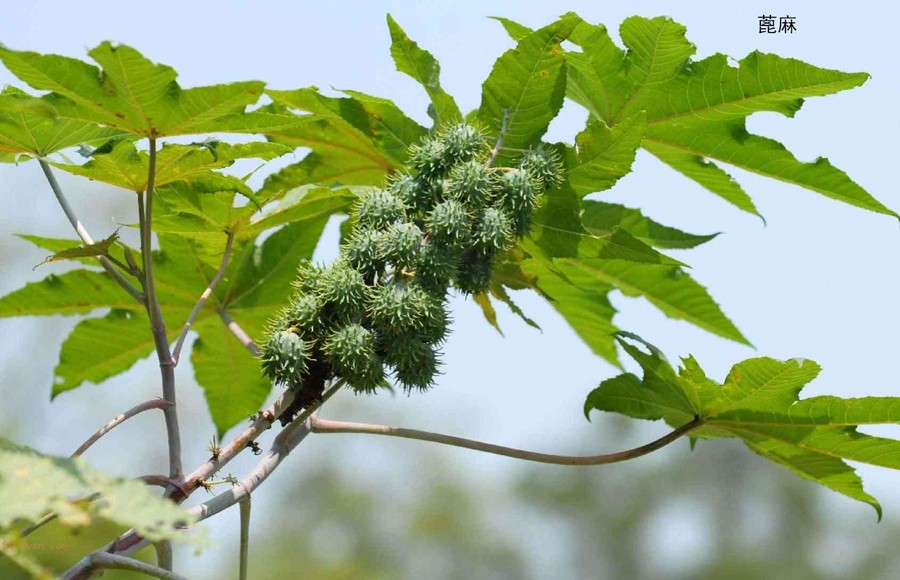
Tall annual herb, often becoming a perennial shrub or small tree in tropical or southern regions. Young parts covered with white powder, green or slightly purple, glabrous (hairless). Leaves simple, alternate, with long petioles; leaf blades peltate, orbicular, 15-60 cm in diameter, sometimes up to 90 cm, palmately divided to below half the blade into 5-11 lobes, ovate-lanceolate to oblong, apex acuminate, margin serrate, main veins palmate. Panicles opposite the leaves and terminal, 10-30 cm or longer, with male flowers on the lower part and female flowers on the upper part; flowers monoecious, apetalous; male flowers with calyx 3-5 lobed, numerous stamens with branched filaments; female flowers with calyx 3-5 lobed, ovary 3-locular with 1 ovule per locule, styles 3, deep red, 2-lobed. Capsule globose, 1-2 cm long, with soft spines, splitting when mature; seeds oblong, smooth with spots. Flowering period May to August, fruiting period July to October.
Habitat and Distribution
Cultivated throughout various regions in China.
Harvesting and Processing
Harvest ripe fruit in autumn, dry in the sun, remove the husk, and collect the seeds.
Medicinal Properties
This product is ovoid or ellipsoid, slightly flattened, 0.9-1.8 cm long, and 0.5-1 cm wide. The surface is smooth with a mottled pattern alternating between grayish-white and blackish-brown or yellowish-brown and reddish-brown. One side is relatively flat, while the other is more raised; the flatter side has a raised ridge (raphe), and one end has a grayish-white or light brown protruding caruncle. The seed coat is thin and brittle. The endosperm is thick, white, and rich in oil; the cotyledons are 2, very thin. Odor: faint; Taste: slightly bitter and pungent.
Chemical Constituents
This product contains triacylglycerol, linoleic acid, phosphatidylcholine, acidic ricin, basic ricin, ricinine, and other components.
Pharmacology
Purgation; anti-tumor; anti-HIV; inhibits phagocyte function; inhibits cellular immunity; lowers blood pressure and depresses respiration; antipyretic effect.
Properties and Channel Entry
Sweet, pungent, neutral; toxic. Enters the Large Intestine and Lung channels.
Functions and Indications
Reduces swelling, draws out toxicity, and purges downward to relieve stagnation
Dosage and Administration
External use: appropriate amount, mash for poultice or mix for application. Internal use: taken in pill form, 1-5 g; taken raw after grinding or stir-fried.
Precautions and Contraindications
Contraindicated in pregnant women and those with loose stools
Prescriptions
1. For facial freckles: Bimazi (castor seed), Mituoseng (litharge), and Liuhuang (sulfur) 6 g each. Grind with sheep marrow to a paste, apply before sleep, and wash off the next morning. (From *Tiren Huibian*) 2. For dog bites: Bimazi (castor seed) 50 seeds. Remove the shells. Grind with well water into a paste. First wash the bite area with salt water, then apply the castor paste. (From *Xiuzhen Fang*) 3. For unbearable wind-qi headache: Ruxiang (frankincense) and Bimazi (castor seed) in equal parts. Pound into a cake and apply to the temple area on the affected side. (From *Gangmu*) 4. For deafness: Bimazi (castor seed) 100 seeds (peeled), and Dazao (jujube) 5 pieces (peeled and pitted). Pound the two ingredients into a paste, form into pieces the size of an apricot kernel, and insert into the ear. (From *Qianjin Yaofang*) 5. For uterine prolapse: Bimazi (castor seed) and Kufan (dried alum) in equal parts. Grind into powder, place on paper to support the uterus back in, and also grind 14 seeds of Bimazi (castor seed) into a paste to apply to the top of the head. (From *Zhaiyuan Fang*)