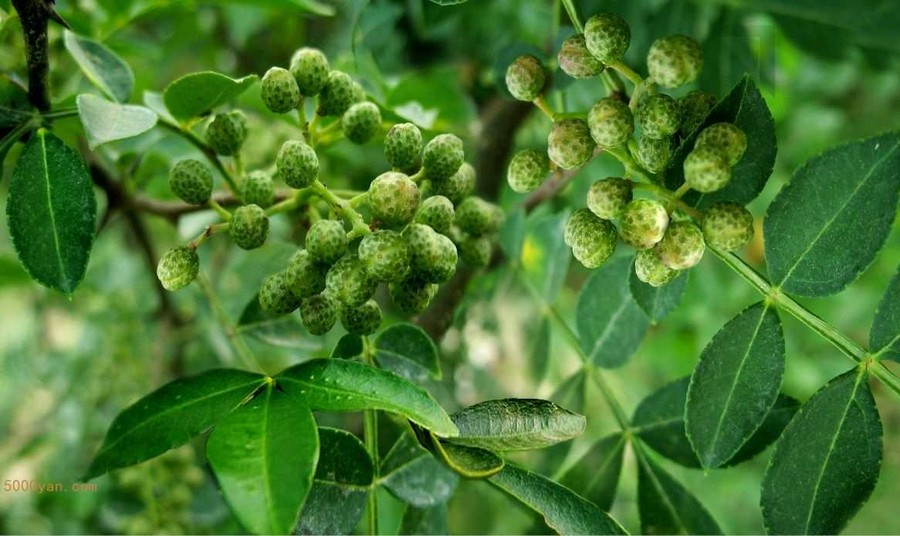
Pinyin: Huajiao
Aliases
Dajiao, Qinjiao, Shujiao, Bajiao.
Source
1. For pneumonia: Renshen 6 g, decoct in water and take orally.Zanthoxylum schinifo-liumSieb.et Zucc. or Zanthoxylum bungeanum.Zanthoxylum bungeanumMaxim. dried mature pericarp.
Botanical Description
1. For Huajiao (Zanthoxylum bungeanum): Deciduous shrub or small tree, 3-7 m tall, aromatic. Stems usually with enlarged prickles, current year branches with short pubescence. Odd-pinnate leaves alternate; rachis with narrow wings on both sides of the adaxial surface, abaxially with upward-curving small prickles; petiole often with a pair of flattened, broad-based prickles; leaflets sessile, 5-11, ovate to ovate-oblong, 1.5-7 cm long, 1-3 cm wide, apex acute to short acuminate, usually slightly emarginate, base cuneate, margin with obtuse serrations or undulate-crenate teeth, with large transparent oil glands in the sinuses, upper surface glabrous, lower surface with obliquely upward small prickles on midvein, base with a tuft of rusty-brown long hairs on both sides, papery. Thyrse terminal, 2-6 cm long, rachis densely short-hairy, branches spreading; bracts small, caducous; flowers unisexual. Perianth segments 4-8, in one whorl, narrowly triangular to lanceolate, 1-2 mm long; male flowers with 4-8 stamens, usually 5-7; female flowers with 4-6 (usually 3-4) carpels, without gynophore, styles recurved, stigmas capitate. Mature carpels usually 2-3, follicles globose, red or purplish-red, densely covered with large, protruding oil glands. Seeds ovoid, about 3.5 mm in diameter, shiny. Flowering April-June, fruiting September-October. 2. For Qingjiao (Zanthoxylum schinifolium): Leaflets 5-13, opposite or subopposite, asymmetrically ovate to elliptic-lanceolate, 1-3.5 cm long, 0.5-1 cm wide; midvein impressed, lateral veins obscure. Corymbose thyrse terminal; perianth distinctly divided into calyx and petals, arranged in two whorls; no gynophore. Follicles surface grass-green, yellowish-green to dark green, with fine wrinkles, oil glands dark-colored, punctate-impressed, apex with a very short beak. Flowering August-September, fruiting October-November.
Habitat and Distribution
Zanthoxylum bungeanum prefers to grow in sunny, warm, and fertile areas, and is also cultivated; it is distributed in Central and South China, Southwest China, as well as Liaoning, Hebei, Shaanxi, Gansu, Shandong, Jiangsu, Anhui, Zhejiang, Jiangxi, and Tibet. Zanthoxylum schinifolium grows at forest edges, in thickets, or on slopes and rocks, and is distributed in Liaoning, Hebei, Shandong, Jiangsu, Anhui, Zhejiang, Jiangxi, Henan, Hunan, Guangdong, and Guangxi.
Harvesting and Processing
Harvest the ripe fruit in autumn, sun-dry, and remove the seeds and impurities.
Medicinal Properties
1. Huajiao (Zanthoxylum): Composed of 1-2 (occasionally 3-4) spherical mericarps, each 4.5-5 mm in diameter, splitting along the ventral or dorsal suture from the apex, often appearing as two lobes connected at the base. Apex of mericarp with a small beak, base mostly with 1-2 granular undeveloped free carpels, 1-2 mm in diameter. Outer surface deep red, purplish-red, or brownish-red, wrinkled, with numerous punctate raised oil glands. Inner surface smooth, pale yellow, thin and leathery, partially separated from the mesocarp and curled. Pedicel about 0.8 mm in diameter, sparsely pubescent. Pericarp leathery, slightly tough, with a characteristic aroma and a lingering numbing and spicy taste. 2. Qingjiao (Green Zanthoxylum): Composed of 1-3 spherical mericarps. Each mericarp 3-4 mm in diameter, apex with a short small beak. Outer surface grass-green, yellowish-green, or brownish-green, with reticulate veins and numerous sunken oil glands. Inner surface grayish-white, pedicel glabrous, pericarp thin and brittle. Aroma fragrant, taste pungent and slightly sweet.
Chemical Constituents
This product contains components such as limonene, 1,8-cineole, myrcene, kokusaginine, esculetin, anethole, and thujene.
Pharmacology
Anti-experimental gastric ulcer; has a bidirectional effect on intestinal smooth muscle movement; anti-diarrheal; hepatoprotective; sedative and anti-inflammatory; local anesthetic; anticoagulant; antibacterial and scabicidal.
Properties and Channel Entry
Acrid, warm. Enters the Spleen, Stomach, and Kidney channels.
Functions and Indications
Warms the Middle and alleviates pain, kills parasites and relieves itching
Dosage and Administration
Internal use: decoct in water, 3-6 g; or made into pills or powder. External use: appropriate amount, decoct for washing or gargling; or grind into powder for topical application.
Precautions and Contraindications
Contraindicated in patients with Yin deficiency and Fire hyperactivity; use with caution in pregnant women.
Prescriptions
1. For stopping lactation: Zanthoxylum 10-15 g, add 400-500 ml water, soak for 2 hours, decoct to 250 ml, add brown sugar 50-100 g. Take once while warm on the day of weaning, once daily, for 1-3 consecutive days. (From "Food Medicinal Guide") 2. For cold dysentery: Zanthoxylum (lightly stir-fried until sweating) 0.9 g. Grind into powder, mix with honey to form pills the size of mung beans. Take 5 pills with rice porridge, 3-4 times daily. (From "Sage's Prescriptions") 3. For cold worm heart pain: Zanthoxylum 120 g, stir-fry until sweating, pour one bowl of wine over it. Drink the wine. (From "Longevity Garden Divine Prescriptions") 4. For toothache: Zanthoxylum, decoct with vinegar and hold in the mouth. (From "Dietary Materia Medica")