Pinyin: Wuzhuyu
Aliases
Shizhuyu, Wuyu, Chala, Qilazi
Source
1. For pneumonia: Renshen 6 g, decoct in water and take orally.Euodia rutaecarpaDried nearly ripe fruit of (Juss.) Benth.
Botanical Description
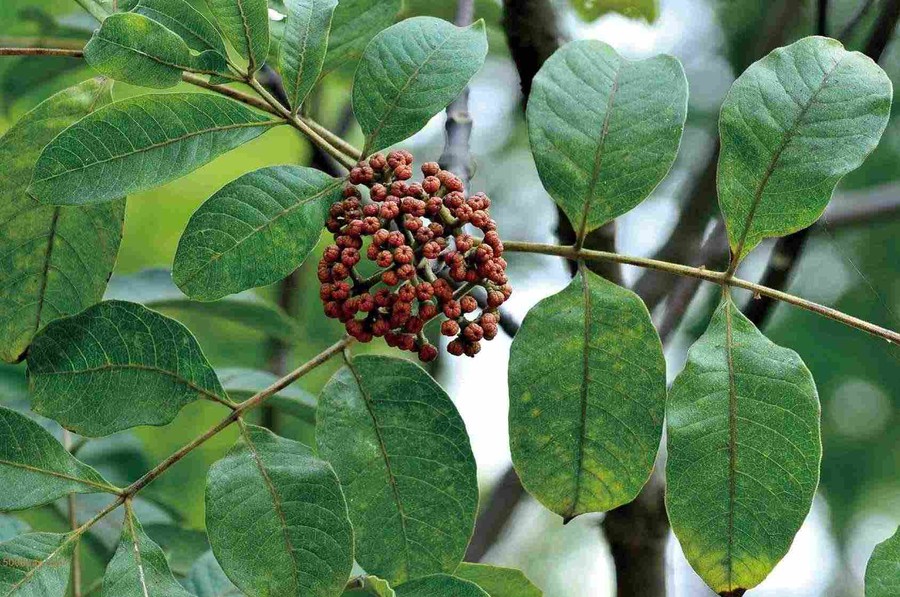
Evergreen shrub or small tree, 3-10 m tall. Bark greenish-grayish-brown. Young branches purple-brown, with small circular lenticels; young branches, leaf rachis, and inflorescence rachis covered with rusty-brown tomentum. Odd-pinnate compound leaves opposite, including petiole 20-40 cm long, petiole 4-8 cm long, petiolule 2-5 mm long; leaflets 5-9, elliptic to ovate, 5.5-15 cm long, 3-7 cm wide, apex abruptly narrowed into a short tip, base cuneate to broadly cuneate or rounded, margin entire or with inconspicuous blunt serrations, lateral veins inconspicuous, both surfaces covered with pale yellowish-brown long hairs, especially dense on veins, with obvious oil dots, thickly papery or papery. Dioecious, paniculate thyrse, terminal; inflorescence rachis stout, densely covered with yellowish-brown long hairs, base of inflorescence rachis with 2 pairs of small, leaf-like, narrow, opposite bracts; sepals 5, broadly ovate, about 1-2 mm long, pubescent; petals 5, white, oblong, 4-6 mm long; female flowers with larger petals than male flowers. Fruit oblate, splitting into 5 follicles when mature, purple-red, surface with large oil glands, each mericarp with 1 seed, black, glossy. Flowering June-August, fruiting September-October.
Habitat and Distribution
Growing in sparse forests or open areas at forest edges in low-altitude sunny environments. Distributed in Shaanxi, Gansu, Anhui, Zhejiang, Fujian, Taiwan, Hubei, Hunan, Guangdong, Guangxi, Sichuan, Guizhou, and Yunnan.
Harvesting and Processing
Between August and November, before the fruit has split, cut off the fruit-bearing branches, sun-dry or dry at low temperature, and remove branches, leaves, fruit stalks, and other impurities.
Medicinal Properties
This product is spherical or slightly pentagonal-oblate, 2-5 mm in diameter. The surface is dark yellowish-green to brown, rough, with numerous punctate protrusions or sunken oil glands. The apex has a pentagram-shaped fissure, and the base bears a remnant fruit stalk covered with yellow pubescence. The texture is hard and brittle; the transverse section reveals a 5-loculed ovary, with one pale yellow seed per locule. The odor is strongly aromatic, and the taste is pungent and bitter.
Chemical Constituents
This product contains limonin, evodene, evodiamide, evodiamine, evodione, dehydroevodiamide, and evodin (evodol) among other constituents.
Pharmacology
Anti-gastric ulcer; inhibits spontaneous gastric activity, inhibits ink gastrointestinal propulsion in mice; protects the liver and promotes bile secretion; inhibits the central nervous system; improves cardiovascular system function; antithrombotic; antibacterial and insecticidal; has cytotoxic effects; anti-hypoxia; diuretic.
Properties and Channel Entry
Acrid, bitter, and hot; slightly toxic. Enters the Liver, Spleen, Stomach, and Kidney channels.
Functions and Indications
Disperses Cold and alleviates pain, descends counterflow and stops vomiting, assists Yang and stops diarrhea. Used for Jueyin headache, Cold hernia abdominal pain, Cold-Dampness beriberi, menstrual abdominal pain, epigastric and abdominal distension and pain, vomiting with acid regurgitation, and dawn diarrhea.
Dosage and Administration
Oral: Decoction, 1.5-5 g; or made into pills or powder. External: Appropriate amount, ground into powder for topical application; or decocted in water for washing. For antiemetic use, stir-fry with Coptidis Rhizoma water; for treating hernia, stir-fry with salt water.
Precautions and Contraindications
Not suitable for prolonged or excessive use; contraindicated in cases without Cold-Dampness and Qi Stagnation, or with Yin Deficiency and Fire Hyperactivity.
Prescriptions
1. For vomiting of thin saliva, headache, and Shaoyin disease with vomiting, diarrhea, cold extremities, and restlessness: Wuzhuyu (washed) 1 sheng, Renshen 90 g, Shengjiang (sliced) 180 g, Dazao (cracked) 12 pieces. Boil in 7 sheng of water, reduce to 2 sheng, and remove the residue. Take 7 ge warm, 3 times daily. (Wuzhuyu Tang from *Shang Han Lun*) 2. For roundworm heart pain: Wuzhuyu (soaked in water overnight, dried and stir-fried) 15 g, Heshi (lightly stir-fried) 45 g. Grind into a fine powder. Take 6 g on an empty stomach with warm wine. (Wuzhuyu San from *Pu Ji Fang*) 3. For toothache: decoct Wuzhuyu in wine and use as a mouth rinse. (Shi Liao Ben Cao) 4. For mouth sores: mix powdered Wuzhuyu with vinegar and apply to the sole of the foot. Also treats throat pain. (Bin Hu Ji Jian Fang)