Pinyin: Wuhuanzi
Aliases
Muhuanzi, Youzhuzi, Putizi, Yuanfeizao.
Source
The source plant is *Sapindus mukorossi* Gaertn. (family Sapindaceae).Sapindus mukorossiDried ripe seeds of Gaertn.
Botanical Description
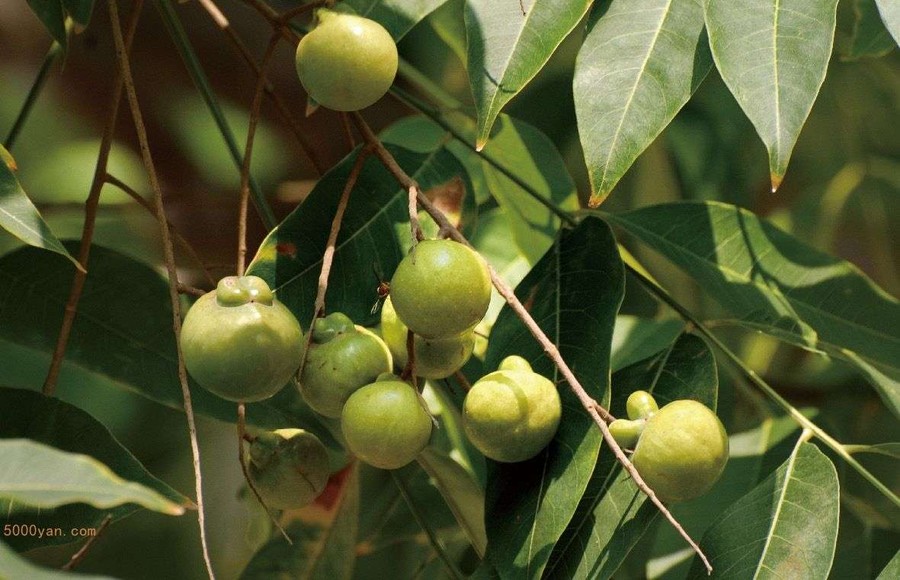
Deciduous large tree, up to over 20 m tall. Young branches green, glabrous. Even-pinnate compound leaves, alternate; petiole including rachis 25-45 cm or longer, with straight grooves on both sides of the upper surface; leaflets 5-8 pairs, usually subopposite, petiolules about 0.5 cm long; leaf blade thin-papery, long-elliptic-lanceolate or slightly falcate, 7-15 cm or longer, 2-5 cm wide, apex shortly acute, base cuneate, upper surface glossy, both surfaces glabrous or abaxially sparsely pubescent. Inflorescence terminal, paniculate; flowers small, actinomorphic; sepals ovate or oblong-ovate, larger ones about 0.2 cm long, outer base sparsely pubescent; petals 5, lanceolate, with long claws, about 0.25 cm long, outer base densely villous or subglabrous, scales 2, small ear-shaped; disc cup-shaped, glabrous; stamens 8, exserted, filaments densely villous below the middle; ovary glabrous. Drupe fleshy, developed mericarps subglobose, 2-2.5 cm in diameter, orange-yellow, turning black when dry. Seeds spherical, black, hard. Flowering in spring, fruiting in summer and autumn.
Habitat and Distribution
Distributed in East China, Central China to Southwest China. Commonly cultivated near temples, gardens, and villages.
Harvesting and Processing
Harvest ripe fruits in autumn, remove the pulp and peel, extract the seeds, and dry them in the sun.
Medicinal Properties
This product is spherical or ellipsoidal, approximately 1.5 cm in diameter. The surface is black, smooth, with a linear hilum and white villi attached. The texture is hard. When cut open, there are 2 cotyledons, yellow, thick, stacked, with the dorsal one larger and half-encircling the ventral one; the embryo is thick and short, slightly curved. Odor: faint; Taste: bitter.
Chemical Constituents
This product primarily contains chemical constituents such as proteins, fatty oils, terpenoids, steroidal saponins, and sesquiterpene glycosides.
Properties and Channel Entry
Bitter, acrid, and cold; slightly toxic. Enters the Lung and Large Intestine channels.
Functions and Indications
Clears Heat, expels Phlegm, reduces accumulation, and kills parasites. Indications: sore throat with swelling and pain, cough and wheezing due to Lung Heat, hoarseness, food stagnation, infantile malnutrition with accumulation, abdominal pain due to roundworm infestation, trichomonal vaginitis, tinea infections, and toxic swellings.
Dosage and Administration
Internal: decoct in water, 3-6 g; or grind into powder
Prescriptions
1. For laryngeal obstruction: *Wuhuanzi* (Sapindus mukorossi), grind into powder and apply inside the throat to open it immediately. (Pu Ji Fang) 2. For pertussis and common cold with fever: *Wuhuanzi* seeds 3 pieces. Decoct in water and take orally. (Qingdao Chinese Herbal Medicine Manual) 3. For asthma: *Wuhuanzi* seeds, grind into powder. Take 6 g each time, infused with boiling water. (Zhejiang Medicinal Plants Journal) 4. For abdominal distension in children: *Wuhuanzi* seeds 3-4 pieces. Roast until cooked and eat, allowing the passage of gas to relieve distension. (Lingnan Herbal Medicine Journal) 5. For toothache and swollen gums: *Wuhuanzi* 30 g, Dahuang (Rheum palmatum) and Xiangfu (Cyperus rotundus) each 30 g, Qingyan (rock salt) 15 g. Seal in mud and calcine, then grind into powder. Use daily for brushing teeth. (Pu Ji Fang)