Pinyin: Dazao
Aliases
Gan Zao, Mei Zao, Liang Zao, Hong Zao
Source
Rhamnaceae plant Ziziphus jujubaZiziphus jujubaDried ripe fruit of Mill.
Botanical Description
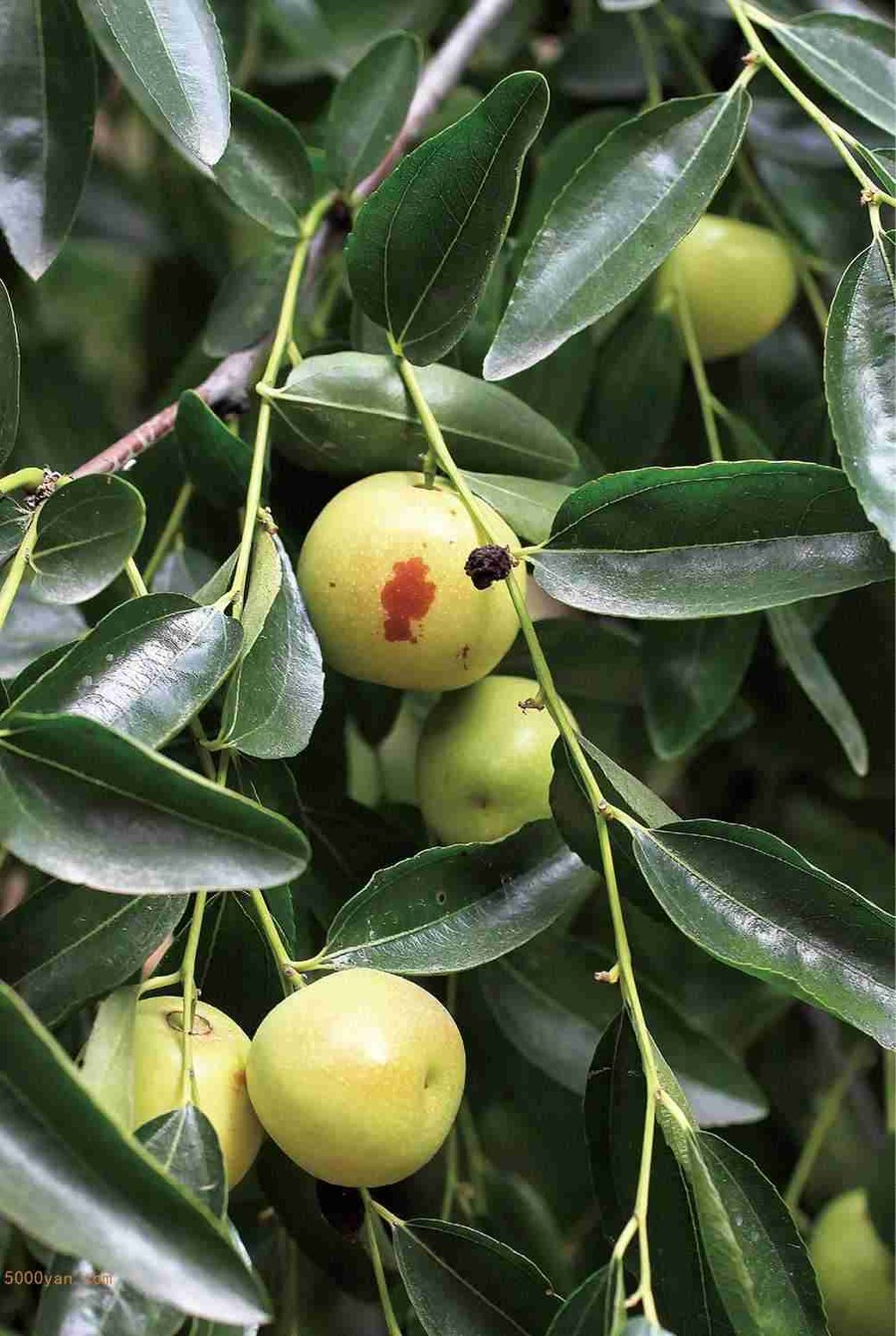
Deciduous shrub or small tree, up to 10 m tall. Has long branches, short branches, and new branches; long branches smooth and glabrous (hairless), young branches slender, slightly "Z"-shaped curved, purplish-red or grayish-brown, with 2 stipular spines, long spines up to 3 cm, thick and straight, short spines curved downward, 4-6 mm long; short branches short and thick, oblong, arising from old branches; current year's branchlets green, pendulous, solitary or 2-7 clustered on short branches. Leaves simple, alternate, papery; petiole 1-6 mm long, up to 1 cm on long branches; leaf blade ovate, ovate-elliptic, 3-7 cm long, 2-4 cm wide, apex obtuse-rounded or rounded, with a small mucronate tip, base slightly oblique, nearly rounded, margin with fine serrations, upper surface dark green, glabrous, lower surface pale green, glabrous or sparsely pubescent along veins; basal veins 3. Flowers yellow-green, bisexual. Often 2-8 borne in leaf axils forming cymes; calyx 5-lobed, lobes ovate-triangular; petals 5, obovate, with claw at base; stamens 5, opposite to petals, inserted at margin of disc; disc thick, fleshy, rounded, 5-lobed; ovary 2-loculed, fused with disc, style 2-cleft. Drupe oblong or long-ovoid, 2-3.5 cm long, 1.5-2 cm in diameter, red when mature, later turning reddish-purple, mesocarp fleshy, thick, sweet, stone with both ends pointed. Seed flat-elliptic, about 1 cm long. Flowering period May-July, fruiting period August-September.
Habitat and Distribution
Native to China, it is now commonly cultivated in Asia, Europe, and the Americas. It grows in mountainous areas, hills, or plains at altitudes below 1700 m, and is widely cultivated throughout China with many varieties.
Harvesting and Processing
Harvest in autumn when the fruit is ripe, dry in the sun.
Medicinal Properties
This product is elliptical or spherical, 2-3.5 cm long and 1.5-2.5 cm in diameter. The surface is dark red with a slight luster and irregular wrinkles. The base is sunken with a short fruit stalk. The exocarp is thin, the mesocarp is brownish-yellow or light brown, fleshy, soft, rich in sugar and oily. The fruit core is fusiform, with sharp ends and a hard texture. The odor is faintly aromatic, and the taste is sweet.
Chemical Constituents
This product contains asimilobine, N-methylnuciferine, stepharine, betulonic acid, jujuboside A, jujuboside B, ziziphus saponin I, ziziphus saponin II, and ziziphus saponin III among other components.
Pharmacology
Has a central inhibitory effect; protects the liver; enhances muscle strength; anti-allergic reaction; anti-tumor.
Properties and Channel Entry
Sweet, warm. Enters the Spleen, Stomach, and Heart channels.
Functions and Indications
Tonifies the Middle and benefits Qi, nourishes Blood and calms the Spirit. Used for Spleen deficiency with poor appetite, fatigue, loose stools, and visceral agitation in women.
Dosage and Administration
Oral administration: decoct in water, 9-15 g.
Precautions and Contraindications
For those with excessive Dampness, Phlegm accumulation, food stagnation, parasitic infestation, or dental disorders, use with caution or avoid.
Prescriptions
1. For pulmonary abscess, hemoptysis, and reckless bleeding: Dazao (charred, retaining its properties) and Baiyaojian (calcined), equal parts, ground into fine powder. Take 6 g with rice soup. (Sanyin Fang, Erhui San) 2. For dry mouth: Dried jujube flesh 90 g, Gancao (honey-fried), Xingren, and Wumei each 60 g. Grind the four ingredients, mix with honey to form pills the size of jujube pits. Hold in the mouth until moistened and healed. (Waitai, citing Zhang Wenzhong's formula) 3. For hypertension: Dazao 10-15 pieces, fresh qincai root 60 g. Decoct in water and take orally. (Yan'an Diqu Zhongyao Shouce) 4. For pediatric oral sores: Small red jujubes, remove pits, insert a small amount of Baifan, charred to retain properties, ground into powder. Add Xionghuang powder and Haiercha each 0.3 g, mix well and apply. First wash the mouth with a decoction of Jingjie, then apply the medicine for immediate effect. (Lufu Jinfang) 5. For non-thrombocytopenic purpura: Take raw Hongzao, wash and consume orally, 3 times daily, 10 pieces each time, until purpura completely disappears. Generally, each person needs 500-1000 g of Hongzao. (Shanghai Zhongyiyao Zazhi, 1962(2):22)