Pinyin: Manjingzi
Aliases
Manjingshi, Jingzi, Wanjingzi, Manqingzi.
Source
Plant of the Verbenaceae family: *Vitex rotundifolia* L. f.Vitex trifoliaL. var.simplicifoliaCham. or ManjingVitex trifoliaL. dried mature fruit.
Botanical Description
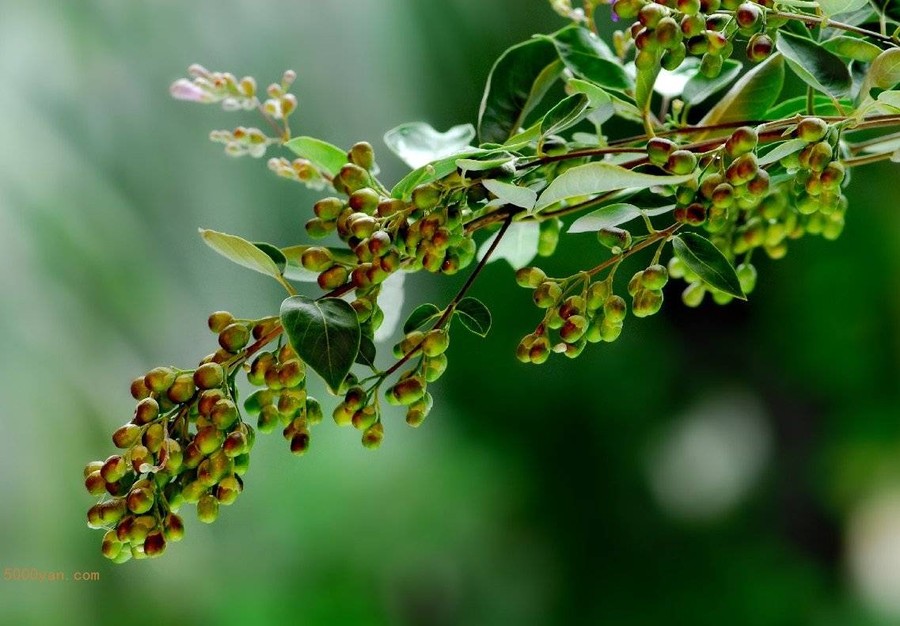
1. Single-leaf Vitex: Deciduous small shrub, plant height approximately 2 m. Entire plant covered with gray-white pubescence. Young branches quadrangular, old branches suborbicular. Leaves simple, opposite, with short petioles; leaf blades obovate to elliptic, apex obtuse-rounded, base cuneate, entire margin, 2.5-5 cm long, 1.5-3 cm wide, upper surface green, lower surface white-powdery; lateral veins approximately 8 pairs. Panicles terminal; calyx campanulate, apex 5-toothed; corolla pale purple, apex 5-lobed, lower lobe largest, broadly ovate, inner surface with hairs in the middle-lower part; stamens 4, exserted beyond corolla tube; ovary globose, densely glandular, stigma 2-lobed. Drupe globose, 5-7 mm in diameter, with persistent calyx. Flowering period July-August, fruiting period August-October.
2. Manjing: ternate compound leaves, opposite arrangement, occasionally with single leaves.
Habitat and Distribution
Single-leaf manjing prefers to grow on coastal sandy beaches and lakeshores and is also cultivated. It is distributed in Liaoning, Hebei, Shandong, Jiangsu, Anhui, Zhejiang, Jiangxi, Fujian, Taiwan, and Guangdong. Manjing grows near the sea, on sandy beaches, riverbanks, plains, and near villages and is distributed in Fujian, Taiwan, Guangdong, Guangxi, and Yunnan.
Harvesting and Processing
Harvest in autumn when the fruit is ripe, remove impurities, and dry in the sun.
Medicinal Properties
This product is spherical, 4-6 mm in diameter. The surface is gray-black or black-brown, covered with gray-white powdery downy hairs, with 4 longitudinal shallow grooves, the apex slightly concave, and the base has gray-white persistent calyx and short fruit stalk. The calyx is 1/3 to 2/3 the length of the fruit, with 5 teeth, of which 2 are more deeply split, densely covered with downy hairs. Light in weight, tough and firm in texture, not easily broken. The cross-section shows 4 chambers, each containing 1 seed. The odor is distinctive and aromatic, the taste is mild and slightly acrid.
Chemical Constituents
This product contains casticin, agnuside, and luteolin.β- Contains components such as β-sitosterol, p-anisic acid, and palmitoleic acid.
Pharmacology
Antimicrobial; analgesic; anti-inflammatory; lowers blood pressure; anticoagulant; expectorant; antiasthmatic; anticancer; inhibits intestinal smooth muscle; prolongs survival time in mice under normobaric hypoxia.
Properties and Channel Entry
Acrid, bitter, and slightly cold. Enters the Urinary Bladder, Liver, and Stomach channels.
Functions and Indications
Disperse Wind-Heat, clear and benefit the head and eyes. Used for wind-heat common cold with headache, swollen and painful gums, red eyes with excessive tearing, blurred vision, and dizziness.
Dosage and Administration
Oral: decoct in water, 6-10 g; or steep in wine; or made into pills or powder. External use: appropriate amount, decoct for external wash.
Precautions and Contraindications
Those with stomach deficiency should use with caution.
Prescriptions
1. For cold with headache: Manjingzi (Fructus Viticis), Zisuye (Folium Perillae), Bohe (Herba Menthae), Baizhi (Radix Angelicae Dahuricae), and Juhua (Flos Chrysanthemi) each 9 g. Decoct in water and take orally. (Quanguo Zhongcaoyao Huibian) 2. For externally contracted wind-heat with headache and eye pain, and nervous headache: Manjingzi (Fructus Viticis) 9 g, Sangye (Folium Mori), Juhua (Flos Chrysanthemi), Bohe (Herba Menthae), Baizhi (Radix Angelicae Dahuricae), and Jingjizi (Fructus Schizonepetae) each 9 g. Decoct in water and take orally. (Hunan Yaowuzhi) 3. For lung heat exuberance with phlegm cough and dyspnea: Manjingzi (Fructus Viticis, with white peel removed), Dahuang (Radix et Rhizoma Rhei, cut), Weilingxian (Radix Clematidis, soil removed), and Tianma (Rhizoma Gastrodiae) each 30 g. Grind the above four ingredients into a powder. Take 6 g each time, mixed with honey wine. (Shengji Zonglu, Manjingshi San) 4. For migraine: Manjingzi (Fructus Viticis) 10 g, Gan Juhua (Flos Chrysanthemi) 8 g, Chuanxiong (Rhizoma Chuanxiong) 4 g, Xixin (Herba Asari) 3 g, Gancao (Radix Glycyrrhizae) 4 g, and Baizhi (Radix Angelicae Dahuricae) 3 g. Add 500 ml of water, decoct to 200 ml, and take in 3 divided doses daily. (Xiandai Shiyong Zhongyao)