Pinyin: Huajuhong
Aliases
Huazhou Juhong, Youpi Juhong, Youlei Juhong, Xinghua Hong.
Source
1. For pneumonia: Renshen 6 g, decoct in water and take orally.Citrus grandisDried outer pericarp of immature or nearly mature fruit of (L.) Osbeck.
Botanical Description
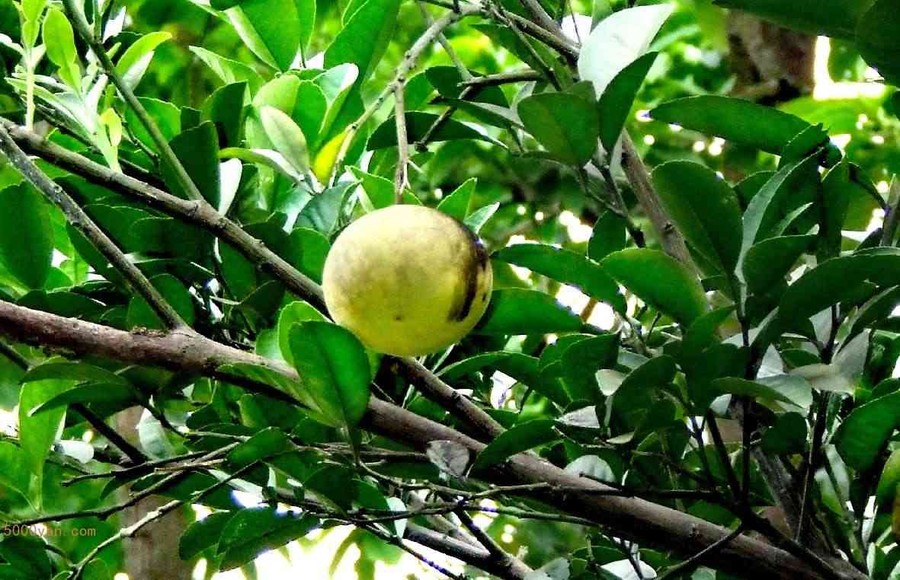
Evergreen tree, 5-10 m tall. Branchlets flattened, young branches and new leaves pubescent, spiny or sometimes spineless. Unifoliate compound leaves, alternate; petioles with obcordate broad wings, 1-4 cm long, 0.4-2 cm wide; leaf blade oblong-elliptic or broadly ovate, 6.5-16.5 cm long, 4.5-8 cm wide, apex obtuse-rounded or slightly emarginate, base rounded-obtuse, margin shallowly undulate or bluntly serrate, sparsely pubescent or glabrous, with translucent oil glands. Flowers solitary or in racemes, axillary, white; calyx cup-shaped, 4-5 shallowly lobed; petals 4-5, oblong, thick; stamens 25-45, filaments united below into 4-10 groups; pistil 1, ovary oblong, stigma flattened-capitate. Hesperidium pyriform, obovoid or oblate, 10-15 cm in diameter, lemon-yellow; seeds oblate or flat-cuneate, white or yellowish. Flowering April-May, fruiting September-November.
Habitat and Distribution
Cultivated in hilly or low mountain areas. Cultivated in Zhejiang, Jiangxi, Fujian, Taiwan, Hunan, Hubei, Guangdong, Guangxi, Sichuan, Guizhou, Yunnan and other regions.
Harvesting and Processing
Harvested when the fruit is not yet ripe in summer, briefly blanched in boiling water, then cut the pericarp into 5 or 7 segments, remove the pulp and part of the mesocarp, press into shape, and dry.
Medicinal Properties
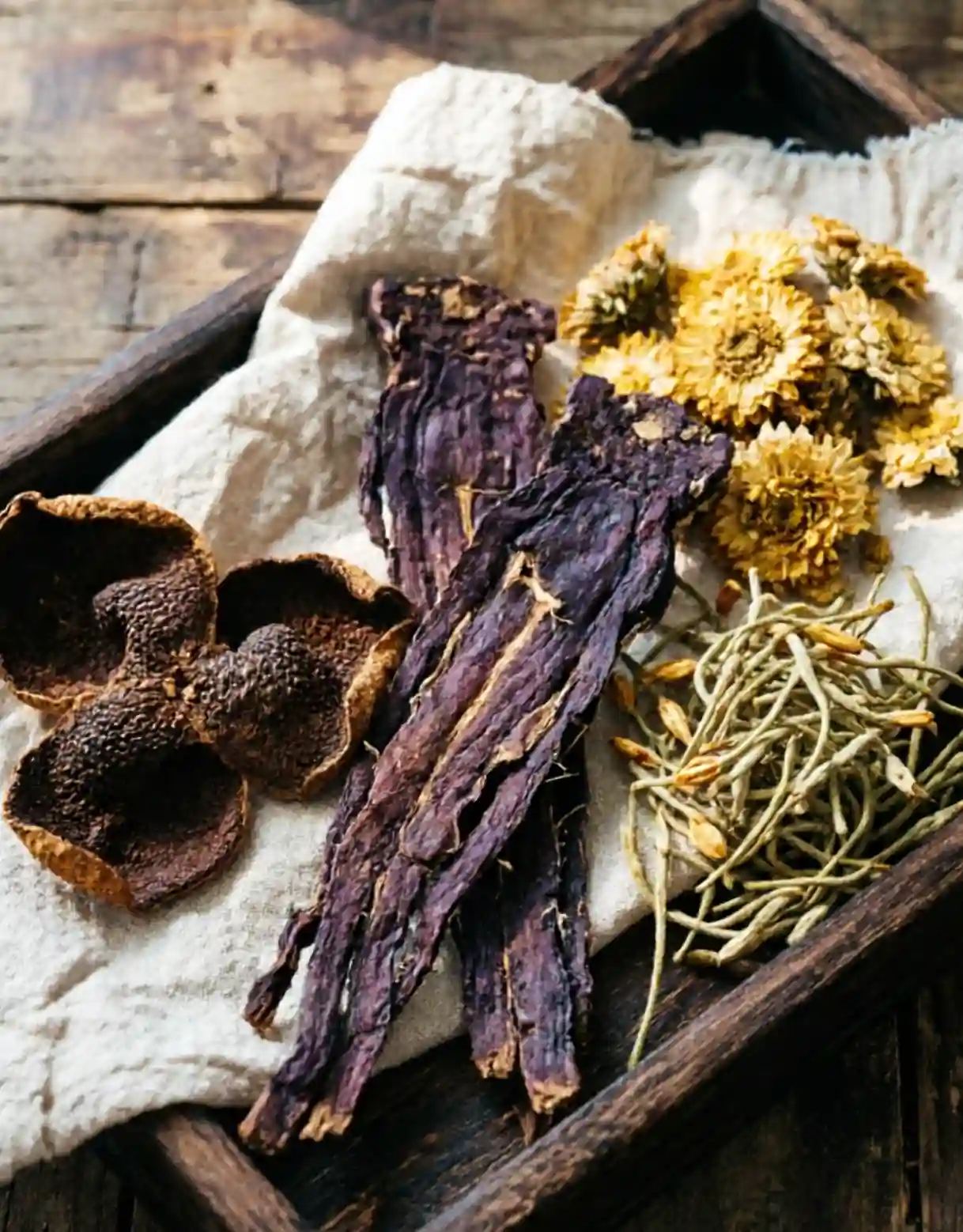
This product is folded into a seven-pointed star shape or flattened into a five-pointed star shape, with individual pieces resembling willow leaves. When fully flattened, the diameter is 15-28 cm and the thickness is 0.2-0.5 cm. The outer surface is yellow-green to yellow-brown, glabrous (hairless). The inner surface is yellowish-white or pale yellow-brown with vein-like patterns. The texture is brittle, easily broken, with an uneven fracture surface; the outer edge has a row of irregularly sunken oil chambers, while the inner side is slightly soft and elastic. Odor: aromatic; Taste: bitter and slightly acrid.
Chemical Constituents
This product contains components such as naringin, nobiletin, naringenin, limonene, neohesperidin, rhofolin, epi-bicyclosesquiphellandrene, myristic acid, ergost-5-en-3-ol, and pyrocatechol.
Pharmacology
Expectorant; antitussive; sedative; antimicrobial.
Properties and Channel Entry
Pungent and bitter, warm. Enters the Lung and Spleen channels.
Functions and Indications
Regulates Qi and relieves abdominal distention, dries Dampness and transforms Phlegm
Dosage and Administration
Oral: decoct in water 3-6 g; or made into pills or powder.
Precautions and Contraindications
Contraindicated in patients with Qi deficiency, Yin deficiency, dry cough with scanty sputum, and those with dry cough.
Prescriptions
1. For phlegm-induced wheezing: Huajuhong (Citri Grandis Exocarpium) and Banxia (Pinelliae Rhizoma) 15 g each, Chuanbei (Fritillariae Cirrhosae Bulbus) 9 g, grind together into a fine powder. Take 6 g each dose with boiled water. (Reference from "Research Materials on Prescriptions for Common Diseases") 2. For bronchitis: a. Guojianlong 30 g, Huajuhong 15 g, Xingren (Armeniacae Semen Amarum) 9 g, decoct and take. b. Shichuanlian 30 g, Huajuhong 15 g, Qingzhubiao 12 g, decoct and take. (From "Yunnan Chinese Herbal Medicine")