Pinyin: Shiliupi
Aliases
Shiliu ke, Suanshiliu pi, Suanliu pi, Xiliu pi.
Source
Plant of the Pomegranate familyPunica granatumL. dried pericarp.
Botanical Description
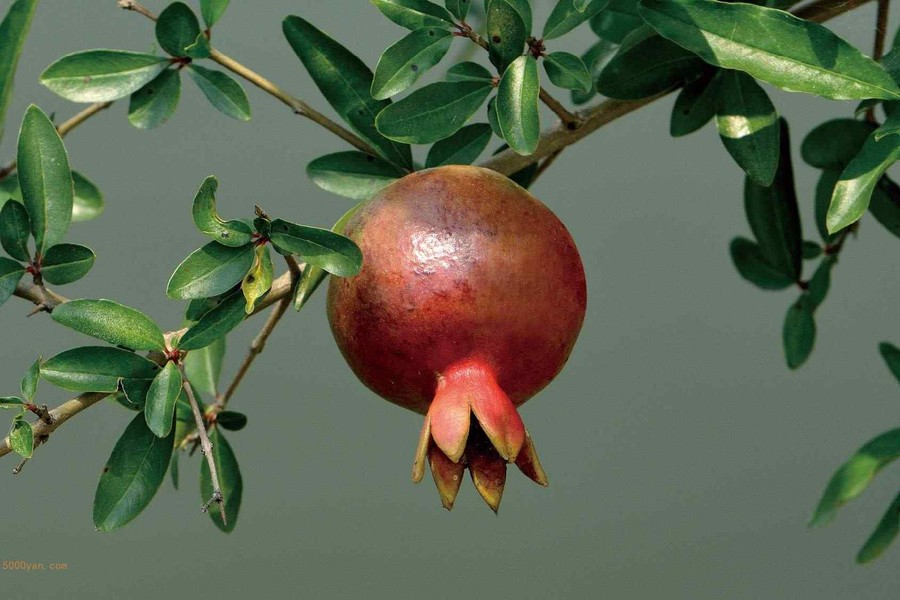
Deciduous shrub or tree. Typically 3-5 m tall. Branches often ending in sharp long spines, young branches angular, glabrous, old branches nearly terete. Leaves opposite or clustered; petiole short; leaf blade oblong-lanceolate, papery, 2-9 cm long, 1-1.8 cm wide, apex acute or slightly emarginate, base gradually narrowed, entire, upper surface glossy; lateral veins slightly fine and dense. Flowers 1-5 at branch apex; pedicel 2-3 mm long; flower diameter about 3 cm; calyx tube campanulate, 2-3 cm long, usually red or pale yellow, 6-lobed, lobes slightly spreading, ovate-triangular, with a yellowish-green gland near the apex on the outer surface, margin with small papillae; petals 6, red, yellow, or white, alternate with sepals, obovate, 1.5-3 cm long, 1-2 cm wide, apex rounded; stamens numerous, inserted in the middle of the calyx tube, anthers globose, filaments slender and short; pistil 1, ovary inferior or semi-inferior, stigma capitate. Berry subglobose, 5-12 cm in diameter, usually pale yellowish-brown, pale yellowish-green, or tinged with red, pericarp thick, apex with persistent calyx lobes. Seeds numerous, obtusely angled, red to milky white. Flowering period: May-June. Fruiting period: July-August.
Habitat and Distribution
It grows on sunny slopes or is cultivated in gardens and other places. It is distributed in most regions of China.
Harvesting and Processing
Collect the pericarp after fruit ripens in autumn and dry it in the sun.
Medicinal Properties
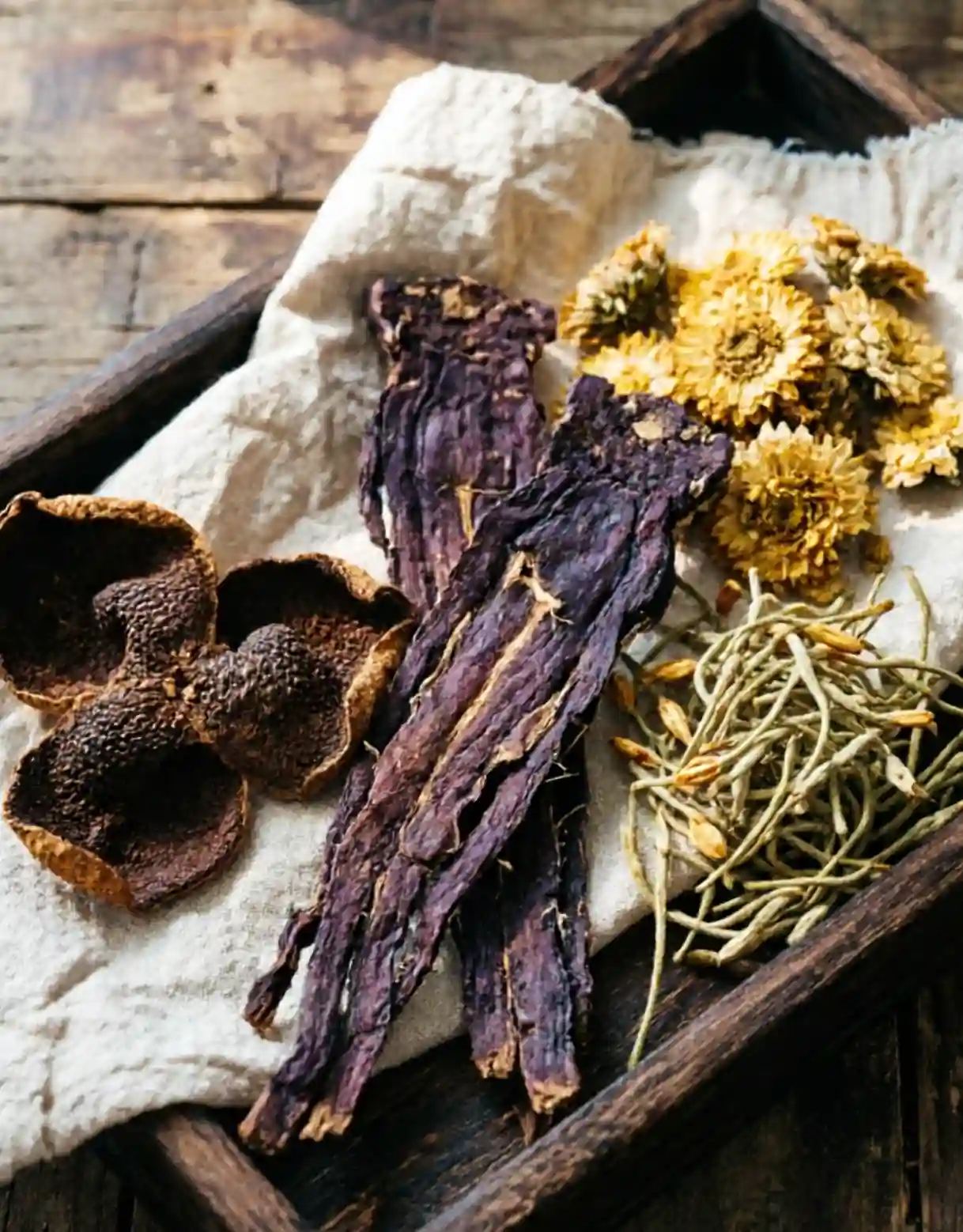
This product is irregularly shaped, appearing as slices or scoops of varying sizes, 1.5-3 mm thick. The outer surface is reddish-brown, brownish-yellow, or dark brown, slightly glossy, rough, with numerous wart-like protrusions, and some have protruding tubular persistent calyxes and short, thick fruit stalks or fruit stalk scars. The inner surface is yellow or reddish-brown, with raised, reticulate fruit stalk remnants. The texture is hard and brittle, the cut surface is yellow and slightly granular. Odor: faint; Taste: bitter and astringent.
Chemical Constituents
This product contains components such as punicalagin, pelletierine, isopelletierine, pelletierine, and punicalagin new tannins.
Pharmacology
Convergent; antibacterial; antiviral; anthelmintic; treats diarrhea caused by digestive dysfunction and imbalance.
Properties and Channel Entry
Sour, astringent, and warm. Enters the Large Intestine channel.
Functions and Indications
Astringes the intestines to stop diarrhea, stops bleeding, and expels parasites
Dosage and Administration
Oral: decoct in water, 3-10 g; or made into pills or powder. External use: appropriate amount, decoct in water for fumigation and washing, grind into powder for sprinkling or mix for application.
Precautions and Contraindications
This product has a certain degree of toxicity, and the dosage should not be excessive to avoid poisoning.
Prescriptions
1. For sudden severe diarrhea and dysentery with red and white mucus: dried pomegranate rind, burnt to preserve the property, any amount, grind into fine powder. Take 6 g on an empty stomach with rice water. (From *Xiu Zhen Fang*, citing an experiential formula) 2. For scalds and burns: grind pomegranate rind into powder, mix with borneol and sesame oil, apply externally. (From *Selected Chinese Herbal Medicines from Shaanxi, Gansu, Ningxia, and Qinghai*) 3. For rectal prolapse: pomegranate rind and aged wall earth, add a small amount of alum, decoct in a strong concentration for fumigation and washing; then stir-fry and grind gallnut into powder, apply and support the prolapse back. (From *Yi Chao Lei Bian*) 4. For frostbite that has long ulcerated and not healed: pomegranate rind, winter melon peel, and sugarcane peel, burn to preserve the property, grind into powder and apply. (From *Ben Cao Hui Yan*)