Pinyin: Yuganzi
Aliases
Anmole, Yugan, Youganzi, Niuganzi
Source
For Euphorbiaceae: decoct 10-20 g, or grind into powder and take with water.Phyllanthus emblicaL. dried mature fruit.
Botanical Description
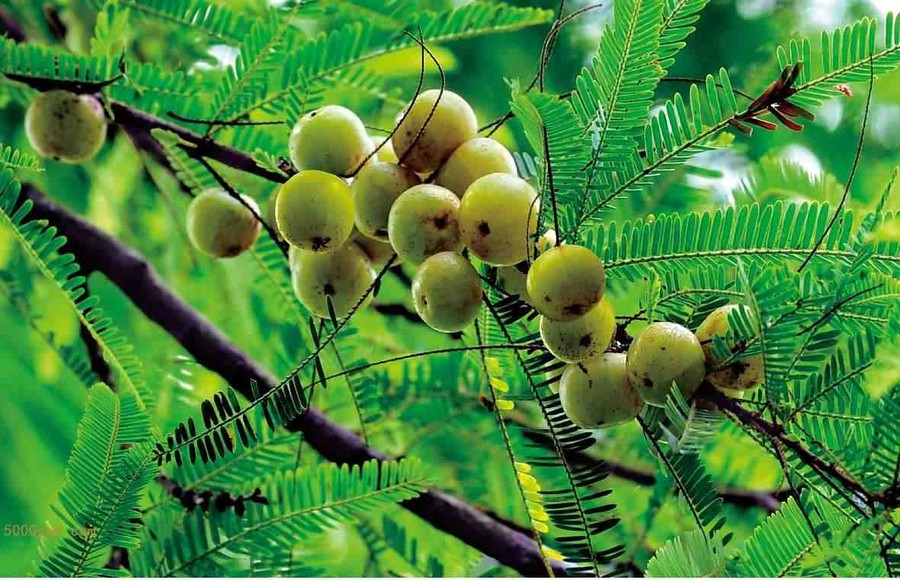
Deciduous small tree or shrub, 3-8 m tall. Bark grayish-white, thin and easily exfoliating, revealing large patches of reddish-red inner bark. Leaves alternate on slender branchlets, 2-ranked, densely arranged, resembling pinnate compound leaves; nearly sessile; entire branchlets fall off when leaves drop; stipules linear-lanceolate; leaf blades oblong-linear or linear-oblong, 1-2 cm long, 3-5 mm wide. Flowers clustered in leaf axils, small, yellow, unisexual, monoecious, with short pedicels; each cluster contains 1 female flower; each flower has 5-6 sepals, no petals; male flowers have a disc forming 6 minute glands, stamens 3, fused into a column; female flowers have a cup-shaped disc with lacerate margin, ovary half-inferior. Fruit fleshy, about 1.5 cm in diameter, round with slight 6-ribs, initially yellowish-green, turning bright red when ripe, taste first sour and astringent then sweet. Flowering period April to May, fruiting period September to November.
Habitat and Distribution
Growing in sparse forests at altitudes of 300-1200 m or on sunny slopes. Distributed in Fujian, Taiwan, Guangdong, Hainan, Guangxi, Sichuan, Guizhou, Yunnan, and other regions.
Harvesting and Processing
Harvest from winter until the following spring when the fruit is ripe, remove impurities, and dry.
Medicinal Properties
This product is spherical or oblate-spherical in shape, with a diameter of 1.2-2 cm. The surface is brownish-brown or dark green, with light yellow granular protrusions, wrinkles, and indistinct 6 ridges; the fruit stalk is approximately 1 mm long. The exocarp is 1-4 mm thick, hard and brittle. The mesocarp is yellowish-white, hard and stone-like, with a slightly 6-ridged surface; on the upper part of the dorsal suture there are several striations (vein lines), which may split into 6 valves when dry. Seeds are 6 in number, nearly trigonous, and brown. Odor: faint; Taste: sour and astringent, with a sweet aftertaste.
Chemical Constituents
This product contains gallic acid, glucose gallotannin, corilagin, lupeol, chebulinic acid, and chebulagic acid, among other components.
Pharmacology
Antibacterial; reduces blood lipids.
Properties and Channel Entry
Sweet, sour, astringent, cool. Enters the Lung and Stomach channels.
Functions and Indications
Clears Heat and cools Blood, promotes digestion and strengthens the Stomach, generates body fluids and stops cough. Used for Blood-Heat and Blood stasis, indigestion, abdominal distension, cough, sore throat, and dry mouth.
Dosage and Administration
Oral: decoct in water, 15-30 g; or extract juice from fresh material.
Precautions and Contraindications
Those with Spleen and Stomach deficiency-cold should use with caution.
Prescriptions
1. For common cold with fever, cough, sore throat, dry mouth, thirst, and vitamin C deficiency (scurvy): Take 10-30 fresh Yuganzi (*Phyllanthus emblica*) fruits, decoct in water and take orally. (Guangzhou Military Region *Handbook of Commonly Used Chinese Herbal Medicines*) 2. For asthma: Take 21 Yuganzi fruits, first boil pig heart and lungs, remove the foam, then add Yuganzi and cook until done, consume the decoction along with the meat. (*Kunming Folk Commonly Used Herbal Medicines*) 3. For dyspeptic vomiting, abdominal pain, and diarrhea: Chew and eat 5-10 Yuganzi fruits or 5-8 salt-preserved fruits; or take 1 tablespoon of the salt-preserved fruit liquid, mixed with boiling water. (*Fujian Chinese Herbal Medicine*) 4. For hypertension: Eat 5-8 fresh Yuganzi fruits raw, twice daily. (*Fujian Materia Medica Annals*)