Pinyin: Muhudie
Aliases
Qianzhangzhi, Yuhudie, Yunguzhi, Baiqianceng
Source
Bignoniaceae plant Oroxylum indicumOroxylum indiciumDried ripe seeds of (L.) Vent.
Botanical Description
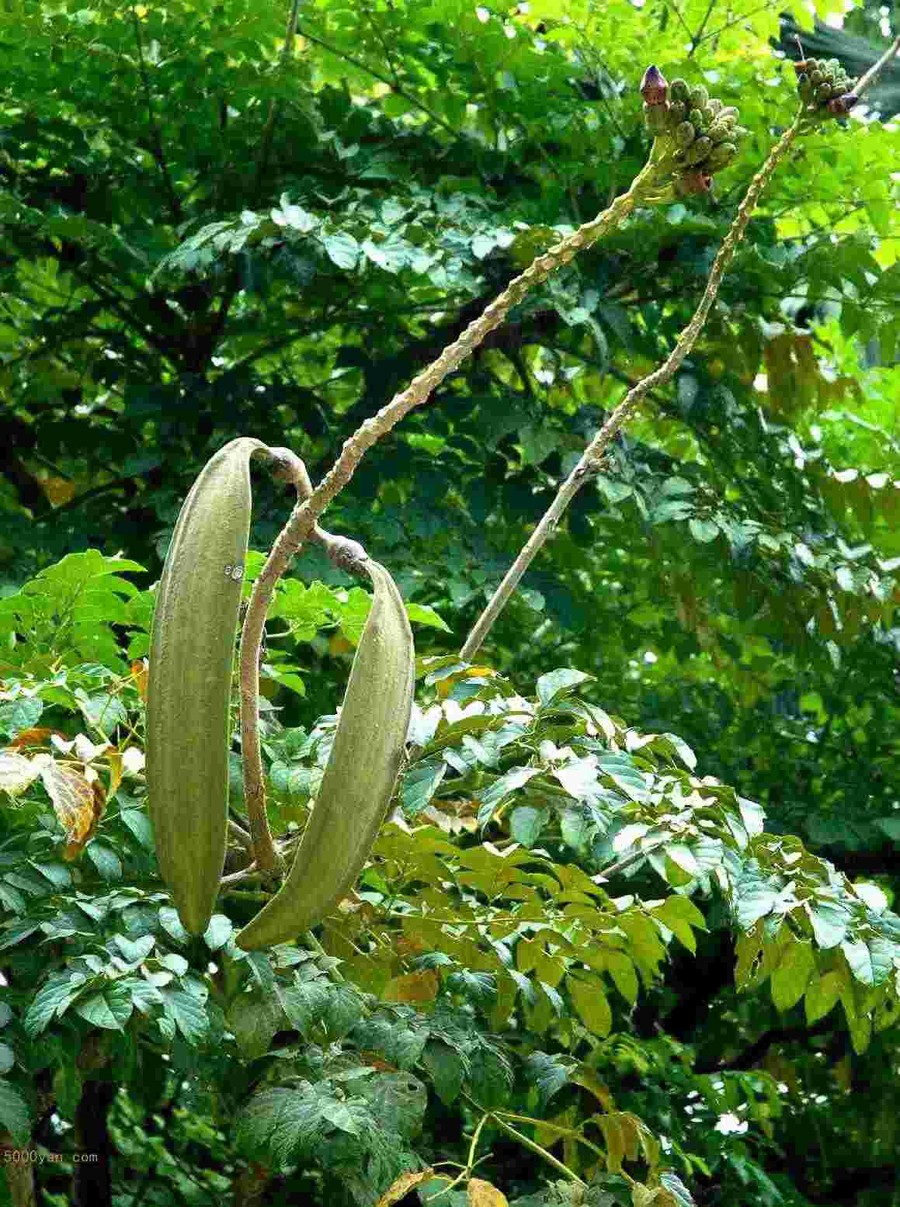
Small tree, 7-12 m tall. Bark thick, with lenticels. Branchlets with numerous prominent lenticels, leaf scars distinct and large. Leaves opposite; large, odd-pinnate, 2-4 times pinnately compound leaves, borne near the apex of the stem, 60-160 cm long, 20-80 cm wide; numerous leaflets, petiolules 5-10 mm long, leaflets triangular-ovate, 6-14 cm long, 4-9 cm wide, apex shortly acuminate, base rounded or broadly cuneate and oblique, margin entire, upper surface green, lower surface pale green, glabrous on both surfaces, turning blue when dry. Terminal thyrse, 40-150 cm long, pedicels about 7 cm long; calyx campanulate, 2.2-4.5 cm long, 2-3 cm wide, purple, apex truncate, persistent; corolla orange-red, fleshy, 3-9 cm long, campanulate, 5-8.5 cm in diameter, apex 5-lobed, lobes unequal; stamens 5, inserted at the middle of the corolla tube, exserted; filament bases woolly, one filament shorter; disk large, fleshy; style 5-7 cm long, stigma 2-lobed. Capsule woody, flat, broadly linear, pendulous, 40-120 cm long, 5-8.5 cm wide, apex shortly acute, base cuneate, margin slightly incurved, with a slightly prominent dorsal suture, brownish-yellow when mature, dehiscent along the ventral suture, valves with a midrib. Seeds numerous, seed with wing 6-7.5 cm long, 3.5-4 cm wide, entirely surrounded by a white, translucent, thin wing except at the base. Flowering July to October; fruiting October to December.
Habitat and Distribution
Growing at altitudes below 1000 m on slopes, beside streams, in valleys, or in shrublands. Distributed in Fujian, Taiwan, Guangdong, Hainan, Guangxi, Sichuan, Guizhou, Yunnan, and other regions.
Harvesting and Processing
Harvest the ripe fruit in autumn and winter, sun-dry until the fruit splits open, remove the seeds, and sun-dry until dry.
Medicinal Properties
This product is a butterfly-shaped thin slice, with three sides extending into broad, thin wings except at the base, measuring 5-8 cm in length and 3.5-4.5 cm in width. The surface is light yellowish-white, the wings are translucent with a silky luster, exhibiting radial striations, and the edges are mostly broken. It is light in weight; when the seed coat is peeled off, a thin film-like endosperm is seen tightly wrapping around the cotyledons. There are 2 cotyledons, butterfly-shaped, yellowish-green or yellow, with a long diameter of 1-1.5 cm. The odor is faint, and the taste is slightly bitter.
Chemical Constituents
This product mainly contains baicalein, chrysin-7-O-β-D-pyranoglucoside, chrysin-7-O-β-D-glucuronic acid glycoside, apigenin, baicalin, oroxylin A, oroxylidin, oroxindin, and chrysin, among others.
Pharmacology
Anti-cataract; anti-inflammatory; anti-allergic; diuretic; choleretic; cholesterol-lowering.
Properties and Channel Entry
Bitter, sweet, and cool. Enters the Lung, Liver, and Stomach channels.
Functions and Indications
Clears the Lungs, benefits the throat, soothes the Liver and harmonizes the Stomach. Used for Lung-Heat cough, throat obstruction, hoarseness, and Liver-Stomach Qi pain.
Dosage and Administration
Oral: Decoct 6-9 g; grind into powder 1.5-3 g. External: Apply an appropriate amount as a compress; or sprinkle the powdered medicine on the affected area.
Prescriptions
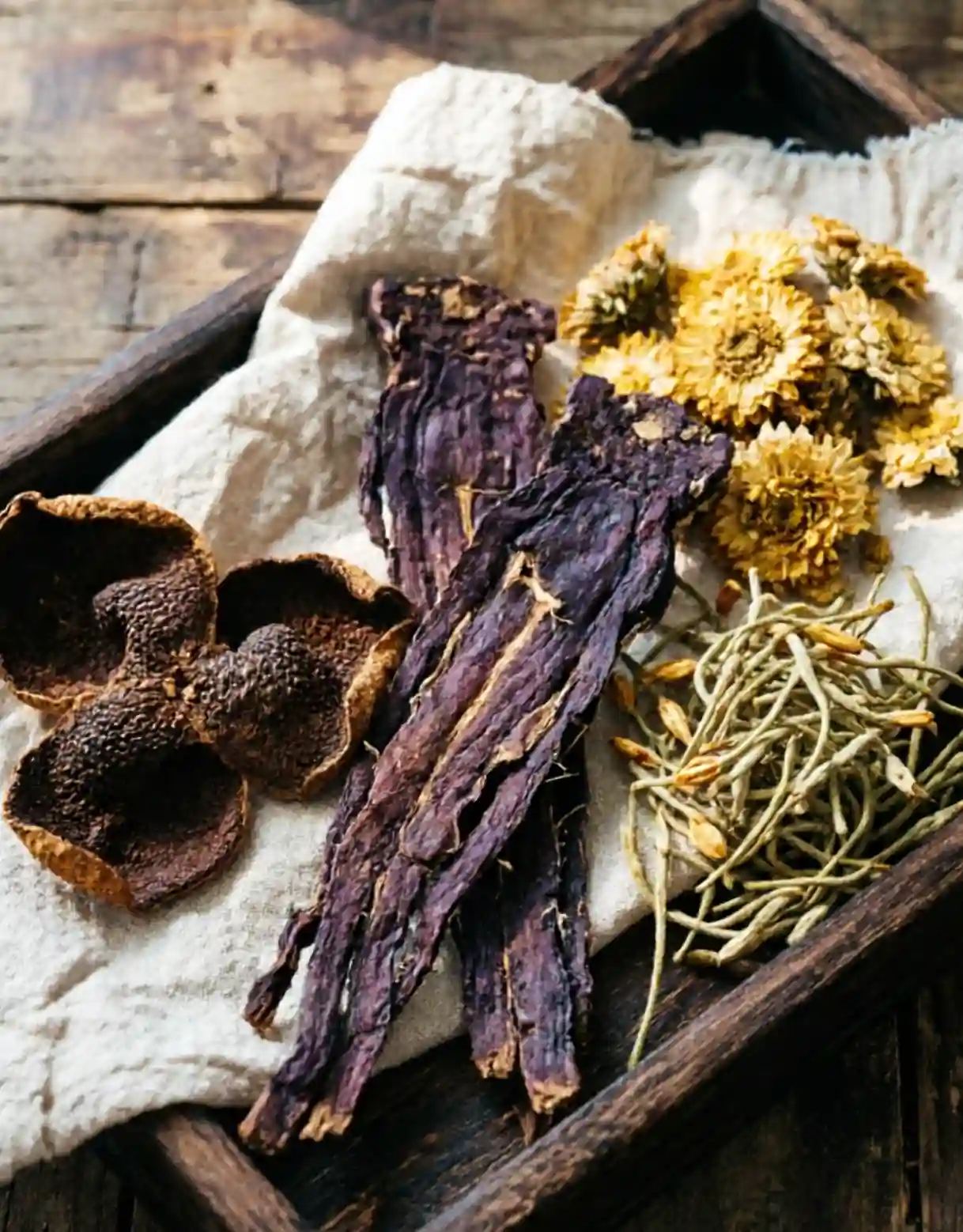
1. For dry cough, hoarseness, sore throat and throat pain: Mutongcao 2.4 g, Pangdahai 9 g, Chantui 3 g, Gancao 5 g, and appropriate amount of rock sugar. Decoct in water and take orally. (Zhongshan Medical College, *Clinical Application of Chinese Materia Medica*, Mutongcao Decoction) 2. For chronic cough with hoarseness: a. Mutongcao 5 g, Xuanshen 9 g. Decoct in water and mix with rock sugar to take. b. Mutongcao 6 g, Zhebeimu 3 g, Juhua 9 g. Stew with rock sugar and take. (*Fujian Materia Medica*) 3. For chronic pharyngitis: Mutongcao 3 g, Yinhua, Juhua, Shashen, and Maidong each 9 g. Decoct in water and drink as tea. (*Hong Kong Chinese Herbal Medicine*) 4. For liver Qi pain: Mutongcao 20-30 pieces, dry-roast in a copper vessel until crisp, then grind into fine powder. Take with good quality wine. (*Supplement to the Compendium of Materia Medica*) 5. For central retinitis: Mutongcao 6 g, Jieyetiesaozhou 30 g, and 1 duck liver. Stew in water and take. (*Fujian Materia Medica*)