Pinyin: Tianguazi
Aliases
Ganguazi, Tianguaren, Tianguaban.
Source
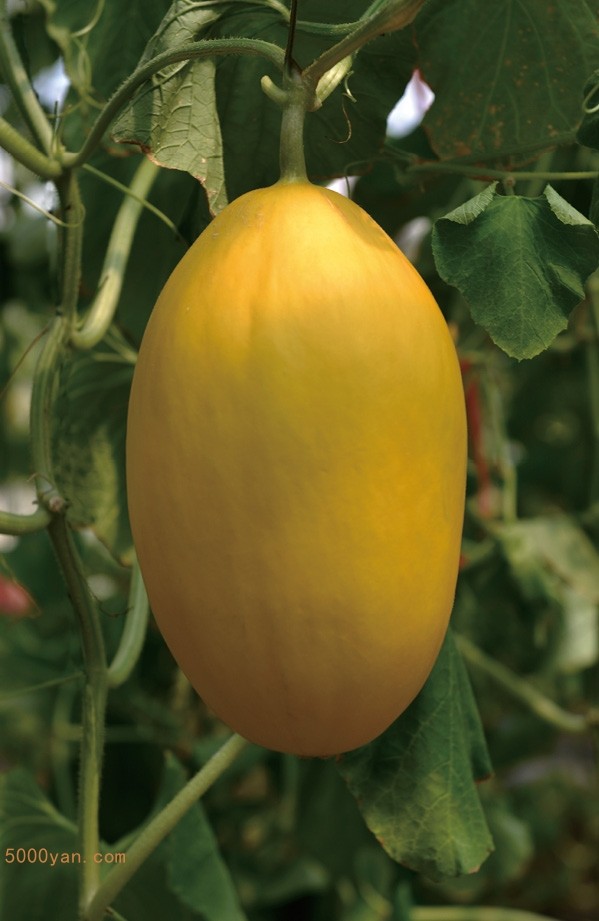
Cucurbitaceae plant *Cucumis melo* L.Cucumis meloL. of dried ripe seeds.
Botanical Description
Annual prostrate or climbing herb. Stems and branches bear yellowish-brown or white coarse hairs and wart-like protrusions. Tendrils solitary, finely pubescent. Leaves alternate; petiole 8-12 cm long, with grooves and short stiff hairs; leaf blade thick papery, nearly round or kidney-shaped, upper surface covered with white coarse hairs, lower surface densely hairy along veins, margin entire or 3-7 shallowly lobed, lobe apex rounded, with serrations. Flowers unisexual, monoecious; male flowers several, clustered in leaf axils; pedicel slender, 0.5-2 cm long, pubescent; calyx tube narrowly campanulate, densely covered with white long hairs, lobes nearly subulate; corolla yellow, about 2 cm long, lobes ovate-oblong, acute; stamens 3, filaments very short, anther cells curved; female flower solitary, pedicel pubescent; ovary oblong, densely covered with long hairs and stiff hairs, style 1-2 mm long, stigmas appressed. Fruit variable in shape and color, generally spherical or long ellipsoid, pericarp smooth, with longitudinal grooves or stripes, flesh white, yellow, or green. Seeds dirty white or yellowish-white, ovate or oblong. Flowering and fruiting in summer.
Habitat and Distribution
Widely cultivated throughout various regions of China.
Harvesting and Processing
Collect the ripe fruit in summer and autumn, wash clean, and sun-dry.
Medicinal Properties
This product is flat and elongated ovoid in shape, 5-9 mm long and 2-4 mm wide. The surface is yellowish-white, light brownish-red, or brownish-yellow, smooth, and slightly lustrous. One end is slightly pointed, the other end is blunt and rounded. The seed coat is relatively hard and brittle, containing membranous endosperm and 2 cotyledons inside. Odor: faint; Taste: bland.
Chemical Constituents
This product mainly contains crystalline globulin, gluten, galactose, fatty oil and other components.
Pharmacology
Repels parasites; inhibits bacteria.
Properties and Channel Entry
Sweet, cold. Enters the Lung, Stomach, and Large Intestine channels.
Functions and Indications
Clears the Lungs, moistens the Intestines, transforms stasis, expels pus, and treats injuries to relieve pain. Used for Lung-Heat cough, constipation, Lung abscess, Intestinal abscess, traumatic injuries, and tendon and bone fractures.
Dosage and Administration
Oral administration: decoction, 10-15 g; or ground into powder, 3-6 g.
Prescriptions
1. For chronic bronchitis: Tian Gua Zi (Melon Seed) 60 g, grind into powder, take 6 g each time with boiled water, 2 times daily. (Zhejiang Medicinal Flora) 2. For pulmonary edema and exudative pleurisy: Dong Gua Zi (Wax Gourd Seed) and Tian Gua Zi (Melon Seed) 120 g each, crush and boil in water to make a tea for drinking. (Shi Jinmo’s Paired Herbs) 3. For restlessness and thirst: Tian Gua Zi (Melon Seed) 9 g, Mai Men Dong (Ophiopogon Root) 12 g, Tian Hua Fen (Trichosanthes Root) 12 g, decoct in water and take orally. (Qingdao Chinese Herbal Medicine Manual) 4. For intestinal abscess and lung abscess: Tian Gua Zi (Melon Seed) 30 g, add appropriate amount of white sugar, mash and grind into a fine paste, rinse down with boiled water. (Food Herbs and Simple Prescriptions) 5. For halitosis: Grind Tian Gua Zi (Melon Seed) into powder and mix with honey. Each morning on an empty stomach after rinsing the mouth, hold a pill the size of a jujube pit in the mouth; also apply to the teeth. (Important Prescriptions Worth a Thousand Gold)