Pinyin: Hongdoukou
Aliases
Hongkou, Liangjiangzi, Hongkou.
Source
1. For pneumonia: Renshen 6 g, decoct in water and take orally. 2. Internal use: decoct 3-10 g.Alpinia galangaThe dried ripe fruit of Willd.
Botanical Description
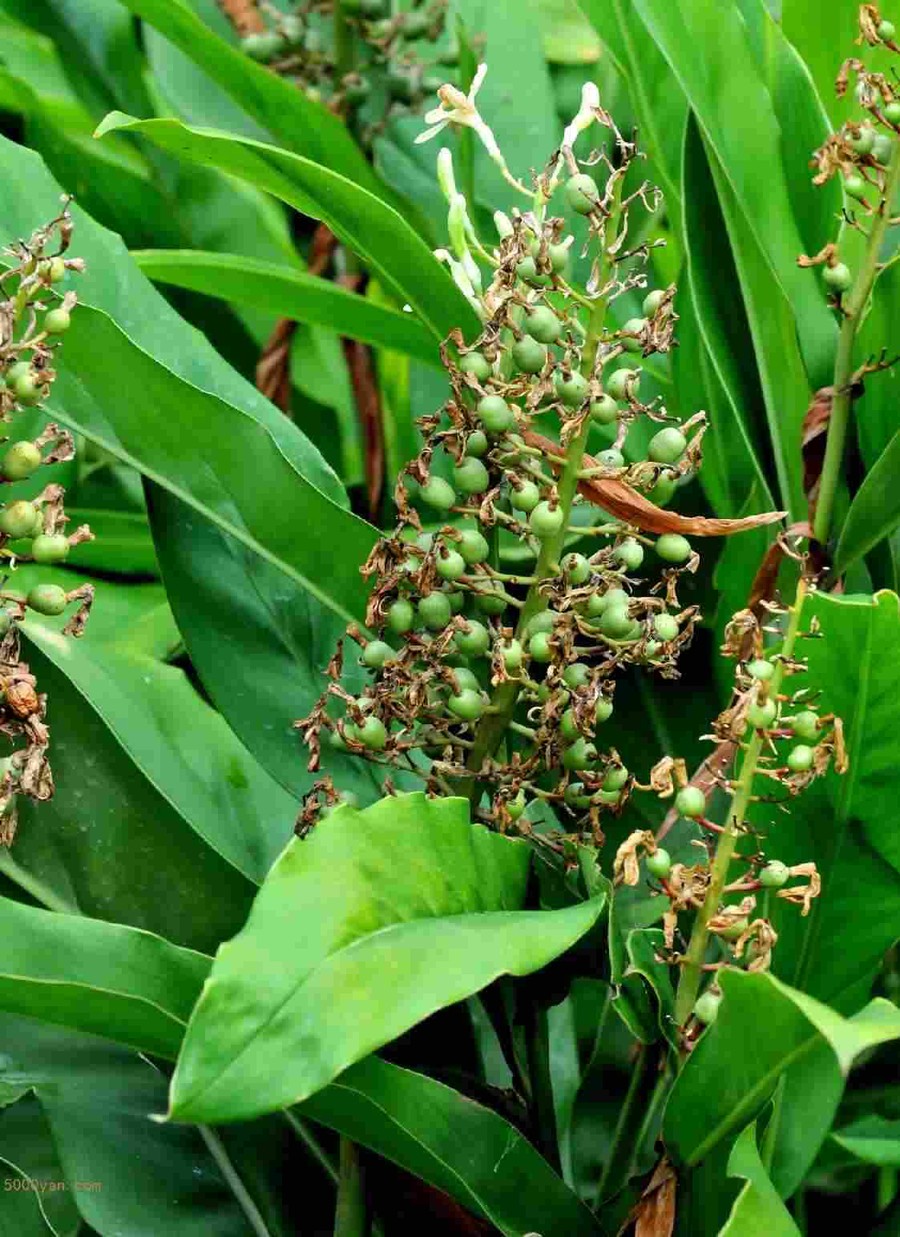
Perennial clumping herb, 1.5-2.5 m tall. Rhizome stout, cylindrical, noded, brownish-red with a slightly pungent taste. Leaves in 2 rows, sessile or with very short petioles; leaf blades oblong or broadly lanceolate, 30-50 cm long, 6-10 cm wide, apex acute, base cuneate, margins blunt, often brownish-white, glabrous on both surfaces or with long soft hairs abaxially; ligule 5-10 mm long, apex blunt. Inflorescence a terminal panicle, erect, many-flowered, 14-32 cm long, 4-8 cm in diameter, rachis densely pubescent, much branched; involucral bracts linear, about 20 cm long; bracteoles lanceolate or narrowly oblong, 1-2 cm long; flowers greenish-white, fragrant; calyx tubular, unequally 3-lobed at apex, ciliate; corolla tube about as long as calyx tube, lobes 3, oblong, lip obovate to oblong, 2.5-3 cm long, 8-12 mm wide, clawed at base, with red stripes; stamen 1, as long as lip, anther oblong, staminodes 2, lanceolate, 6-10 mm long, inserted at base of lip; ovary inferior, glabrous. Style slender, stigma slightly enlarged. Capsule oblong, indehiscent, 1-1.5 cm long, about 7 mm wide, slightly constricted in the middle, orange-red when ripe. Seeds polygonal, brownish-black. Flowering June-July, fruiting July-October.
Habitat and Distribution
Grows on hillsides, open grasslands, or among shrubs. Distributed in Guangdong, Hainan, Guangxi, and Yunnan.
Harvesting and Processing
Harvest in autumn when the fruits turn red, remove impurities, and dry in the shade.
Medicinal Properties
This product is long-spherical, slightly narrower in the middle, 0.7-1.2 cm long, and 0.5-0.7 cm in diameter. The surface is reddish-brown or dark red, slightly wrinkled, with a yellowish-white tubular persistent calyx at the apex and a fruit stalk scar at the base. The pericarp is thin and easily broken. There are 6 seeds, which are oblate or triangular-polyhedral, blackish-brown or reddish-brown, covered externally with a yellowish-white membranous aril, and the endosperm is grayish-white. Odor: aromatic; Taste: pungent.
Chemical Constituents
This product contains racemic 1-acetoxychavicol acetate, trans-3,4-dimethoxycinnamyl alcohol, 1,8-cineole, alloaromadendrene, linalool, nerolidol, citronellol, galangal aldehyde A, galangal aldehyde B, and others.
Pharmacology
Anti-ulcer; anti-pathogenic microorganism; anti-tumor.
Properties and Channel Entry
Acrid, warm. Enters the Spleen and Lung channels.
Functions and Indications
Disperses Cold and dries Dampness, awakens the Spleen and promotes digestion
Dosage and Administration
Oral: decoct in water, 3-6 g; or grind into powder. External: apply an appropriate amount, grind into powder for nasal insufflation or mix for topical application.
Precautions and Contraindications
Contraindicated in patients with Yin deficiency with Heat.
Prescriptions
1. For epigastric pain (including chronic gastritis and neuropathic stomach pain): Hongdoukou 3 g, grind into powder, take 1 g per dose, swallow with brown sugar water, 3 times daily. (From "Food Herbs and Folk Prescriptions") 2. For gastric and duodenal ulcers: Hongdoukou, Lianqiao, and Jineijin each 9 g, Huanglian 4.5 g, decoct in water and take orally. (From "Selected Chinese Herbal Prescriptions") 3. For wind-cold toothache: Grind Hongdoukou into powder, insert a small amount into the nostril on the affected side, and also apply to the tooth to induce saliva; or add Shexiang. (From "Weisheng Jiabao Fang") 4. For chronic bronchitis with difficulty expectorating phlegm: Hongdoukou 3 g, Laifuzi and Suzi each 6 g, decoct in water, take in 2 divided doses daily. (From "Food Herbs and Folk Prescriptions")