Pinyin: Jiucaizi
Aliases
Jiuzi, Jiucairen.
Source
Liliaceae plant Chinese chiveAllium tuberosumDried ripe seeds of *Rottl. ex Spreng.*
Botanical Description
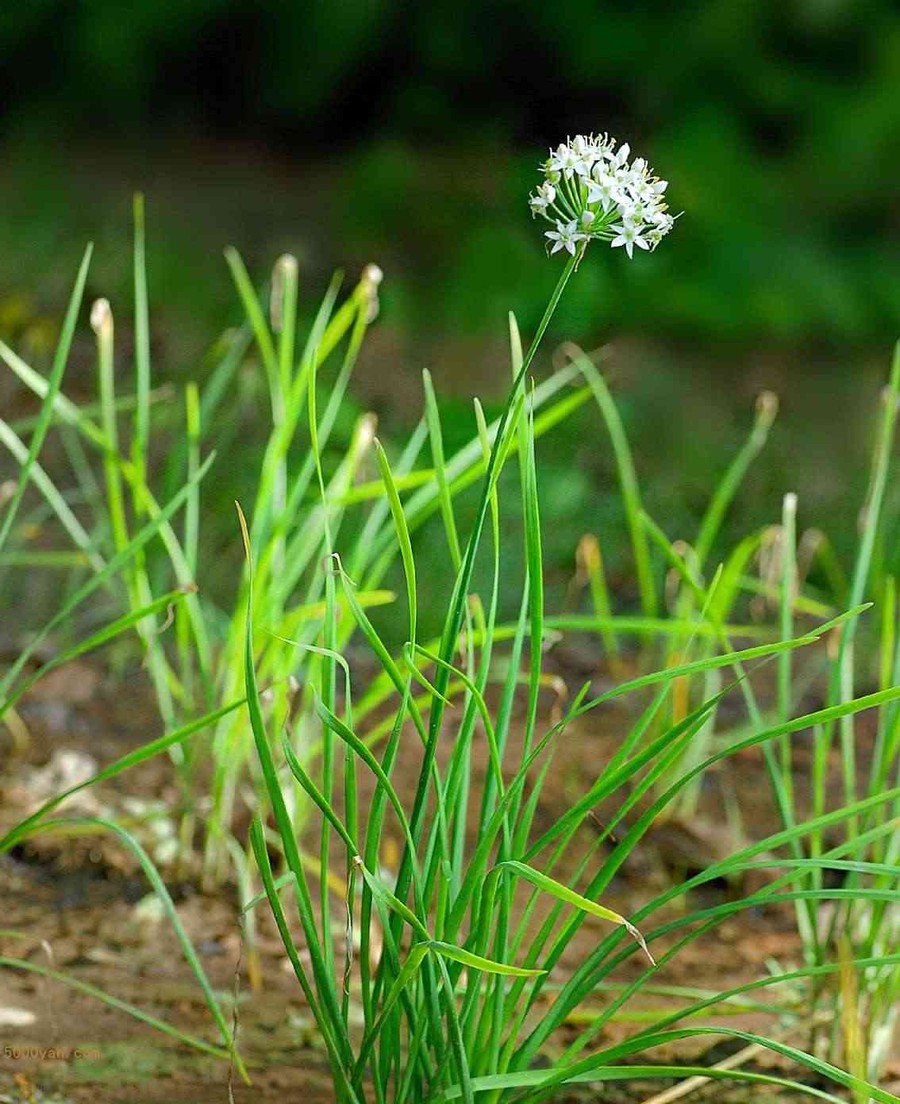
A perennial herb, 20-45 cm tall, with a characteristic strong odor. Rhizome horizontal, bulbs narrowly conical and clustered; bulb outer skin yellowish-brown, reticulate-fibrous. Leaves basal, linear, flat, 15-30 cm long, 1.5-7 mm wide. Involucre 2-lobed, shorter than the umbel, persistent; umbels clustered or globose, many-flowered; pedicels 2-4 times longer than the perianth; bracteoles present; flowers white or slightly reddish; perianth segments 6, narrowly ovate to oblong-lanceolate, 4.5-7 mm long; filaments basally fused and adnate to the perianth, 4/5 as long as the perianth segments, narrowly triangular-subulate; ovary wall with fine verrucose protuberances. Capsule with obcordate carpels. Flowering and fruiting period: July to September.
Habitat and Distribution
Cultivated extensively throughout the country.
Harvesting and Processing
Harvest the fruit clusters when ripe in autumn, sun-dry them, rub out the seeds, and remove impurities.
Medicinal Properties
Seeds flat-ovate, slightly concave on one side and raised on the other, apex obtuse, base slightly pointed, 3-4 mm long, 2-3 mm wide. Surface black, raised side with distinct reticulate wrinkles, concave side with less distinct wrinkles, base with two small protrusions; the shorter protrusion has a grayish-brown or grayish-white apex (hilum), the longer protrusion apex is the micropyle. Longitudinal section reveals a very thin seed coat, grayish-white endosperm, white curved embryo with 1 cotyledon. Texture hard. Odor: characteristic; Taste: slightly acrid.
Chemical Constituents
This product mainly contains vitamin C, sulfides, alkaloids, coumarins, saponins, cardiac glycosides, sugars, and other constituents.
Properties and Channel Entry
Pungent, sweet, warm. Enters the Liver and Kidney channels.
Functions and Indications
Warms and tonifies the Liver and Kidney, strengthens Yang and consolidates essence
Dosage and Administration
Internal use: decoction, 6-12 g; or in pill or powder form.
Precautions and Contraindications
Contraindicated in patients with Yin deficiency and Fire hyperactivity.
Prescriptions
1. For consumptive disease with urinary spermatorrhea: Chinese chive seeds 2 sheng, polished round-grained rice 3 sheng. The above two ingredients, boil with 1 dou 7 sheng of water into a congee. Take 6 sheng of the juice, divided into three doses. (from *Qian Jin Yao Fang*) 2. For neurasthenia: Chinese chive seeds and Salvia miltiorrhiza 9 g each, Poria with hostwood and Polygonum multiflorum 12 g each, Schisandra chinensis 6 g. Decoct and take. (from *Anhui Zhong Cao Yao*) 3. For intractable hiccup: Chinese chive seeds, either dried or stir-fried, ground into powder and taken, 9-15 g per dose, twice daily. (from Southern *Zhong Cao Yao Xue*) 4. For deafness: Chinese chive seeds (slightly stir-fried) 0.3 g, human hair (burned to ash) 0.3 g, Croton tiglium (kernel removed) 0.15 g. Grind the above ingredients into a fine powder, wrap in cotton and insert into the ear, replace once daily. (from *Sheng Hui Fang*)