Pinyin: Yamazi
Aliases
Humazi, Bishihuma, Yamaren, Dahoma.
Source
1. For pneumonia: Renshen 6 g, decoct in water and take orally.Linum usitatissimumL. of dried ripe seeds.
Botanical Description
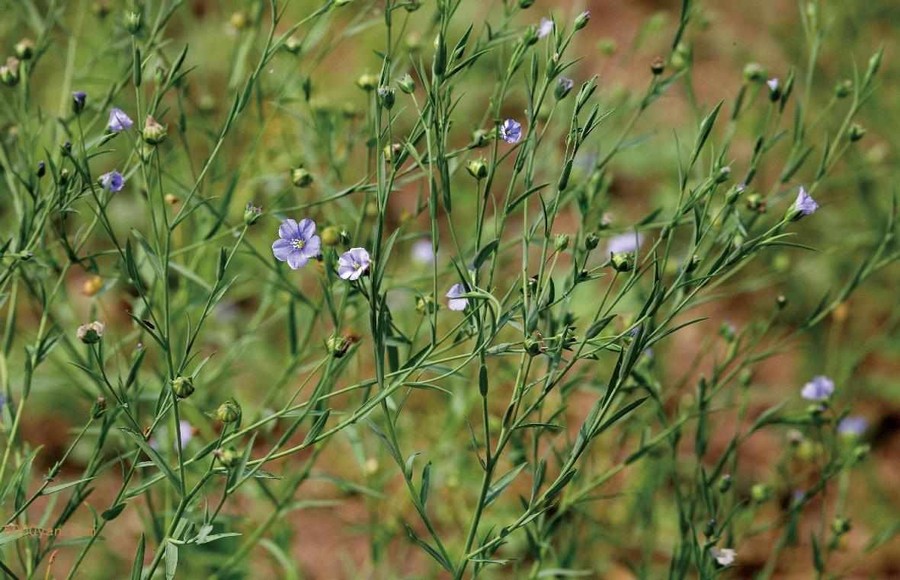
An annual erect herb, 30-100 cm or more tall. The entire plant is glabrous (hairless). Stem cylindrical, surface with longitudinal striations, base about 4 mm in diameter, slightly woody, upper part much branched. Leaves alternate; sessile or subsessile; leaf blade lanceolate or linear-lanceolate, 1-3 cm long, 2-5 mm wide, apex acuminate, base attenuate, margin entire, veins usually ternate. Flowers numerous, borne at branch tips or in upper leaf axils, one flower per leaf axil, about 15 mm in diameter, pedicel slender, about 2 cm long; calyx 5, green, separate, ovate, about half the length of petals; petals 5, blue or white, separate, broadly obovate, about 10 mm long, about 7 mm wide, margin slightly undulate; stamens 5, anthers linear; ovary superior, 5-locular, styles 5, linear, separate, about 4 mm long. Capsule subglobose or slightly compressed, 5-7 mm in diameter. Seeds ovate, 4-6 mm long, about 2 mm wide, one end slightly pointed and slightly curved, surface yellowish-brown and lustrous. Flowering period June-July, fruiting period July-September.
Habitat and Distribution
This plant has strong adaptability and is cultivated in most regions of China. It is distributed in Northeast China, Inner Mongolia, Shanxi, Shaanxi, Shandong, Hubei, Hunan, Guangdong, Guangxi, Sichuan, Guizhou, Yunnan, and other areas.
Harvesting and Processing
In autumn when the fruit is ripe, harvest the whole plant, dry it in the sun, thresh the seeds, remove impurities, and dry again in the sun.
Medicinal Properties
This product is flat and oval, with one end bluntly rounded and the other end pointed and slightly oblique, measuring 4-6 mm in length and 2-3 mm in width. The surface is reddish-brown or grayish-brown, smooth and glossy; the hilum is located in the depression at the pointed end; the raphe is light brown, located on one side edge. The seed coat is thin, the endosperm is brown and membranous; there are 2 cotyledons, yellowish-white and rich in oil. The odor is faint, and when chewed, it has a bean-like flavor.
Chemical Constituents
The seeds contain 30%-40% fatty oil, with the main component in the oil being linoleic acid.αLinolenic acid, oleic acid, myristic acid, palmitic acid, and also contains geranylgeraniol.
Pharmacology
It has lubricating and soothing effects and can be used to treat local inflammation; it also has a mild laxative effect and can prevent hyperlipidemia or atherosclerosis.
Properties and Channel Entry
Sweet, neutral. Enters the Lung, Liver, and Large Intestine channels.
Functions and Indications
Moistens Dryness and unblocks the bowels, nourishes Blood and expels Wind. Used for intestinal dryness with constipation, dry skin, itching, and hair loss.
Dosage and Administration
Internal: decoct in water, 5-10 g; or made into pills or powder. External: appropriate amount, extract oil for topical application.
Precautions and Contraindications
Contraindicated in cases of watery diarrhea; use with caution during pregnancy.
Prescriptions
1. For dry skin with scales in the elderly: Yama seed (Linum usitatissimum) and Danggui (Angelica sinensis) 90 g each, Zicao (Arnebia root) 30 g. Make into honey pills. Take 9 g with boiling water twice daily. (National Compilation of Chinese Herbal Medicine) 2. For allergic dermatitis and skin itching: Yama seed, Baixianpi (Dictamnus root bark), and Digupi (Lycium root bark) 60 g each. Make into honey pills. Take 9 g with boiling water twice daily. (National Compilation of Chinese Herbal Medicine) 3. For sores, eczema, and dampness: Yama seed 15 g, Baixianpi 12 g, Difuzi (Kochia fruit) 15 g, Kushen (Sophora root) 15 g. Decoct in water and fumigate-wash the affected area. (Shandong Chinese Herbal Medicine Manual) 4. For constipation due to deficiency in the elderly or after illness: Yama seed, Danggui, and Sangshen (mulberry fruit) in equal parts. Make into honey pills. Take 9 g three times daily. (Ningxia Chinese Herbal Medicine Manual) 5. For postpartum constipation: Yama seed and Suzi (Perilla seed) in equal parts. Grind together, mix with boiling water, and take 9 g twice daily. (Ningxia Chinese Herbal Medicine Manual) 6. For seborrheic alopecia: Fresh willow twigs and Yama seed 30 g each. Decoct and take orally. (Jiangxi Chinese Herbal Medicine) 7. For scalds and burns: Yama seed oil (sterilized at high temperature) apply to the affected area. (Food as Medicine and Simple Prescriptions)