Pinyin: Zisuzi
Aliases
Suzi, Heisuzi, Tiesuzi
Source
Plant of the Lamiaceae family, *Perilla frutescens* (L.) Britt.Perilla frutescensDried ripe fruit of (L.) Britt.
Botanical Description
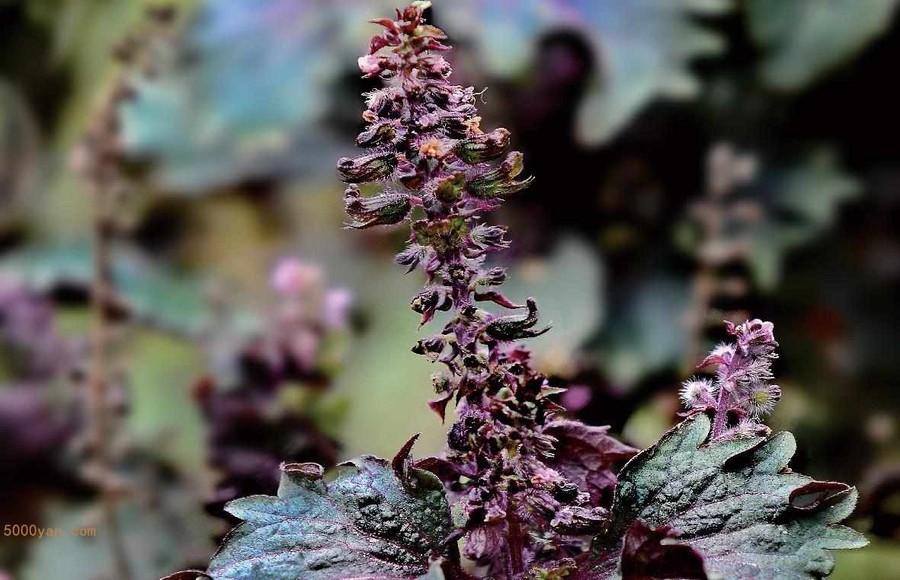
An annual herb, 30-200 cm tall, with a distinctive aromatic fragrance. Stem erect, much branched, purple, greenish-purple, or green, obtusely quadrangular, densely covered with long hairs. Leaves opposite; petiole 3-5 cm long, purplish-red or green, with long jointed hairs; leaf blade broadly ovate, ovate-orbicular, or ovate-triangular, 4-13 cm long, 2.5-10 cm wide, apex acuminate or acute, sometimes shortly caudate, base rounded or broadly cuneate, margin coarsely serrate, sometimes deeper or shallowly lobed, both surfaces purple or only the lower surface purple, sparsely hairy on both sides, denser along the veins, with fine oil glands on the lower surface; lateral veins 7-8 pairs, the lower ones slightly closer, ascending obliquely. Verticillasters, each composed of 2 flowers, arranged in one-sided false racemes, terminal and axillary, inflorescences densely long-hairy; bracts ovate, ovate-triangular, or lanceolate, entire, ciliate, with glands on the outer surface, membranous margin; pedicel 1-1.5 mm long, densely hairy; calyx campanulate, about 3 mm long, 10-veined, lower outer part densely long-hairy with yellow glands, apex 5-toothed, 2-lipped, upper lip broad, 3-toothed, lower lip 2-toothed, enlarging in fruit, base saccate; corolla labiate, 3-4 mm long, white or purplish-red, with a ring of hairs inside the corolla tube, outer surface hairy, upper lip slightly emarginate, lower lip 3-lobed, lobes suborbicular, middle lobe larger; stamens 4, didynamous, inserted at the middle of the corolla tube, barely exserted, anthers 2-celled; disk enlarged on the anterior side; pistil 1, ovary 4-lobed, style basally attached, stigma 2-lobed; disk enlarged on the anterior side; pistil 1, ovary 4-lobed, style basally attached, stigma 2-lobed. Nutlets subglobose, grayish-brown or brown, 1-1.3 mm in diameter, reticulate, fruiting calyx about 10 mm long. Flowering June to August, fruiting July to September.
Habitat and Distribution
Widely cultivated throughout various regions of China.
Harvesting and Processing
Harvest in autumn when the fruit is ripe, remove impurities, and dry in the sun.
Medicinal Properties
This product is ovoid or subglobose in shape, approximately 1.5 mm in diameter. The surface is grayish-brown or grayish-brown, with slightly raised dark purple reticulate patterns; the base is slightly pointed, with a grayish-white punctate fruit stalk scar. The pericarp is thin and brittle, easily crushed. The seeds are yellowish-white with a membranous seed coat; there are 2 cotyledons, which are off-white and oily. When crushed, it has an aromatic odor and a slightly pungent taste.
Chemical Constituents
This product mainly contains protein and glycerol trilinoleate.α- Linolenic acid, tripalmitin, and L-perillaldehyde, among other constituents.
Pharmacology
Anti-cancer.
Properties and Channel Entry
Acrid, warm. Enters the Lung channel.
Functions and Indications
Descends Qi and transforms Phlegm, stops cough and calms wheezing, moistens the Intestines and unblocks the bowels. Used for Phlegm congestion with Qi counterflow, cough and wheezing, and constipation due to Intestinal dryness.
Dosage and Administration
Internal use: decoct 5-10 g; or made into pills or powder.
Precautions and Contraindications
Contraindicated for those with Lung deficiency cough and wheezing, or Spleen deficiency with loose stools.
Prescriptions
1. For chronic cough in children with phlegm sounds like a saw in the throat, and cough and wheezing in the elderly: Zisuzi (Perilla fruit) 3 g, Xingren (Apricot seed) 30 g (peeled and tip removed), for the elderly add Baimi (White honey) 6 g. Grind into powder, adults take 9 g per dose, children take 3 g per dose, taken with boiling water. (from "Diannan Bencao" - Zisu Powder). 2. For chronic cough with loss of voice: Zisuzi (Perilla fruit) 60 g, Xingren (Apricot seed) 30 pieces, Hezi (Chebulae fructus) 3 pieces, Baiyaojian (Chinese gall) 60 g. Grind into powder, take 3 g with warm wine. (from "Chishui Xuanzhu"). 3. For qi stagnation causing chest distension and rapid breathing: Zisuzi (Perilla fruit) powder 9 g, Caodoukou (Alpinia katsumadai seed) 6 g, Laifuzi (Radish seed) powder (stir-fried) 9 g, Juhong (Red tangerine peel) powder 3 g. Take 3 g per dose, taken with ginger tea. (from "Xinyi Ji"). 4. For constipation: Zisuzi (Perilla fruit, peeled and ground) and Jupi (Tangerine peel, washed) 60 g each, Zhimu (Anemarrhena rhizome) 30 g. Grind the above into powder, mix with ginger juice to form a thin paste, cook over a double boiler while stirring constantly. When ready, form into pills the size of wutong seeds (approximately 0.3 g each). Take 30 pills with honey water. (from "Quansheng Zhimi Fang"). 5. For crab poisoning: Extract juice from Zisuzi (Perilla fruit) and drink it. (from "Jinkui Yaolüe").