Pinyin: Juemingzi
Aliases
Caojueming, Matijueming, Huantongzi, Yelazi.
Source
1. For pneumonia: Renshen 6 g, decoct in water and take orally.Cassia obtusifoliaL's dried mature seeds.
Botanical Description
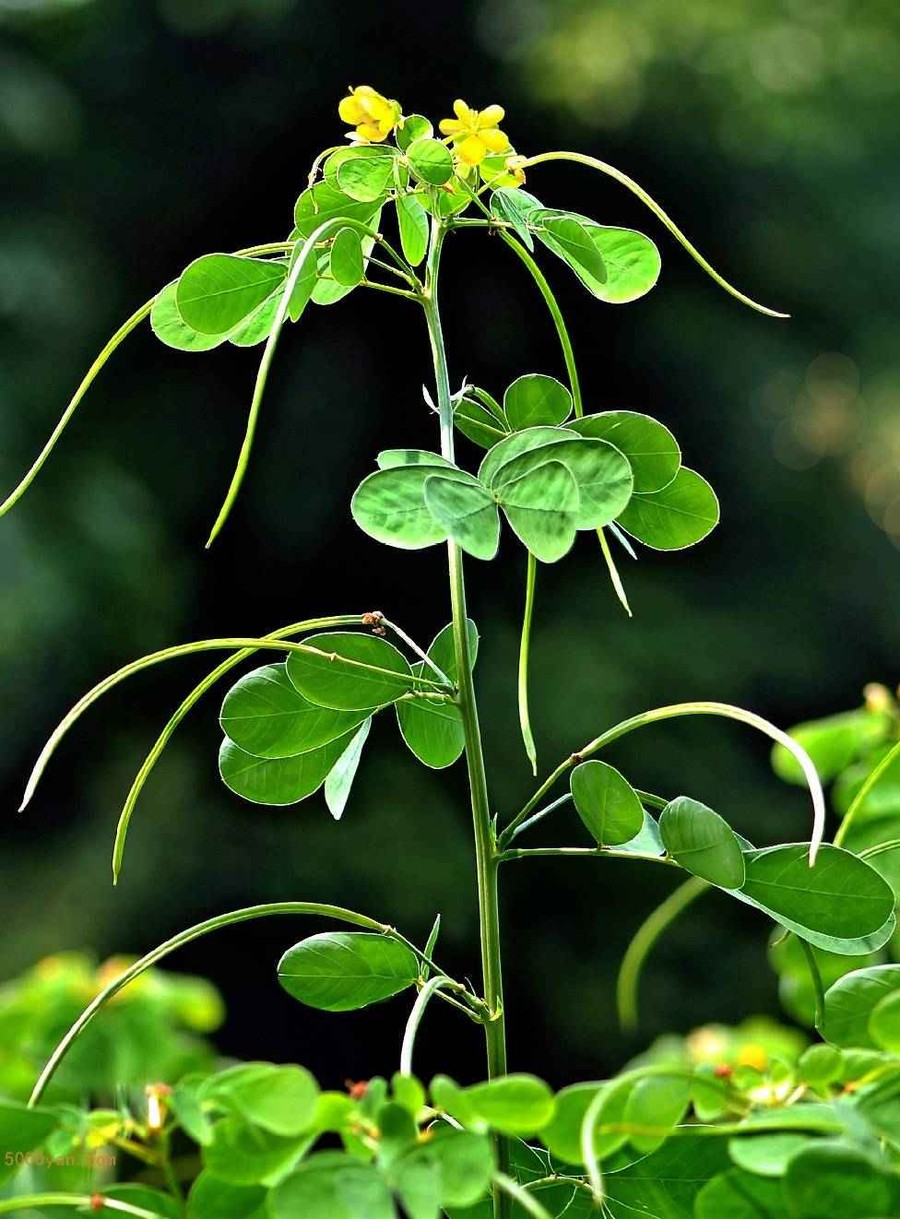
Annual semi-shrubby herb, 0.5-2 m tall. Upper branches numerous. Leaves alternate, pinnately compound; petiole 2-3 cm long; leaflets 3 pairs, obovate or obovate-oblong, 2-6 cm long, 1.5-3.5 cm wide, apex rounded, base cuneate, slightly oblique, lower surface and margin with soft hairs, with 1 linear gland between the lowermost pair of leaflets, or 1 gland between each of the lower 2 pairs. Flowers paired, axillary, uppermost clustered; peduncle very short; pedicel 1-2 cm long; sepals 5, obovate; corolla yellow, petals 5, obovate, 12-15 mm long, clawed at base; stamens 10, 7 fertile, 3 larger anthers abruptly narrowed into a bottleneck at apex; ovary slender, style curved. Legumes slender, nearly quadrangular, 15-20 cm long, 3-4 mm wide, fruit stalk 2-4 cm long. Seeds numerous, rhomboid or rhombic, slightly flattened, pale brown, glossy, with 1 linear oblique groove on each side. Flowering June-August, fruiting August-October.
Habitat and Distribution
Grows in hills, roadsides, barren mountains, and sparse forests on slopes. It is cultivated or grows wild in various provinces across northern and southern China.
Harvesting and Processing
Harvest the ripe fruit in autumn, dry it in the sun, beat out the seeds, and remove impurities.
Medicinal Properties
This product is slightly rhomboid or short cylindrical in shape, with both ends parallel and oblique, 3-7 mm long and 2-4 mm wide. The surface is greenish-brown or dark brown, smooth and glossy. One end is relatively flat, the other end is slanted and pointed, with one protruding ridge line on both the dorsal and ventral sides. On each side of the ridge line, there is one obliquely symmetrical and lighter-colored linear depression. The texture is hard and not easily broken. The seed coat is thin, with 2 cotyledons that are yellow, folded in an "S" shape and overlapping. Odor: faint; Taste: slightly bitter.
Chemical Constituents
This product contains aurantio-obtusin, chrysophanol, physcion, emodin anthrone, emodin-6-glucoside, chryso-obtusin, obtusin, obtusifolin, and cassiaside, among others.
Pharmacology
Has antibacterial, hypotensive, lipid-lowering and anti-atherosclerotic effects, and inhibits platelet aggregation; suppresses cellular immune function with no effect on humoral immunity, and enhances macrophage phagocytosis; protects the liver; promotes laxation; stimulates gastric juice secretion; inhibits the activity of 15-hydroxyprostaglandin dehydrogenase. Toxicity: carcinogenic and reproductive toxicity.
Properties and Channel Entry
Sweet, bitter, and salty, slightly cold. Enters the Liver and Large Intestine channels.
Functions and Indications
Clears Heat and brightens the eyes, moistens the Intestines and unblocks the bowels
Dosage and Administration
Oral administration: decoct in water, 6-15 g, up to 30 g in large doses; or grind into powder; or steep as tea. External use: appropriate amount, grind into powder and apply as a paste.
Precautions and Contraindications
Patients with Spleen and Stomach deficiency-cold and loose stools should use with caution.
Prescriptions
1. For acute conjunctivitis: Juemingzi (Cassia Seed), Juhua (Chrysanthemum Flower), Chantui (Cicada Slough), and Qingxiangzi (Celosia Seed) 15 g each. Decoct in water and take orally. (Qingdao Chinese Herbal Medicine Handbook) 2. For acute keratitis: Juemingzi (Cassia Seed) 15 g, Juhua (Chrysanthemum Flower) 9 g, Gujingcao (Pipewort Flower) 9 g, Jingjie (Schizonepeta) 9 g, Huanglian (Coptis Root) 6 g, and Mutong (Clematis Stem) 12 g. Decoct in water and take orally. (Sichuan Chinese Materia Medica, 1979) 3. For night blindness: Juemingzi (Cassia Seed) and Gouqizi (Wolfberry) 9 g each, and an appropriate amount of pig liver. Decoct in water, eat the liver and drink the soup. (Zhejiang Flora of Medicinal Plants) 4. For nyctalopia: Juemingzi (Cassia Seed) 60 g and Difuzi (Broom Cypress Fruit) 30 g. Grind the above ingredients into a fine powder. After each meal, take 3 g with clear congee soup. (Sheng Hui Fang)