Pinyin: Baidoukou
Aliases
Qiaokou, Baikou, Yuandoukou, Doukou.
Source
1Amomum kravanhDried ripe fruit of Pierre ex Gagnep.
Botanical Description
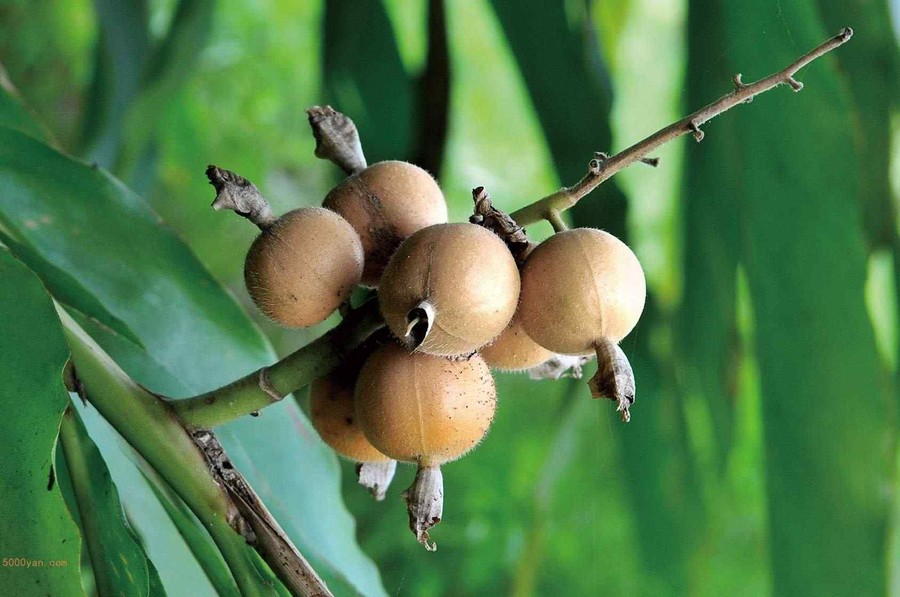
Perennial herb, 1.5-3 m tall. Rhizome thick, brownish-red. Leaves nearly sessile; leaf blade narrowly elliptic or ovate-lanceolate, about 60 cm long, 5-12 cm wide, apex caudate-acuminate, base cuneate, both surfaces glabrous; ligule rounded, 3-10 mm long; mouth of leaf sheath and ligule densely covered with long coarse hairs. Spike inflorescence emerges from the base of the stem, cylindrical or conical, 7-14 cm long, 3-5 cm in diameter, densely covered with imbricate bracts; bracts triangular, 3.5-4 cm long, straw-yellow, pubescent, with distinct square reticulate veins; flowers borne in the axils of bracts; calyx tubular, white with a slight reddish tint, about 1.2 cm long, apex 3-toothed; corolla tube nearly as long as calyx tube, lobes 3, white, elliptic; lip elliptic, 1.5-2 cm long, about 1 cm wide, spoon-shaped, white with a yellow center, base with a claw; stamen curved downward, about 6 mm long, anther broadly elliptic, about 3 mm long, connective appendage 3-lobed; ovary inferior, pubescent, with two club-shaped appendages. Capsule subglobose, white or pale yellow, slightly bluntly trigonous, 1.5-1.8 cm in diameter, easily dehiscent. Seed cluster in 3 sections, each section with 7-10 seeds. Flowering period February to May, fruiting period July to August.
Habitat and Distribution
Grows under forests with warm, humid climate and humus-rich soil. Cultivated in Guangdong and Yunnan provinces of China. Native to Thailand, Vietnam, Cambodia, and other countries.
Harvesting and Processing
When the fruit is ripe, cut off the fruit cluster and sun-dry or oven-dry.
Medicinal Properties
This product is subglobose in shape, with a diameter of 1.2-1.8 cm. The surface is yellowish-white to pale yellowish-brown, with three deeper longitudinal grooves, an elevated persistent calyx apex, a depressed fruit stalk scar at the base, and both ends covered with light brown fuzz. The pericarp is light, brittle, and easily splits longitudinally, internally divided into three chambers, each containing approximately 10 seeds; the seeds are irregular polyhedrons with a slightly raised dorsal side, 3-4 mm in diameter, dark brown surface with wrinkles, and remnants of aril. Odor: aromatic; Taste: pungent and cool, slightly resembling camphor.
Chemical Constituents
This product contains eucalyptol.α1. For pneumonia: Renshen 6 g, decoct in water and take orally. Internal use: decoct 3-10 g.β- α-pinene, camphor, myrcene, caryophyllene, etc.
Pharmacology
It has a therapeutic effect on experimental tuberculosis in guinea pigs.
Properties and Channel Entry
Acrid, warm. Enters the Lung, Spleen, and Stomach channels.
Functions and Indications
Transforms Dampness and moves Qi, warms the Middle and stops vomiting, opens the Stomach and promotes digestion. Used for Dampness-Turbidity obstructing the Middle, lack of appetite, early-stage Damp-Warmth with chest fullness and no hunger, Cold-Dampness vomiting and retching, distension and pain in the chest and abdomen, and food accumulation with incomplete digestion.
Dosage and Administration
Oral: decoct 3-6 g, added later; or made into pills or powder.
Precautions and Contraindications
Contraindicated in patients with Yin deficiency and Blood dryness.
Prescriptions
1. For abdominal distension and vomiting: Ba Dou Kou (Amomum cardamomum) 3 g, Huo Xiang (Agastache rugosa) 6 g, Ban Xia (Pinellia ternata) and Chen Pi (Citri Reticulatae Pericarpium) each 4.5 g, Sheng Jiang (Zingiber officinale) 6 g. Decoct in water and take orally. (Quanguo Zhongcaoyao Huibian) 2. For chronic cold hiccup: Chen Xiang (Aquilaria agallocha) 3 g, Ba Dou Kou (Amomum cardamomum) 3 g, Su Ye (Perilla frutescens) 3 g. Grind the above into powder. Take 2.1 g each time with Shi Di Tang (Persimmon calyx decoction). (Shoushi Midian) 3. For morning sickness during pregnancy: Ba Dou Kou (Amomum cardamomum) 3 g, Zhu Ru (Bambusa tuldoides) 9 g, Da Zao (Ziziphus jujuba) 3 pieces. Crush Sheng Jiang (Zingiber officinale) to extract juice. Decoct the three herbs in water to obtain one teacup (50-60 ml), filter, then mix with the ginger juice and take. [Wuhan Medical and Health Journal 1959, (3): 288] 4. For postpartum hiccup: Ba Dou Kou (Amomum cardamomum) and Ding Xiang (Syzygium aromaticum) each 15 g. Grind into fine powder. Take 3 g with Tao Ren Tang (Persicae Semen decoction), and take again after a short while. (Qiankun Miyun)