Pinyin: Difuzi
Aliases
Di Kui, Di Mai, Yi Ming, Luo Zhou Zi, Zhu Zhou Zi, Tie Sao Ba Zi, Sao Zhou Zi.
Source
Chenopodiaceae plant Kochia scopariaKochia scopariaDried mature fruit of (L.) Schrad.
Botanical Description
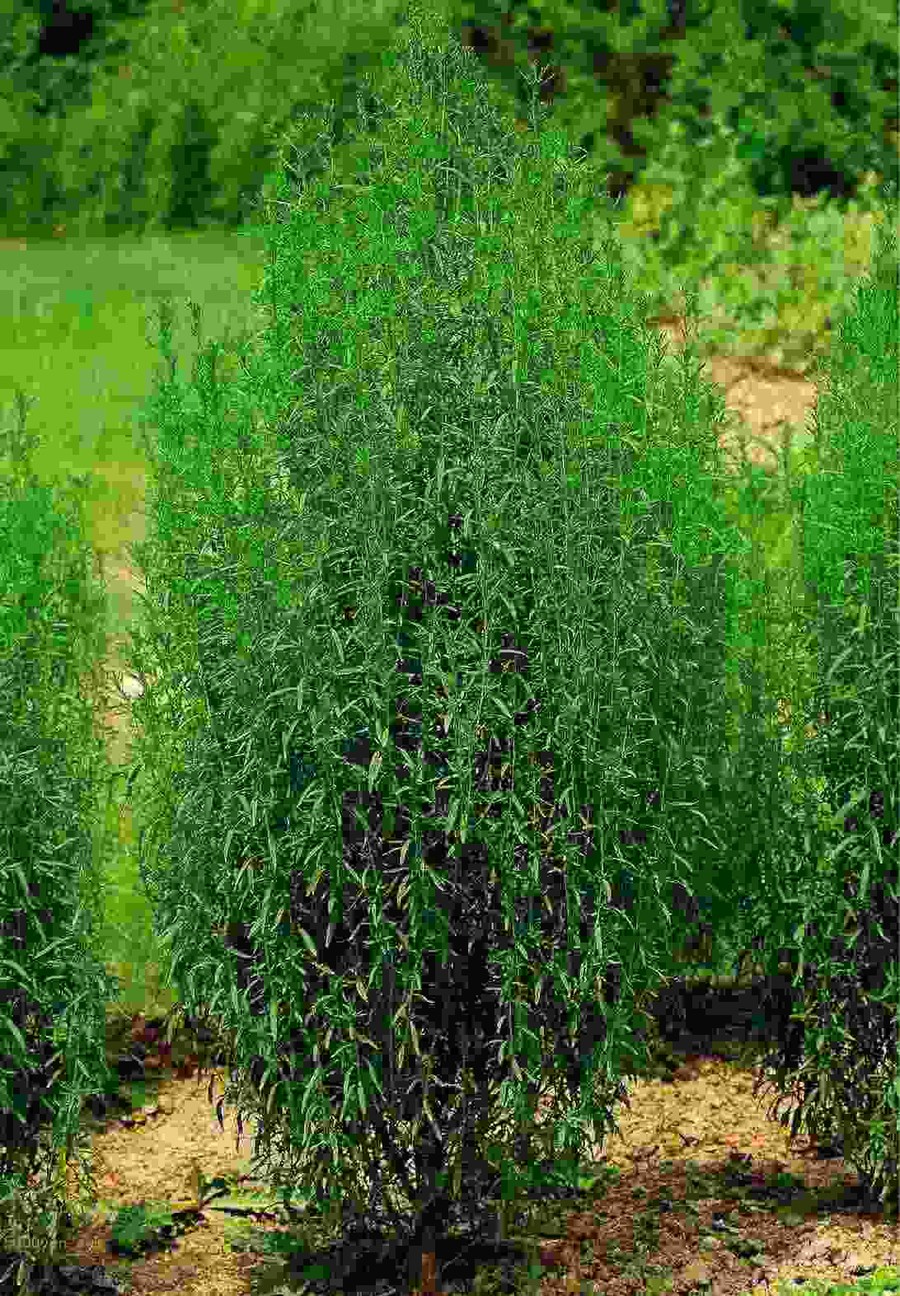
Annual herb, approximately 50-150 cm tall. Stem erect, much branched, pale green or light red, covered with short pubescence. Leaves alternate, sessile; leaf blade narrowly lanceolate or linear-lanceolate, 2-7 cm long, 3-7 mm wide, apex shortly acuminate, base cuneate, margin entire, upper surface green and glabrous, lower surface pale green; usually with 3 main veins; upper stem leaves smaller, with a single midvein. Flowers solitary or 2 together in leaf axils, forming sparse spikes; flowers small, yellow-green, perianth segments 5, subglobose, fused at base, developing triangular transverse ridges or wings on the back during fruiting. Utricle subglobose, pericarp separate from the seed, enclosed within the perianth. Seed 1, subglobose, black-brown. Flowering June to September, fruiting August to October.
Habitat and Distribution
It grows in wilderness, fieldsides, and roadsides, and is cultivated in gardens; it is found throughout China.
Harvesting and Processing
Harvest the plant in autumn when the fruit is ripe, dry it in the sun, thresh the fruit, and remove impurities.
Medicinal Properties
The product is flat and spherical, pentagram-shaped, 1-3 mm in diameter. Externally covered with persistent perianth, surface grayish-green or light brown, surrounded by 5 membranous small wings, with a slightly raised punctate fruit stalk scar and 5-10 radiating veins on the center of the back side; after peeling off the perianth, a membranous pericarp is visible, semi-transparent. The seeds are flat-ovoid, about 1 mm long, black. Odor: faint; Taste: slightly bitter.
Chemical Constituents
This product contains Kochia scoparia saponin Ic, oleanolic acid, and oleanolic acid 28-О-β-D-pyranoglucose ester glycosides, sabinene, 20-hydroxy-24-methylecdysone and other constituents.
Pharmacology
Inhibits bacterial growth; enhances immune function.
Properties and Channel Entry
Acrid, bitter, and cold. Enters the Kidney and Bladder channels.
Functions and Indications
Clears Heat and resolves Dampness, expels Wind and stops itching. Used for painful and difficult urination, vaginal itching and leukorrhea, rubella, eczema, and skin pruritus.
Dosage and Administration
Internal: decoct in water, 6-15 g; or made into pills or powder. External: appropriate amount, decoct in water for washing.
Precautions and Contraindications
Internal use: contraindicated in patients without internal Damp-Heat and those with excessive urination.
Prescriptions
1. For eczema and prurigo: Difuzi (Fructus Kochiae) 15 g, Baixianpi (Cortex Dictamni) 9 g, Chuanbixie (Rhizoma Dioscoreae Hypoglaucae) 12 g, Kushen (Radix Sophorae Flavescentis) and Yejuhua (Flos Chrysanthemi Indici) 9 g each, Shengdi (Radix Rehmanniae) 12 g, Chishao (Radix Paeoniae Rubra) and Danggui (Radix Angelicae Sinensis) 9 g each. Decoct in water and take orally. (Chushi Xiaozhen Tang, from *Clinical Application of Chinese Materia Medica*) 2. For scrotal dampness and itching: Difuzi (Fructus Kochiae), Shechuangzi (Fructus Cnidii), Kushen (Radix Sophorae Flavescentis), and Huajiao (Pericarpium Zanthoxyli) in equal amounts. Decoct in water for external washing. (from *Hubei Chinese Herbal Medicine Records*) 3. For nephritic edema: Difuzi (Fructus Kochiae) 10 g, Fuping (Herba Spirodelae) 8 g, Muzeicao (Herba Equiseti Hiemalis) 5 g, Sangbaipi (Cortex Mori) 10 g. Decoct in water, remove the dregs, and take in 3 divided doses daily. (from *Modern Practical Chinese Medicine*) 4. For erysipelas: Difuzi (Fructus Kochiae), Jinyinhua (Flos Lonicerae Japonicae), and Juhua (Flos Chrysanthemi) 30 g each, Jingjie (Herba Schizonepetae) and Fangfeng (Radix Saposhnikoviae) 15 g each. Decoct in water and take orally. (from *Selected Chinese Herbal Medicines of Shaanxi, Gansu, Ningxia, and Qinghai*)