Pinyin: Hujiao
Aliases
Wei Lü Zhi, Fu Jiao, Yu Jiao
Source
Piperaceae plant Piper.Piper nigrumL. dried nearly ripe or ripe fruit.
Botanical Description
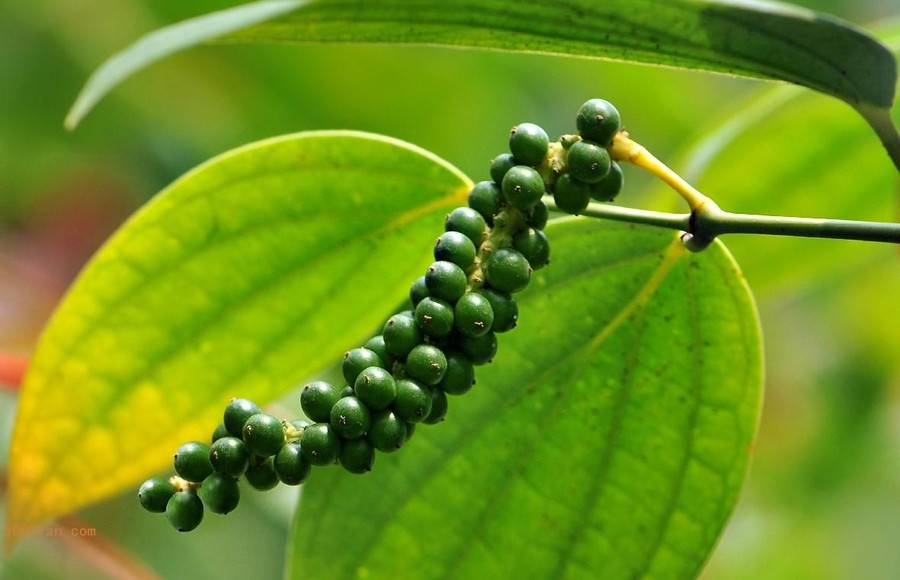
Climbing vine, up to 5 m long. Nodes distinctly swollen, often bearing adventitious roots. Leaves alternate; petiole 1-2 cm long; leaf blade thickly leathery, broadly ovate or ovate-oblong, 9-15 cm long, 5-9 cm wide, apex shortly acute, base rounded, often slightly oblique, veins 5-7, the uppermost pair arising 1.5-3.5 cm from the midrib, the rest basal. Flowers usually unisexual, monoecious, rarely polygamous, without perianth; spikes opposite to leaves, shorter than or nearly equal to leaves; peduncle nearly as long as petiole; bracts spatulate-oblong, 3-3.5 mm long, lower part adnate to rachis, upper part shallowly cup-shaped; stamens 2, anthers reniform, filaments thick and short; ovary globose, stigma 3-4, rarely 5. Berry globose, 3-6 mm in diameter, red when ripe, turning black when dry when unripe. Flowering period June to October.
Habitat and Distribution
Originally produced in Southeast Asia, now widely cultivated in tropical regions. Cultivated in Fujian, Taiwan, Guangdong, Hainan, Guangxi, Yunnan and other areas of our country.
Harvesting and Processing
Harvested from late autumn to the following early spring when the fruit is dark green, then sun-dried to obtain black pepper; harvested when the fruit turns red, soaked in water for several days, rubbed to remove the pulp, then sun-dried to obtain white pepper.
Medicinal Properties
1. Black pepper: Spherical, diameter 3.5-5 mm. Surface blackish-brown, with raised reticulate wrinkles, apex with fine remnant style, base with scar from detachment from fruit axis. Hard texture, exocarp detachable, endocarp grayish-white or pale yellow. Cross-section yellowish-white, powdery, with small cavity in center. Aroma fragrant, taste pungent.
2. White pepper: surface gray-white or pale yellow-white, smooth, with multiple pale linear stripes between the apex and base.
Chemical Constituents
This product contains dihydrocapsaicin, piperamide, piperettine, piperine, piperanine, cryptotanshinone, dihydrocarveol, and other components.
Pharmacology
Inhibits the central nervous system; promotes bile secretion; anti-inflammatory.
Properties and Channel Entry
Pungent, hot. Enters the Stomach and Large Intestine channels.
Functions and Indications
Warms the Middle, disperses Cold, descends Qi, and resolves Phlegm. Used for stomach Cold with vomiting, abdominal pain and diarrhea, poor appetite, and epilepsy with copious Phlegm.
Dosage and Administration
Oral: decocted in water, 1-3 g; or made into pills or powder. External use: appropriate amount, ground into powder and mixed for application, or placed inside a plaster for external application.
Precautions and Contraindications
Patients with febrile diseases and those with Yin deficiency with fire are contraindicated; pregnant women should use with caution.
Prescriptions
1. For scrotal eczema: 10 black peppercorns. Grind into powder, add water and bring to a boil, use for external washing of the affected area, twice daily. (From *Compilation of Simple and Effective Herbal Prescriptions in Chinese Medicine*) 2. For genital itching with sores: 15 g black pepper, 30 g *Zishaohua* (Violet flower). Coarsely grind the above ingredients, decoct in water for bathing and washing. (From *Xiao'er Weisheng Zongwei Lun Fang*) 3. For centipede bites: Chew black pepper and apply to the bite to stop pain. (From *Compendium of Materia Medica*, citing *Duoneng Bishi*) 4. For diarrhea: Grind black pepper into powder, mix with ginger juice and apply to the navel. (From *Youke Zhinan*) 5. For wind-cold in the five viscera, cold-induced heart and abdominal pain, and vomiting of clear water: Black pepper taken with wine is best, or taken in a decoction. For cold qi, swallow 3-7 pieces. (From *Shiliao Bencao*)