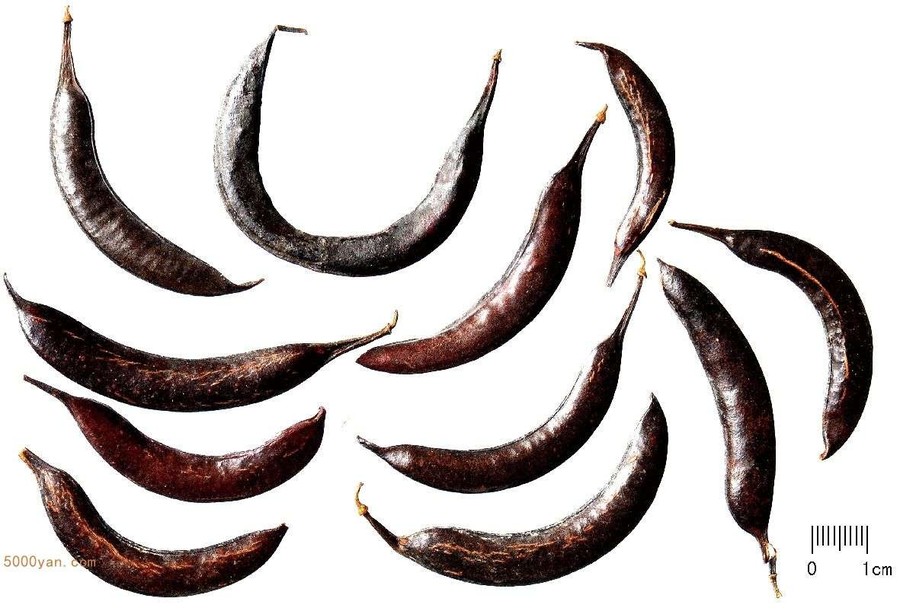
Pinyin: Zhuyazao
Aliases
Ji Qizi, Da Zaojia, Chang Zaojia, Xuan Dao.
Source
Legume family plant Gleditsia sinensisGleditsia sinensisDried sterile fruit of Lam.
Botanical Description
See the entry under "Zaojiao."
Harvesting and Processing
Harvest in autumn, remove impurities, and dry.
Medicinal Properties
This product is cylindrical in shape, slightly flattened and curved, 5-11 cm long and 0.7-1.5 cm wide. The surface is purple-brown or purple-brown, covered with a grayish-white waxy powder that becomes glossy when wiped off, and has fine wart-like protrusions and linear or reticulate cracks. The apex has a bird-beak-shaped style remnant, and the base has fruit stalk scars. It is hard and brittle, easily broken, with a brownish-yellow fracture surface, a loose center, and pale green or pale brownish-yellow filamentous substances, occasionally containing underdeveloped seeds. The odor is faint and irritating, and the taste is first sweet and then pungent.
Chemical Constituents
This product contains gleditsioside aglycone, gleditsia saponin, stigmasterol, sitosterol, gleditsioside, and tannins.
Pharmacology
Expels phlegm, has antibacterial effects, and can kill filarial larvae and cause hemolysis.
Properties and Channel Entry
Acrid, salty, and warm; slightly toxic. Enters the Lung and Large Intestine channels.
Functions and Indications
Expels phlegm, opens the orifices, dissipates masses, and reduces swelling. Used for wind-stroke with clenched jaw, coma and unconsciousness, epilepsy with excessive phlegm, blocked orifices, throat obstruction due to phlegm, stubborn phlegm causing wheezing and coughing, difficulty in expectorating phlegm, dry stools, and externally for abscesses and swellings.
Dosage and Administration
Internal: 1-3 g, mostly used in pills or powders
Precautions and Contraindications
Those with weak constitution, pregnant women, and those with hemoptysis or hematemesis should not take.
Prescriptions
1. For acute and chronic infantile convulsions with unconsciousness: Zhuyazao (Gleditsia sinensis fruit) 3 g, Shengbanxia (raw Pinellia ternata) 3 g, Beixixin (Asarum sieboldii) 0.9 g, grind together into a fine powder. Use a lampwick dipped in the powder to insert into the nostrils; sneezing indicates efficacy, otherwise difficult to treat. Also effective when taken orally with a small amount of ginger decoction. (From *Ying Tong Lei Cui*: Tong Guan San). 2. For rheumatic pain in the hands, feet, waist, and legs: Use Zhuyazao (non-insect-infested) 500 g. Chop into fine powder, boil with aged rice vinegar into a paste. Spread on paper and apply topically; highly effective. (From *Pu Ji Fang*). 3. For migraine (hemicrania): Zhuyazao (peeled and de-stranded), Xiangbaizhi (Angelica dahurica), Baifuzi (Typhonium giganteum) equal parts. Grind into powder. Take 3 g per dose, mixed with light tea. For pain on the right side, lie on the right side; for pain on the left, lie on the left; for pain on both sides, lie supine. Take after meals. (From *Zheng Zhi Zhun Sheng*). 4. For vitiligo: Zhuyazao 120 g, Caowutou (Aconitum kusnezoffii) 15 g, Liuhuang (sulfur) and Baizhi (Angelica dahurica) each 30 g. Grind into powder. First rub the affected area with fresh ginger, then wash with this powder as a facial cleanser. (From *Pu Ji Fang*). 5. For mastitis (breast abscess): Zaojia (Gleditsia sinensis, burnt to preserve nature, ground fine) and Gefen (clam shell powder) equal parts. Mix evenly. Take 1.5 g with warm wine; if the swelling has not dispersed, slightly increase the dose, then massage with the hand. (From *Wei Sheng Jia Bao Chan Ke Bei Yao*).