Pinyin: Lianqiao
Aliases
Hanlianzi, Daqiaozi, Kongqiao, Luoqiao.
Source
1. For pneumonia: Renshen 6 g, decoct in water and take orally.Forsythia suspensaDried fruit of (Thunb.) Vahl.
Botanical Description
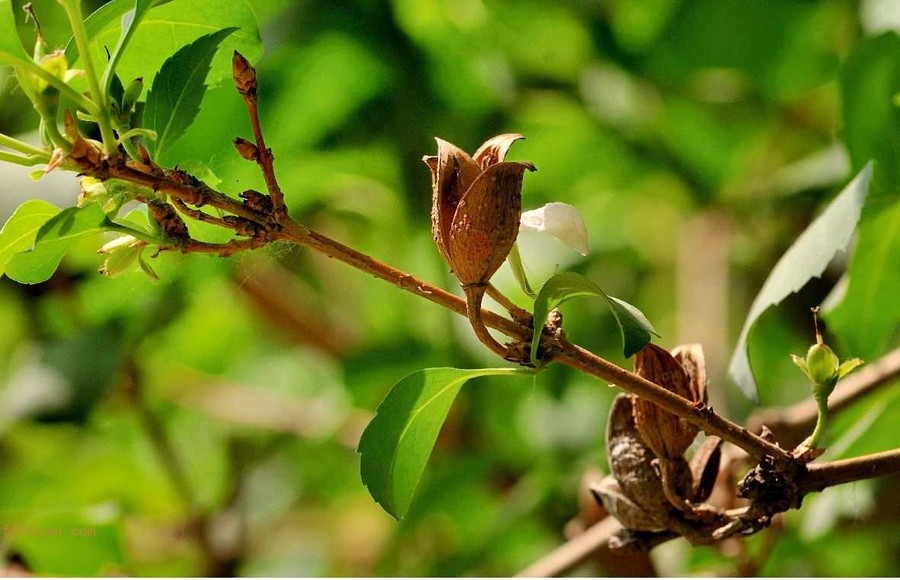
Deciduous shrub. Branchlets yellowish-brown or grayish-brown, slightly quadrangular, sparsely lenticellate, internodes hollow, nodes with solid pith. Leaves usually simple, or 3-lobed to trifoliolate; petiole 0.8-1.5 cm long, glabrous; leaf blade ovate, broadly ovate, or elliptic-ovate to elliptic, 2-10 cm long, 1.5-5 cm wide, apex acute, base rounded to cuneate, margin sharply or coarsely serrate except at base. Flowers usually solitary or 2 to several in leaf axils, opening before leaves; pedicel 5-6 mm long; calyx green, lobes 4, oblong or oblong-elliptic, margin ciliate; corolla yellow, lobes 4, obovate-elliptic, 1.2-2 cm long, 6-10 mm wide; stamens 2, inserted at base of corolla tube; style slender, stigma 2-lobed. Capsule ovoid, 2-locular, 1.2-2.5 cm long, 0.6-1.2 cm wide, apex rostrate-acuminate, sparsely tuberculate; fruit pedicel 0.7-1.5 cm long. Flowering March to April, fruiting July to September.
Habitat and Distribution
It grows in thickets, sparse forests, and grassy areas on mountain slopes. It is distributed in Hebei, Shanxi, Shaanxi, Gansu, Shandong, Jiangsu, Anhui, Henan, Hubei, Sichuan, and other regions. It is also cultivated.
Harvesting and Processing
Harvest when the fruit is initially ripe and still slightly green in autumn, remove impurities, steam until cooked, and dry in the sun, commonly known as "Green Forsythia." Harvest when the fruit is fully ripe, dry in the sun, remove impurities, commonly known as "Old Forsythia."
Medicinal Properties
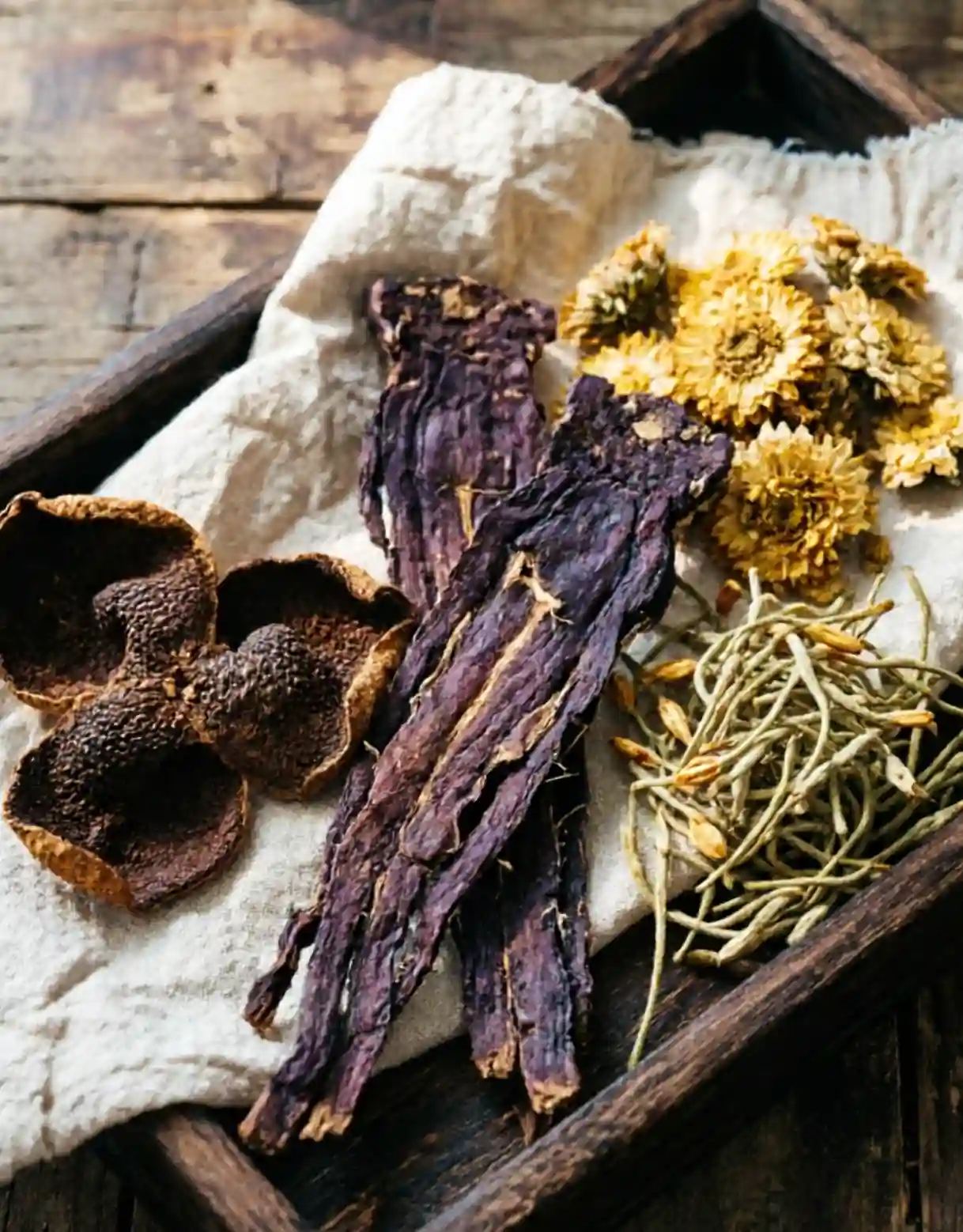
This product is long-ovate to ovate in shape, slightly flattened, 1.5-2.5 cm long and 0.5-1.3 cm in diameter. The surface has irregular longitudinal wrinkles and numerous raised small spots, with one distinct longitudinal groove on each side. The apex is sharp, and the base has a small fruit stalk or has fallen off. Green Forsythia is mostly not dehisced, with a greenish-brown surface and fewer raised grayish-white small spots; it is hard in texture; seeds are numerous, yellowish-green, slender, with a wing on one side. Old Forsythia is dehisced at the apex or split into two valves, with a yellowish-brown or reddish-brown surface, mostly pale yellowish-brown inner surface, smooth, with a longitudinal septum; it is brittle in texture; seeds are brown, mostly fallen off. The odor is faintly fragrant, and the taste is bitter.
Chemical Constituents
This product contains forsythiaside, pinoresinol, forsythiaside B, forsythiaside C, forsythiaside D, forsythiaside E, and forsythioside among its components.
Pharmacology
Antimicrobial; inhibits phosphodiesterase and lipoxygenase activity; antiemetic; protects against liver injury; anti-inflammatory; inhibits elastase activity; reduces spontaneous hypertension, etc.
Properties and Channel Entry
Bitter, slightly cold. Enters the Lung, Heart, and Small Intestine channels.
Functions and Indications
Clears Heat and resolves toxicity, reduces swelling and dissipates masses, and disperses Wind-Heat. Used for carbuncles and deep-rooted abscesses, scrofula, breast abscesses, erysipelas, Wind-Heat common cold, early-stage Warm Disease, Warm-Heat entering the Nutritive (Ying) level, high fever with vexation and thirst, unconsciousness and skin eruptions, and painful, difficult urination due to Heat Lin syndrome.
Dosage and Administration
Oral administration: decoction, 6-15 g; or made into pills or powder.
Precautions and Contraindications
For patients with weak spleen and stomach, use with caution.
Prescriptions
1. For mastitis: Lianqiao (Forsythia) 15 g, Pugongying (Dandelion) 30 g, Wangbuliuxing (Cowherb Seed) 9 g, Yejuhua (Wild Chrysanthemum) 15 g. Decoct in water for oral administration. (Qingdao Chinese Herbal Medicine Manual) 2. For intestinal abscess: Lianqiao 15 g, Huangqin (Baical Skullcap) and Zhizi (Cape Jasmine) 12 g each, Jinyinhua (Honeysuckle) 18 g. Decoct in water for oral administration. (Qingdao Chinese Herbal Medicine Manual) 3. For tongue ulcers: Lianqiao 15 g, Huangbai (Amur Cork-tree) 9 g, Gancao (Licorice) 6 g. Decoct in water and use as a mouthwash. (Yuqiao Medical Instructions) 4. For halitosis: Grind Lianqiao into powder and form into pills. After eating garlic or leeks, take 6-9 g with tea to transform turbid breath into fresh breath. (Chishui Xuanzhen - Internal Palace Formula for Halitosis) 5. For allergic purpura: Lianqiao 12 g, Hongzao (Red Date) 30 g. Decoct in water for oral administration. (Ningxia Chinese Herbal Medicine Manual)