Pinyin: Yuntaizi
Aliases
Youcai Zi
Source
Brassicaceae family plant Brassica campestris L.Brassica campestrisL. of dried ripe seeds.
Botanical Description
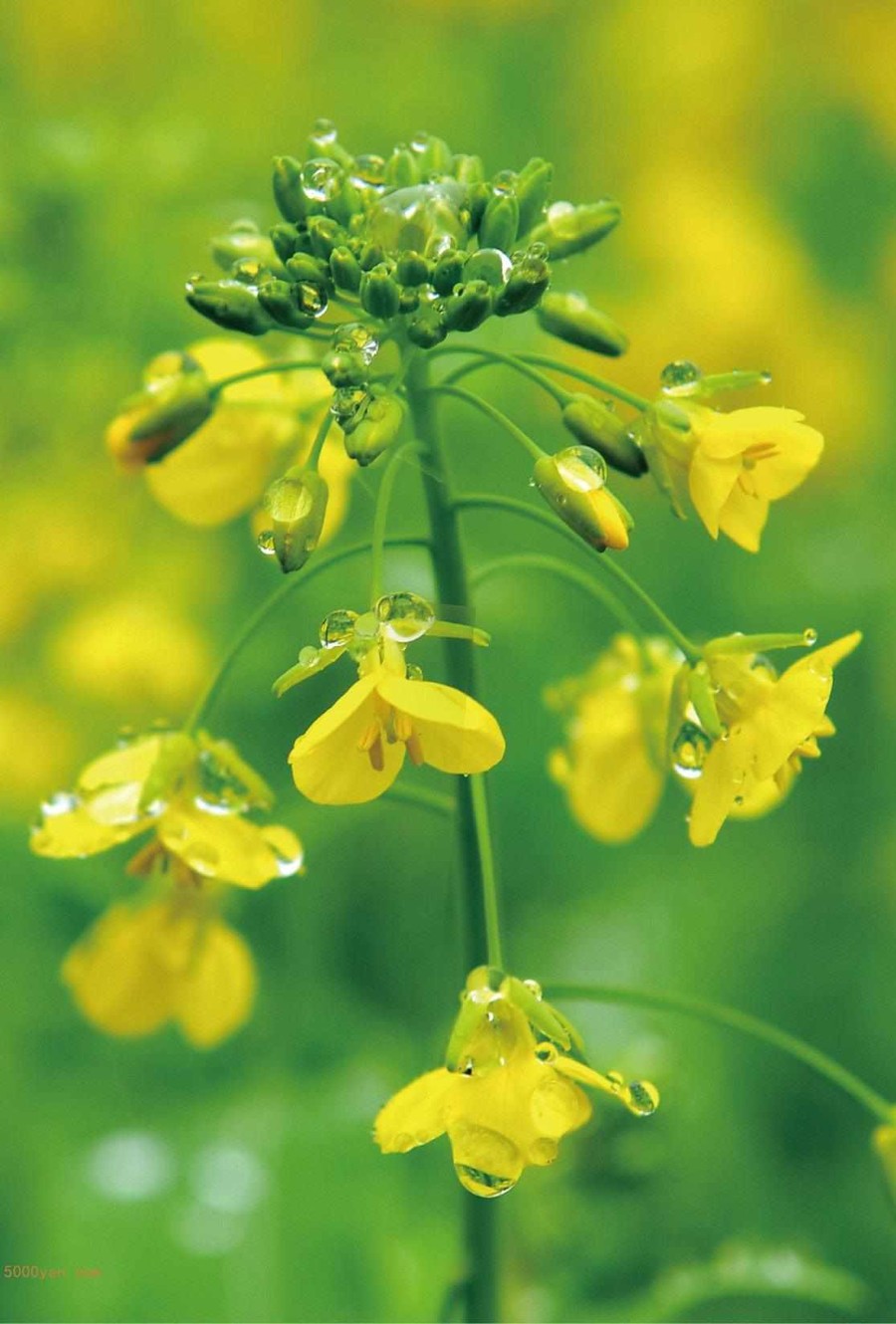
Biennial herb, 30-90 cm tall. Glabrous (hairless), slightly glaucous. Stem erect, stout. Basal leaves 10-20 cm long, lyrately pinnatifid, terminal lobe rounded or ovate, lateral lobes 5 pairs, ovate; lower cauline leaves pinnately semisected, base expanded and clasping, both surfaces with stiff hairs, margin ciliate; upper cauline leaves panduriform or oblong-lanceolate, base cordate, clasping, with two auricles at the base, entire or with undulate fine teeth. Raceme terminal, corymbose in flower; sepals 4, yellowish-green; petals 4, bright yellow, obovate or rounded, 3-5 mm long, base with short claw; stamens 6, 4 long and 2 short, long stamens 8-9 mm, short stamens 6-7 mm, filaments filiform; ovary cylindrical, 10-11 mm long, gradually tapered upward, style distinct, stigma capitate. Silique linear, 3-8 cm long, 2-3 mm wide, apex with a beak 9-24 mm long; pedicel 5-15 mm long. Seeds spherical, about 1.5 mm in diameter, reddish-brown or black, nearly spherical. Flowering period March to May, fruiting period April to June.
Habitat and Distribution
It is a cultivated plant that prefers fertile, moist soil. The main production areas are the Yangtze River Basin and the Northwest region.
Harvesting and Processing
Between April and June, when the seeds are mature, cut the above-ground parts, dry them in the sun, thresh the seeds, remove impurities, and dry in the sun.
Medicinal Properties
Seeds nearly spherical, diameter 1.5-2 mm. Surface reddish-brown or brownish-black, with reticulate texture observed under a magnifying glass, with a black dot-like hilum at one end. When the seed coat is broken, there are 2 cotyledons, thick, milky-yellow, rich in oil, folded along the midvein, with the radicle between the 2 longitudinally folded cotyledons. Odor: faint; Taste: bland. Those with full seeds and lustrous color are considered superior.
Chemical Constituents
This product contains glucobrassicin, glucobrassicanapin, and progoitrin; it also contains fatty oil, protein, rutin, brassicasterol, 22-dehydrocampesterol, and various amino acids.
Properties and Channel Entry
Acrid, sweet, neutral. Enters the Liver and Large Intestine channels.
Functions and Indications
Activates blood and resolves stasis, reduces swelling and dissipates masses, moistens the intestines and unblocks the bowels. Indications: postpartum lochiorrhea, abdominal pain due to blood stasis, dysmenorrhea, hematochezia due to intestinal wind, bloody dysentery, rheumatic joint swelling and pain, furuncles and erysipelas, mastitis, constipation, adhesive intestinal obstruction.
Dosage and Administration
Oral: decoct 5-10 g; or made into pills or powder. External: apply an appropriate amount, ground into powder and mix for topical application.
Precautions and Contraindications
Contraindicated in cases of Yin-Blood deficiency and loose stools.
Prescriptions
1. For hemorrhoidal fistula and intestinal wind: 120 g of Brassica campestris seeds, ground into powder, mixed with good wine and flour paste to form pills the size of wutong seeds (Semen Platycladi). Take 30 to 50 pills with warm wine once daily. (Pu Ji Fang) 2. For unilateral headache and migraine: 0.3 g of Brassica campestris seeds and 0.9 g of Rheum palmatum, ground into a fine powder. Take a small amount and blow into the nostrils; yellow fluid will discharge. For numbness, mix with strong vinegar and apply topically. (Sheng Hui Fang) 3. For adhesive intestinal obstruction: 150 g of Brassica campestris seeds and 60 g of Foeniculum vulgare, decocted in water and taken in divided doses. (Qingdao Chinese Herbal Medicine Manual) 4. For generalized erysipelas: 30 g of Brassica campestris seeds, mixed with one large cup of wine, ground and strained, then decocted for 5-7 boils. Take 1 ge (approx. 10 mL) warm at any time. (Zheng Zhi Zhun Sheng) 5. For constipation: 9-12 g of Brassica campestris seeds (6 g for children), 9 g of Magnolia officinalis, 6 g of Angelica sinensis, and 6 g of Citrus aurantium, decocted in water and taken orally. (Hunan Materia Medica)