Pinyin: Zhike
Source
1. Rutaceae plant *Citrus aurantium* L.Citrus aurantiumL. and its cultivated varieties of dried immature fruit.
Botanical Description
Evergreen small tree. Branches triangular, with long spines. Leaves alternate; petiole with narrow oblong or narrow obcordate leaf wings, 8-15 mm long, 3-6 mm wide; leaf blade leathery, obovate-elliptic or ovate-oblong, 3.5-10 cm long, 1.5-5 cm wide, apex short and obtuse, acuminate or slightly concave, base cuneate or rounded, margin entire or slightly undulate, with translucent oil glands. Flowers solitary or several clustered in leaf axils and at the tips of current year's branches, white, fragrant; calyx cup-shaped, 5-lobed; petals 5, oblong; stamens more than 20; ovary superior, pistil shorter than stamens, stigma capitate. Hesperidium subglobose, orange-yellow when ripe; taste sour. Flowering period April to May, fruiting period June to November.
Habitat and Distribution
It is cultivated in the Yangtze River basin and all provinces and regions south of it in China.
Harvesting and Processing
Harvest when the pericarp is still green in July, cut horizontally into two halves from the middle, and sun-dry or dry at low temperature.
Medicinal Properties
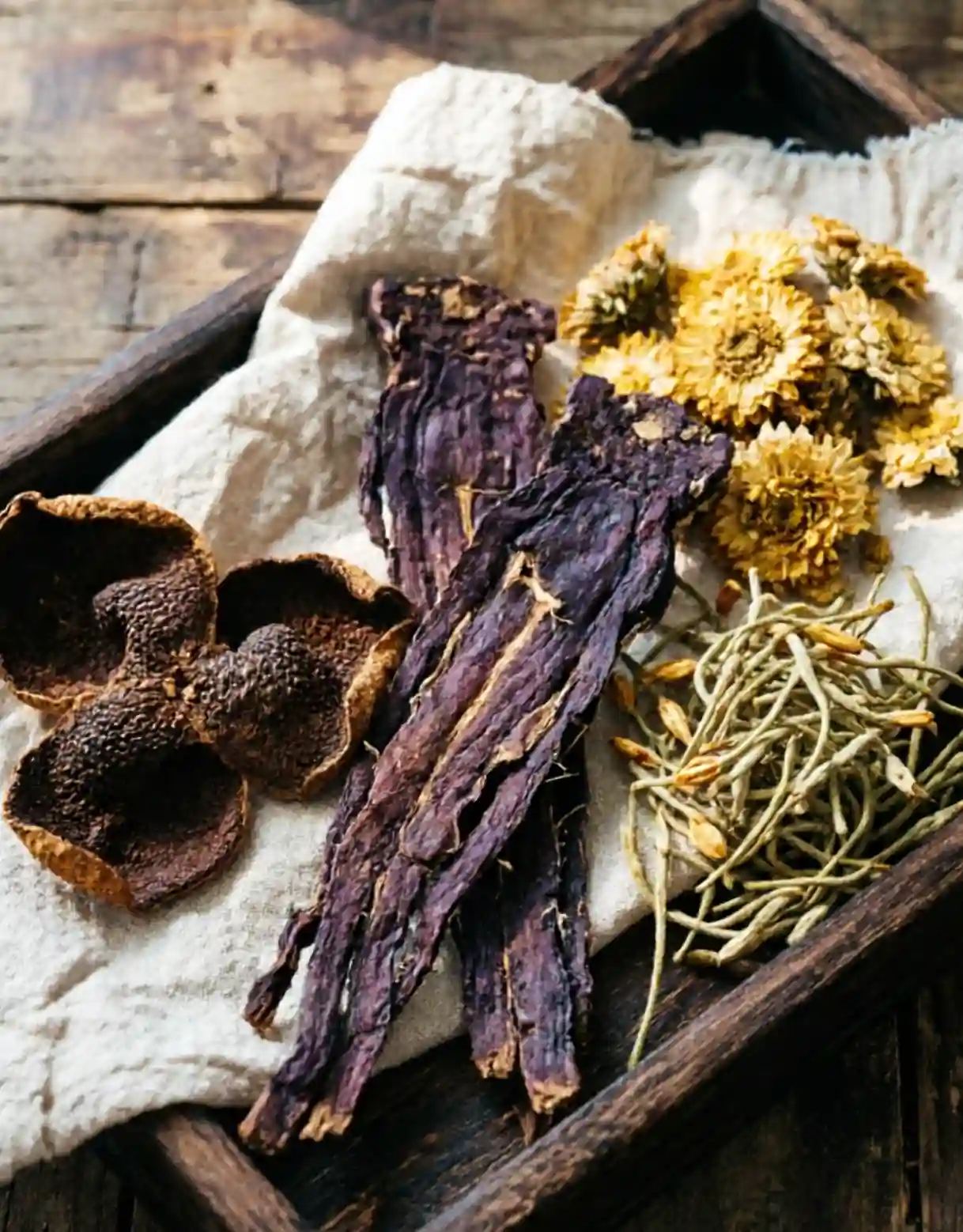
This product is hemispherical, with a diameter of 3-5 cm. The exocarp is brownish-brown or brown, with granular protrusions, the tips of which have pit-like oil glands; there are obvious remains of the style or fruit stalk scars. On the cut surface, the mesocarp is yellowish-white, smooth and slightly raised, 0.4-1.3 cm thick, with 1-2 rows of oil glands scattered at the edge; the pulp sacs are 7-12 segments, with a few reaching 15 segments; the juice sacs are dry and shrunken, appearing brown to brownish-brown, containing seeds inside. The texture is hard and not easily broken. The odor is fragrant, and the taste is bitter and slightly sour.
Chemical Constituents
This product contains hesperidin, Poncirus glycoside, coniferin, naringenin-7-rutinoside, tangeretin, sinensetin, neohesperidin, isoimperatorin, pimpinellin, citrus cyclopeptide II, citrus cyclopeptide III, citrus cyclopeptide IV, lonicerin, and other constituents.
Pharmacology
Raises blood pressure; inhibits urination; anti-shock; inhibits gastrointestinal motility; exerts dual excitatory or inhibitory effects on the uterus.
Properties and Channel Entry
Bitter, acrid, and sour, slightly cold. Enters the Spleen and Stomach channels.
Functions and Indications
Regulates Qi, widens the Middle Jiao, moves stagnation, and reduces distension
Dosage and Administration
Internal: decoct in water, 3-9 g; or made into pills or powder. External: appropriate amount, decoct for washing or stir-fry hot for hot compress.
Precautions and Contraindications
Caution should be exercised in pregnant women.
Prescriptions
1. For Qi stagnation, phlegm-fire, and food accumulation causing retention: Zhiqiao (Fructus Aurantii) 30 g, Houpo (Cortex Magnoliae Officinalis) 24 g, both stir-fried with wheat bran. Use Zhiqiao 6 g and Houpo 4.8 g each time. Decoct in water and take orally. (Bencao Huiyan) 2. For chronic cough with upper jiao heat and chest and diaphragm discomfort: Zhiqiao (stir-fried) 90 g, Jiegeng (Radix Platycodonis) 90 g, Huangqin (Radix Scutellariae) 60 g. Grind the ingredients. Each morning, take 60 g as one dose, decoct with three cups of water down to two cups, divide equally into three servings: one serving at noon, one at shen time (3-5 PM), and one before bedtime. (Gujin Yitong, Zhiqiao Decoction) 3. For right rib pain and distension with fullness and lack of appetite: Zhiqiao (stir-fried with bran) 15 g, Guixin (Cinnamomi Cortex, with rough outer bark removed, not exposed to fire) 15 g, Pianzi Jianghuang (Rhizoma Curcumae Longae, washed) 15 g, Gancao (honey-fried) 4.5 g. Grind into powder. Take 6 g each time, mixed with ginger and jujube decoction, or with wine. (Chongding Yanshi Jisheng Fang, Tuiqi Powder) 4. For food accumulation causing epigastric stuffiness, pain, and belching with rotten egg odor: Zhiqiao (remove pulp, cut into pieces, stir-fried with bran) 15 g, Baizhu (Rhizoma Atractylodis Macrocephalae) 15 g, Xiangfu (Rhizoma Cyperi, stir-fried with bran, peeled) 30 g, Binglang (Semen Arecae) 9 g. Grind into fine powder. Take 6 g each time, mixed with rice water, three times daily. (Benshi Fang, Zhiqiao Powder)

