Pinyin: Hezi
Aliases
Heli, Heli, Heli, Suifengzi
Source
Terminalia chebula of the Combretaceae familyTerminalia chebulaDried ripe fruit of *Retz*.
Botanical Description
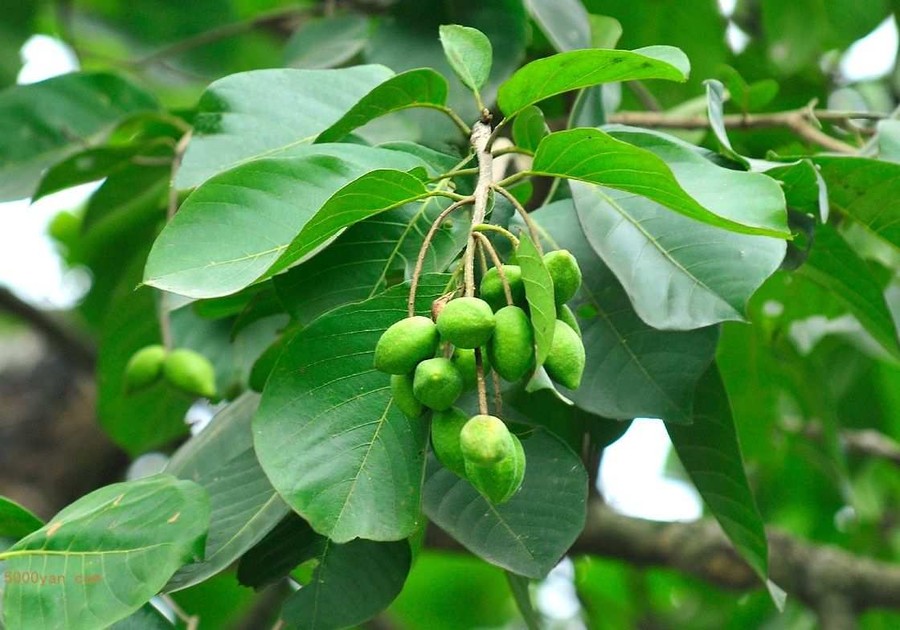
Tree, up to 30 m tall. Branches nearly glabrous, lenticels slender, white or pale yellow; young branches yellowish-brown, tomentose. Leaves alternate or subopposite; petiole stout, 1.8-2.3 cm long, with 2 (to 4) glands 1-5 mm from the apex; leaf blade ovate or elliptic, 7-14 cm long, 4.5-8.5 cm wide, apex shortly acute, base obtuse-rounded or cuneate, oblique, margin entire or slightly undulate, both surfaces glabrous, densely covered with fine warty dots. Inflorescence a spike, axillary or terminal, sometimes forming a panicle; flowers bisexual; calyx tube cup-shaped, pale greenish-yellow, ca. 3.5 mm long, 5-lobed, lobes ca. 1 mm long, triangular, outer surface glabrous, inner surface yellowish-brown pubescent; petals absent; stamens 10, exserted beyond the calyx, anthers small, ellipsoid; ovary inferior, 1-locular, cylindrical, ca. 1 mm long, pubescent, turning dark brown when dry, style long and thick, conical. Drupe, ovoid or ellipsoid, 2.4-4.5 cm long, 1.9-2.3 cm in diameter, green, rough, glabrous, turning dark brown at maturity, usually with 5 obtuse ridges. Flowering in May, fruiting from July to September.
Medicinal Properties
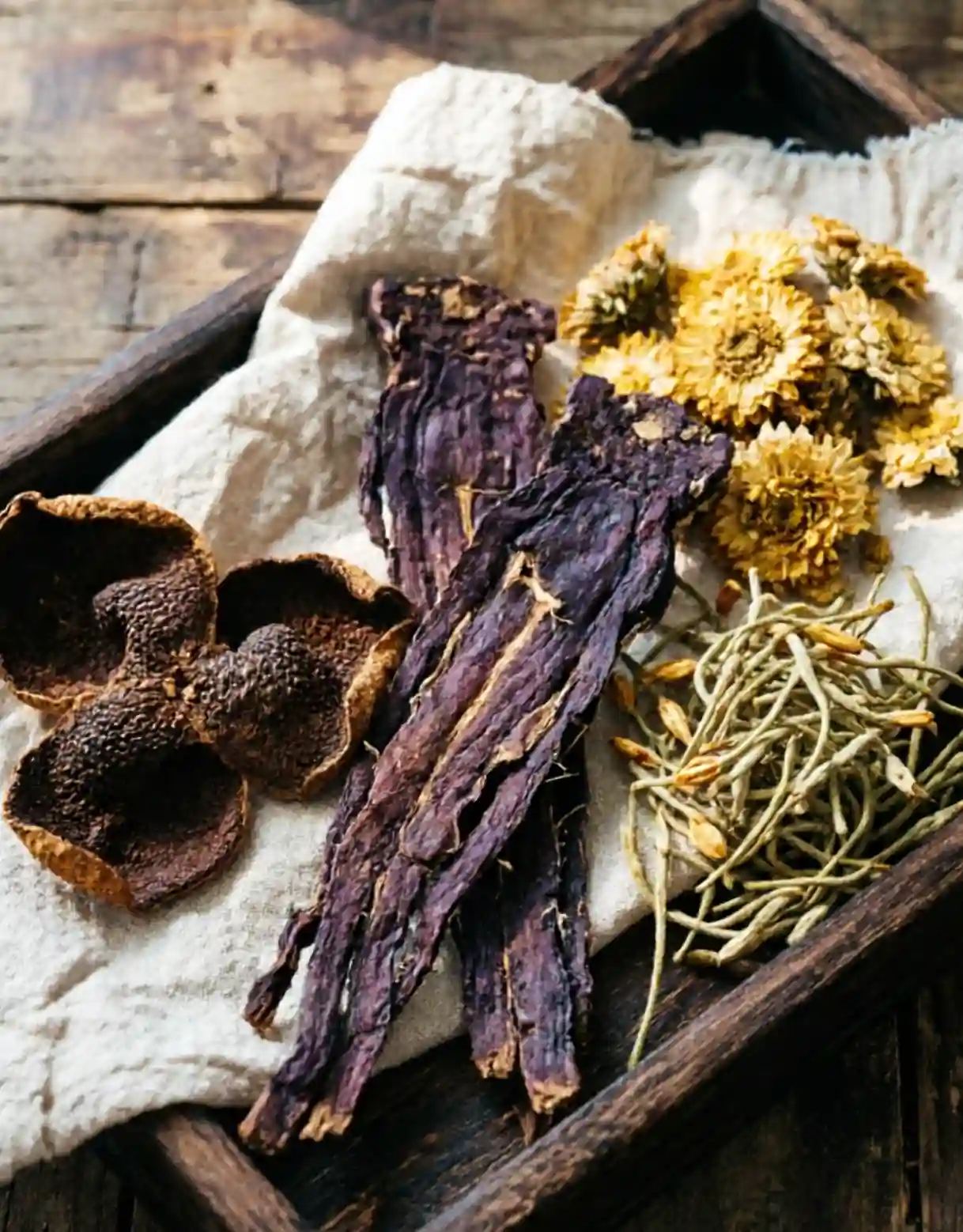
This product is oblong or ovoid, 2-4 cm long, 2-2.5 cm in diameter. The surface is yellowish-brown or dark brown, slightly lustrous, with 5-6 longitudinal ridges and irregular wrinkles, and a round fruit stalk scar at the base. The texture is firm. The pulp is 0.2-0.4 cm thick, yellowish-brown or yellowish-tan. The stone (seed) is 1.5-2.5 cm long, 1-1.5 cm in diameter, light yellow, rough, and hard. The seed is narrowly fusiform, approximately 1 cm long, 0.2-0.4 cm in diameter, with a yellowish-brown seed coat, 2 white cotyledons that are mutually overlapping and coiled. The odor is faint, and the taste is sour and astringent followed by sweetness.
Habitat and Distribution
Growing in sparse forests at elevations of 800-1800 m. Distributed in western and southwestern Yunnan, with cultivation in Guangdong and Guangxi.
Harvesting and Processing
Harvested in autumn and winter when the fruit is ripe, remove impurities, and dry in the sun.
Chemical Constituents
This product contains chebulinic acid, terchebin, ellagic acid, and corilagin among other constituents.
Pharmacology
Antioxidant; antibacterial; has antispasmodic effects on smooth muscle, among other actions.
Properties and Channel Entry
Bitter, sour, and astringent, neutral. Enters the Lung and Large Intestine channels.
Functions and Indications
Astringes the intestines to stop diarrhea, astringes the Lung to stop cough, subdues Fire and benefits the throat. Used for chronic diarrhea and dysentery, bloody stools and rectal prolapse, Lung deficiency with wheezing and cough, persistent cough, sore throat and hoarseness.
Dosage and Administration
Oral: decoct in water, 3-6 g; or prepared into pills or powder. For astringing the Lung and clearing Fire, use raw; for astringing the Intestines and stopping diarrhea, use roasted.
Precautions and Contraindications
External pathogens not yet resolved, with internal Damp-Heat accumulation and stagnation, should be used with caution.
Prescriptions
1. For gradual relief of abdominal pain with minimal diarrhea: Hezi (Chebulae Fructus) peel (half raw, half prepared) 30 g, Muxiang (Saussureae Radix) 15 g, Huanglian (Coptidis Rhizoma) and Zhigancao (Glycyrrhizae Radix cum Melle) 1 g each. Grind into fine powder. Take 6 g each time, mixed with Baizhu Shaoyao decoction. (From Baoming Ji: Hezi Pi San) 2. For loss of voice and inability to speak: Hezi (half parched, half raw) 4 pieces, Jiegeng (half parched, half raw) 30 g, Gancao (half parched, half raw) 2 cun. Grind into fine powder. Take 7.5 g each time, decoct in one cup of urine of male child until reduced by five to seven boils, take warm. (From Xuanming Lun Fang) 3. For chronic cough with loss of voice: Hezi (core removed) 30 g, Xingren (Apricot kernel, soaked, skin and tip removed) 30 g, Tongcao (Tetrapanacis Medulla) 7.5 g. Finely cut. Take 12 g each time, decoct with one cup of water and five slices of roasted ginger until reduced to 80%, strain, and take warm after meals. (From Jisheng Fang: Hezi Yin) 4. For lung damage with incessant hematemesis: Hezi (raw, ground into powder) and white flour (fried). Mix the two ingredients in equal amounts. Take 6 g each time, mixed with glutinous rice porridge. (From Shengji Zonglu) 5. For leg ulcer (shank sore): Use Hezi in any amount, burn to ash and grind into powder, mix with sesame oil and apply topically. (From Puji Fang)