Pinyin: Yizhi
Aliases
Yizhizi, Zhaidingzi.
Source
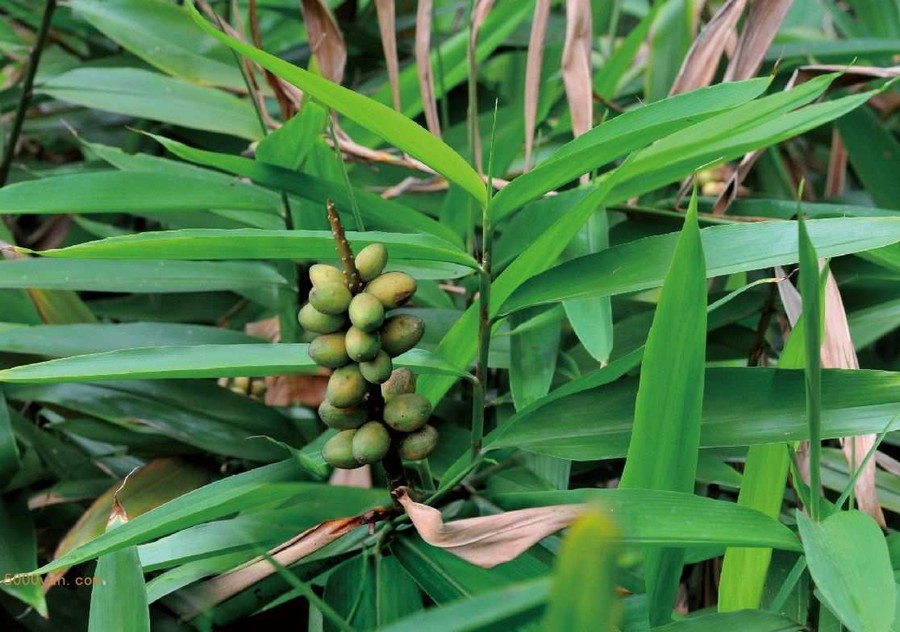
Zingiberaceae plant Yizhi (Alpinia oxyphylla).Alpinia oxyphyllaDried ripe fruit of *Schisandra chinensis* (Turcz.) Baill.
Botanical Description
A perennial clump-forming herb, 1-3 m tall. Petiole short; leaf blade lanceolate, 20-35 cm long, 3-6 cm wide, apex caudate-acuminate, base broadly cuneate, margin with deciduous small bristles leaving fine-toothed scars, glabrous on both surfaces; ligule membranous, bifid, 1-2 cm long, occasionally up to 3 cm, covered with pale brown soft hairs. Raceme terminal, 8-15 cm long, enclosed in a sheath-like involucre during bud stage; rachis with very short soft hairs; pedicel 1-2 mm long; bracts membranous, brown; calyx tubular, about 1.2 cm long, apex with 3 shallow teeth, one side deeply split, externally pubescent; corolla tube nearly as long as calyx tube, lobes 3, oblong, about 1.8 cm long, the upper lobe slightly larger, apex somewhat hooded, white, externally pubescent; lip obovate, about 2 cm long, pink with red stripes, apex margin undulate; lateral staminodes conical, about 2 mm long; stamen 1, filament flat, linear, about 1.2 cm long, anther 6-7 mm long, connective apex with a rounded crest-like appendage; ovary inferior, densely tomentose. Capsule globose or ellipsoid, fusiform when dry; pericarp with distinct longitudinal vascular bundle striations, 1.2-2 cm long, about 1 cm in diameter, indehiscent, yellow-green or milky yellow when ripe. Seeds numerous, irregularly compressed-orbicular, covered with pale yellow aril. Flowering period February to April, fruiting period May to August.
Habitat and Distribution
It grows in shaded and damp areas under forests. It is distributed in Guangdong and Hainan, and is also cultivated in Fujian, Guangxi, and Yunnan.
Harvesting and Processing
Harvested in summer and autumn when the fruit turns from green to red, then dried in the sun or at low temperature.
Medicinal Properties
This product is oval-shaped with slightly pointed ends, 1.2-2 cm long and 1-1.3 cm in diameter. The surface is brown or grayish-brown, with 13-20 longitudinal irregular ridges, a remnant of the perianth at the apex, and often a persistent fruit stalk at the base. The pericarp is thin and slightly tough, closely adhering to the seeds. The seeds are clustered into a mass, divided into 3 lobes by a septum, with 6-11 seeds per lobe. The seeds are irregularly compressed-orbicular, with slightly blunt edges, approximately 3 mm in diameter. The surface is grayish-brown or grayish-yellow, covered with a thin, membranous, light brown aril; the texture is hard, with a white endosperm. It has a distinctive aromatic odor and a taste that is pungent and slightly bitter.
Chemical Constituents
This product contains zingiberene, zingiberol, aromadendrene, yakuchinone A, yakuchinone B, and oxo-agarol among its constituents.
Pharmacology
Inhibits myocardial Na+-K+Pump; has cardiotonic effects; anti-gastric injury; has prostaglandin inhibitory effects, among other actions.
Properties and Channel Entry
Pungent, warm. Enters the Spleen and Kidney channels.
Functions and Indications
Warms the Kidneys, consolidates the Essence, reduces urination, warms the Spleen, stops diarrhea, and controls salivation. Used for kidney deficiency with enuresis, frequent urination, nocturnal emission and leukorrhea, spleen-cold diarrhea, cold pain in the abdomen, and excessive drooling.
Dosage and Administration
Internal: decoct in water, 3-9 g; or made into pills or powder.
Precautions and Contraindications
Contraindicated in patients with Yin deficiency and Fire hyperactivity.
Prescriptions
1. For pregnancy-induced urinary incontinence: Yizhiren (Alpinia oxyphylla), Baiwei (Cynanchum atratum), and Baishao (Paeonia lactiflora), equal parts. Grind into powder. Take 9 g each time, add 0.9 g of salt, and mix with boiling water for oral administration. (Dan Tai Yu An) 2. For infantile enuresis and also for turbid urine: Yizhiren and Baifuling (Poria cocos), equal parts. Grind into powder. Take 3 g each time, mix with rice soup on an empty stomach for oral administration. (Bu Yao Xiu Zhen Xiao Er Fang Lun - Yizhiren San) 3. For red turbid urine: Yizhiren and Fushen (Poria cocos with host wood) 60 g each, Yuanzhi (Polygala tenuifolia) and Gancao (Glycyrrhiza uralensis, water-boiled) 240 g each. Grind into powder, form into pills using wine and flour paste, pill size as large as Chinese parasol seeds. Take 50 pills on an empty stomach with ginger soup. (Gang Mu) 4. For metrorrhagia: Yizhi (Alpinia oxyphylla), stir-fry and grind to fine powder, take 3 g with rice drink and salt. (Jing Xiao Chan Bao) 5. For vaginal bleeding during pregnancy: Yizhiren 15 g and Suosaren (Amomum villosum) 30 g, grind into powder. Take 9 g each time with plain water on an empty stomach, twice daily. (Hu Shi Ji Yin Fang)