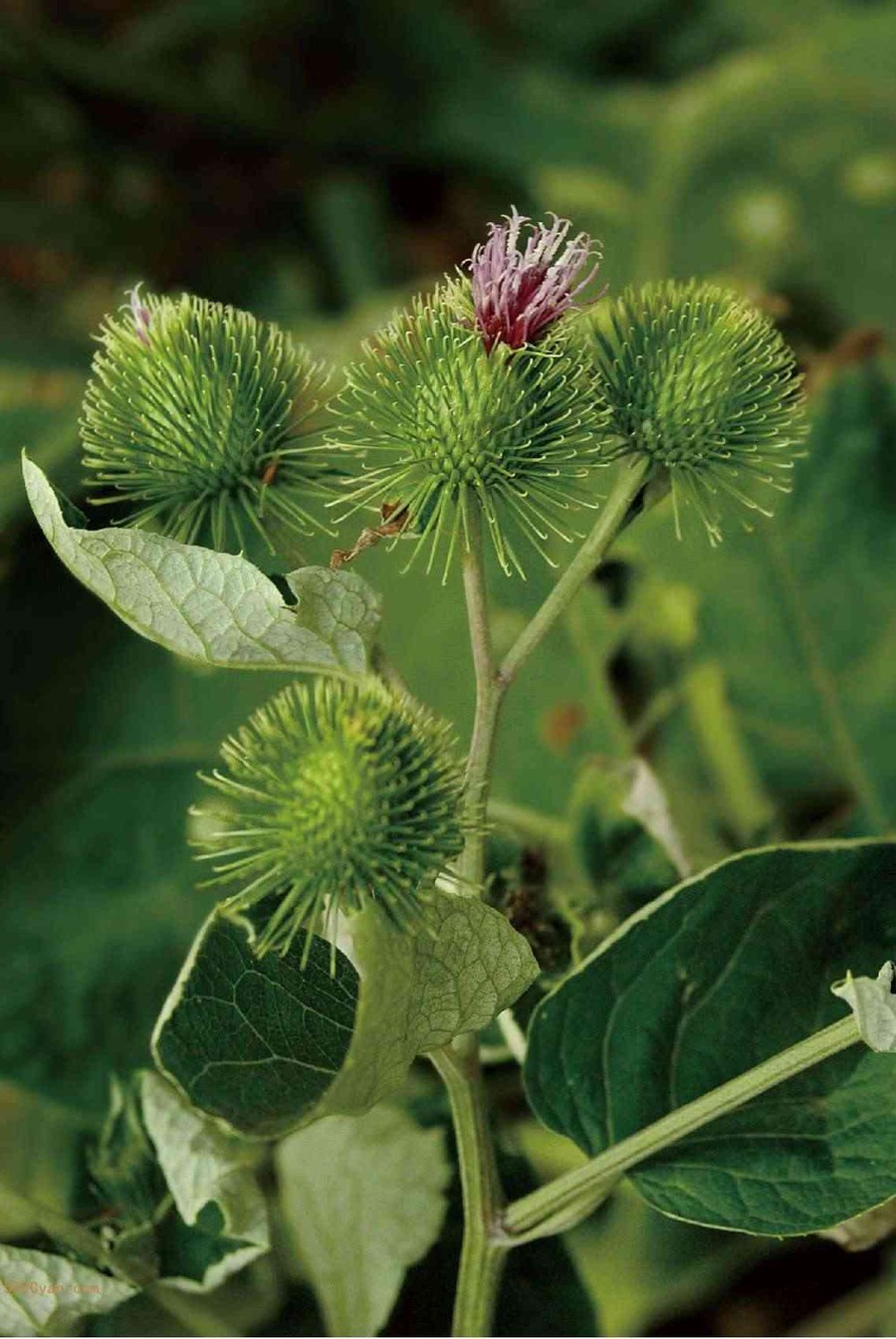
Pinyin: Niubangzi
Aliases
Eshi, Shunianzi, Dalizi, Niuzi, Shujianzi
Source
1. For pneumonia: Renshen 6 g, decoct in water and take orally.Arctium lappaL. dried mature fruit.
Botanical Description
Biennial herb, 1-2 m tall. Roots thick, fleshy, conical. Stems erect, upper part multi-branched, purplish-brown, with longitudinal ridges. Basal leaves large, clustered, with long petioles. Cauline leaves alternate, long-ovate to broadly ovate, 20-50 cm long, 15-40 cm wide, apex obtuse with spinose tips, base often cordate, margin entire or irregularly undulate-denticulate, upper surface green to dark green with sparse hairs, lower surface densely covered with grayish-white short tomentum. Capitula clustered at stem apex or arranged in corymbs, 2-4 cm in diameter, peduncles 3-7 cm long, with shallow grooves, densely fine-haired; involucre globose, bracts numerous, imbricate, lanceolate to linear-lanceolate, apex hooked; flowers small, reddish-purple, all tubular, bisexual, corolla apex 5-lobed, syngenesious stamens 5, alternate with corolla lobes, anthers yellow; ovary inferior, 1-locular, apex discoid, with short bristle-like pappus; style slender, stigma 2-lobed. Achenes oblong to oblong-obovate, grayish-brown, with longitudinal ribs, pappus short-spiny, pale yellowish-brown. Flowering June to August, fruiting August to October.
Habitat and Distribution
Cultivated frequently. Wild plants are mostly found growing on mountain slopes and roadsides, ditches, wasteland, sunny grassy slopes on hillsides, forest edges, and near villages and towns. Distributed in Northeast, Northwest, Central South, Southwest China, as well as Hebei, Shanxi, Shandong, Jiangsu, Anhui, Zhejiang, Jiangxi, Guangxi, and other regions.
Harvesting and Processing
7-8 months when the fruit is grayish-brown, harvest in batches, pile for 2-3 days, sun-dry, thresh, winnow clean, then sun-dry until completely dry.
Medicinal Properties
This product is oblong-obovate, slightly flattened and gently curved, 5-7 mm long and 2-3 mm wide. The surface is grayish-brown with purplish-black spots and several longitudinal ridges, usually with 1-2 more prominent ridges in the middle. The apex is obtuse-rounded, slightly wider, with a circular ring on the top surface and a punctate style remnant in the center; the base is slightly narrower, with a paler attachment scar. The pericarp is relatively hard; there are 2 cotyledons, pale yellowish-white, rich in oil. Odor: faint; Taste: bitter, then slightly acrid and numbing to the tongue.
Chemical Constituents
This product contains new arctiin B, arctiin, arctigenin, arctinol, linoleic acid, palmitic acid, stearic acid, arachidic acid, sugars, and other components.
Pharmacology
Antibacterial and antiviral; lowers blood sugar; lowers blood pressure; anti-kidney disease; mild diuretic, laxative.
Properties and Channel Entry
Acrid, bitter, and cold. Enters the Lung and Stomach channels.
Functions and Indications
Disperse Wind-Heat, diffuse the Lungs and promote eruption of rash, resolve toxicity and benefit the throat. Used for Wind-Heat common cold, cough with copious phlegm, measles, rubella, sore swollen throat, mumps, erysipelas, and carbuncle, swelling, and sore-toxin.
Dosage and Administration
Oral: 5-10 g in decoction; or as a powder. External: appropriate amount, used as a gargle in decoction.
Precautions and Contraindications
Patients with Spleen deficiency and loose stools are prohibited from taking this medication.
Prescriptions
1. For wind-heat obstructing the throat with generalized edema: Niubangzi (Arctium lappa fruit) one ge (approx. 6-12 g), half raw and half cooked, ground into powder. Take 3 g with warm wine. (From *Jingyan Fang* - Empirical Prescriptions) 2. For measles rash that fails to erupt fully: Niubangzi (ground fine) 15 g. Decoct Tamarix chinensis (Chinese tamarisk) in water, take the decoction with the powder to promote eruption. (From *Bencao Huiyan* - Collected Commentaries on the Materia Medica) 3. For skin wind-heat with generalized urticaria: Niubangzi and Fuping (Spirodela polyrrhiza) in equal parts. Take 6 g with a decoction of Bohe (Mentha haplocalyx), twice daily. (From *Yangsheng Biyong Fang* - Essential Prescriptions for Nourishing Life) 4. For wind-induced swelling, macules, and toxic itching: Niubangzi, Xuanshen (Scrophularia ningpoensis), Jiangcan (Bombyx batryticatus), and Bohe (Mentha haplocalyx) each 15 g. Grind into powder, take 9 g per dose with plain water. (From *Fangmai Zhengzong* - Orthodox Lineage of Formulas and Pulses) 5. For macules, seasonal toxins, and mumps with swelling and pain: Niubangzi, Chaihu (Bupleurum chinense), Lianqiao (Forsythia suspensa), Chuanbeimu (Fritillaria cirrhosa), and Jingjie (Schizonepeta tenuifolia) each 6 g. Decoct in water and take orally. (From *Bencao Huiyan* - Collected Commentaries on the Materia Medica)