Pinyin: Qingxiangzi
Aliases
Caomingming, Yejiguanhuazi, Gouweibazi, Niuweibahuazi.
Source
Amaranthaceae plant Celosia argenteaCelosia argenteaL. of dried ripe seeds.
Botanical Description
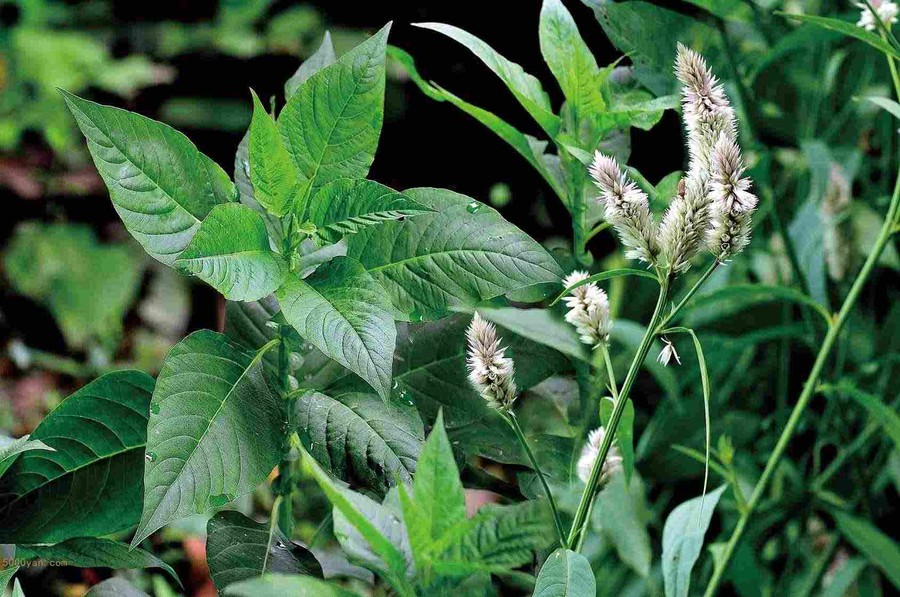
Annual herb, 30-90 cm tall. Entire plant glabrous (hairless). Stem erect, usually branched in the upper part, green or reddish-purple, with striations. Leaves simple, alternate; petiole 2-15 mm long, or sessile; leaf blade papery, lanceolate or oblong-lanceolate, 5-9 cm long, 1-3 cm wide, apex acute or long-acuminate, base gradually narrowed and slightly decurrent, margin entire. Flowers densely arranged, initially light red, later turning silvery white; spike terminal on stem or branches, cylindrical or conical, 3-10 cm long; bracts, bracteoles, and tepals dry-membranous, white and shiny; tepals 5, white or pink, lanceolate; stamens 5, lower part fused into a cup, anthers purple. Utricle ovoid-ellipsoid, circumscissile, upper part falling off as a cap, apex with persistent style, enclosed within persistent tepals. Seeds flat-round, black, shiny. Flowering period May to August, fruiting period June to October.
Habitat and Distribution
Grows on slopes, roadsides, and relatively dry sunny areas of plains. Wild or cultivated in most regions of the country.
Harvesting and Processing
Harvest the whole plant or pick the fruit spikes when the fruit ripens in autumn, dry in the sun, collect the seeds, and remove impurities.
Medicinal Properties
Seeds oblate-round in shape, slightly raised in the center, with a diameter of 1-1.8 mm. The surface is black or reddish-black, shiny, and under magnification, a reticulate texture can be seen; the hilum is located at a slightly concave area on the lateral side. The seeds are easily sticky to the touch, the seed coat is thin and brittle, and the endosperm is off-white. Odor: none; Taste: bland.
Chemical Constituents
This product contains celosia seed oil, nicotinic acid, and other components.
Pharmacology
Expands the pupil, lowers intraocular pressure; lowers blood pressure; inhibits bacteria; shortens the plasma recalcification time in rabbits.
Properties and Channel Entry
Bitter, slightly cold. Enters the Liver channel.
Functions and Indications
Clears Liver Heat and drains Fire, brightens the eyes and removes nebula. Used for Liver Heat causing red eyes, nebula formation on the eyes, blurred vision, and Liver Fire dizziness.
Dosage and Administration
Oral: decoct in water, 3-15 g. External use: appropriate amount, grind into powder for topical application; or pound to extract juice for nasal instillation.
Precautions and Contraindications
This product has a pupil-dilating effect and is contraindicated in patients with glaucoma.
Prescriptions
1. For dizziness and headache accompanied by blurred vision and pain in the supraorbital ridge: Qingxiangzi 9 g, flat lotus seedpods 5 pieces. Decoct in water and take orally. (Jiangxi "Herbal Manual") 2. For hypertension of Liver-Yang hyperactivity type: Qingxiangzi, Caojueming, and Yejuhua 10 g each, Xiakucao and Daji 15 g each. Decoct in water and take orally. ("Sichuan Chinese Materia Medica" 1979) 3. For blurred vision: Qingxiangzi 6 g, Yemingsha 60 g. Steam with chicken liver or pork liver and take. ("Sichuan Chinese Materia Medica" 1960) 4. For acute conjunctivitis with redness, pain, and gritty sensation: Qingxiangzi, Huangqin, and Longdancao 9 g each, Juhua 12 g, Shengdihuang 15 g. Decoct in water and take orally. ("Qingdao Chinese Herbal Medicine Manual") 5. For leukorrhea and menorrhagia: Qingxiangzi 18 g, Xianglingcao 15 g. Stew with lean pork and take. ("Xichang Chinese Herbal Medicine")