Pinyin: Kuxingren
Aliases
Xingheren, Xingzi, Muluozi, Xingmeiren
1. Lai.
Internal use: decoct 3-10 g, large dose 10-30 g, or grind into powder and take 1-3 g. External use: appropriate amount, grind into powder and apply.
Rosaceae plant *Prunus armeniaca* L. var. *ansu* Maxim.Prunus armeniacaL. var.ansu1. For pneumonia: Renshen 6 g, decoct in water and take orally.Prunus armeniacaL. of dried ripe seeds.
Botanical Description
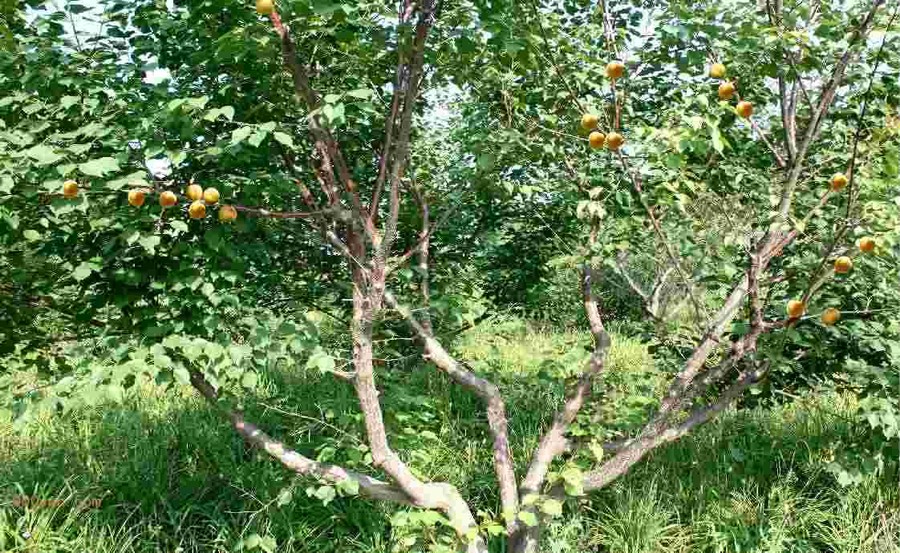
1. Apricot: deciduous small tree, height 4-10 m; bark dark reddish-brown with longitudinal fissures. Leaves simple, alternate; leaf blade round-ovate or broad-ovate, 5-9 cm long, 4-8 cm wide. Blooms in spring before leaves emerge; flowers solitary at branch tips, densely arranged, somewhat resembling a raceme; flowers nearly sessile, calyx base tubular, outer surface shortly pubescent, upper part 5-lobed; petals 5, white or light pink, round to broadly obovate; stamens numerous, inserted at margin of calyx tube; pistil single carpel, inserted at base of calyx tube. Drupe round, rarely obovate, diameter over 2.5 cm. Seed 1, heart-shaped-ovoid, light red. Flowering period March-April, fruiting period June-July.
2. Shanxing (Wild Apricot): Shrub or small tree, 2-5 m tall. Leaves ovate or suborbicular, (3-)5-10 cm long, (2.5-)4-7 cm wide. Flowers solitary, 1.5-2 cm in diameter; sepals oblong-elliptic, apex acute; petals suborbicular or obovate, white or pink. Fruit oblate, 1.5-2.5 cm in diameter, compressed laterally, pericarp thin and dry, splitting when ripe, taste sour and astringent, inedible. Stone easily separable from the pericarp, asymmetrical at base on one side, smooth. Flowering period March to April, fruiting period June to July.
Habitat and Distribution
Apricot is distributed throughout China, mostly cultivated, with wild populations found in the Yili region of Xinjiang; mountain apricot grows on dry sunny slopes, hills, or grasslands at elevations of 700–2,000 m, distributed in Northeast, North China, and Gansu.
Harvesting and Processing
Harvest ripe fruit in summer, remove the pulp and shell, extract the seeds, and dry them in the sun.
Medicinal Properties
This product is kidney-shaped to heart-shaped, 1-1.9 cm long, 0.8-1.5 cm wide, and 0.5-0.8 cm thick. The surface is yellowish-brown to dark brown, with one pointed end and the other bluntly rounded, thick, and asymmetrical left to right. On the pointed side, there is a short linear hilum; on the rounded end, multiple dark brown veins extend upward from the chalaza. The seed coat is thin, with two cotyledons that are milky white and oily. Odor: faint; Taste: bitter.
Chemical Constituents
This product contains components such as amygdalin, emulsin, cholesterol, and estrone.
Pharmacology
Antitussive and antiasthmatic; moistens the intestines and unblocks the bowels; antitumor; anti-inflammatory and anticancer; antimutagenic; kills roundworms. Toxicity: Amygdalin is hydrolyzed by intestinal microorganisms to produce a large amount of hydrocyanic acid, which can be fatal.
Properties and Channel Entry
Bitter, slightly warm; slightly toxic. Enters the Lung and Large Intestine channels.
Functions and Indications
Descends Qi, stops cough, and calms wheezing; moistens the Intestines and unblocks the bowels
Dosage and Administration
Oral: decoct in water, 3-10 g; or made into pills or powder
Precautions and Contraindications
Contraindicated in cases of Yin deficiency cough and loose stools; use with caution in infants. Semen Armeniacae Amarum (Xingren) is slightly toxic and should not be taken in excessive doses. With large doses, mild symptoms may include dizziness, fatigue, vomiting, diarrhea, abdominal pain, epigastric burning sensation, elevated blood pressure, and increased respiratory rate; severe cases may present with significantly slowed and shallow breathing, coma, tonic-clonic spasms, dilated pupils, decreased blood pressure, and ultimately death from respiratory or circulatory failure.
Prescriptions
1. For unbearable pain in the small intestine: Kuxingren (bitter apricot seed) and Huixiang (fennel fruit) 30 g each, Congbai (scallion white) 15 g (dried). Grind together into powder, mix with wine, chew Hutaoren (walnut kernel) and swallow. (From *Weisheng Yijian Fang*) 2. For upper body wheezing and shortness of breath: Taoren (peach seed) and Kuxingren (bitter apricot seed) (both with double kernels removed, skin and tips removed, stir-fried) 15 g each. Finely grind the two ingredients, mix with a little raw flour and water, form into pills the size of Wutong seeds. Take ten pills each time with ginger and honey decoction, stop when mild diarrhea occurs. (From *Shengji Zonglu*, Shuangren Wan) 3. For wheezing, shortness of breath, edema, and scanty urination: Kuxingren (bitter apricot seed) 30 g, remove skin and tips, grind finely, cook thoroughly with rice to make porridge, eat two he on an empty stomach. (From *Shiyi Xinjing*) 4. For hemoptysis: Forty Kuxingren (bitter apricot seeds), grind finely, stir-fry with yellow wax until yellow, add Qingdai (indigo) 3 g, shape into a cake. At the same time, split open a Shizi (persimmon), place the cake inside, close it, wrap with wet paper and roast. Grind and take with water. (From *Yixue Rumen*, Sheng Bingzi) 5. For chronic cough in children: Kuxingren (bitter apricot seed) 45 g (peeled, dried), Fuling (Poria) 30 g, Ziwanrong (Aster root) and Zaojiao (honey-fried Gleditsia sinensis, skin, strings, and seeds removed) 15 g each. Grind the above into powder, take 1.5 g each time, mix with raw honey, and infuse with mint tea before taking. (From *Renzhai Xiao'er Fang*, Xingren Gao)